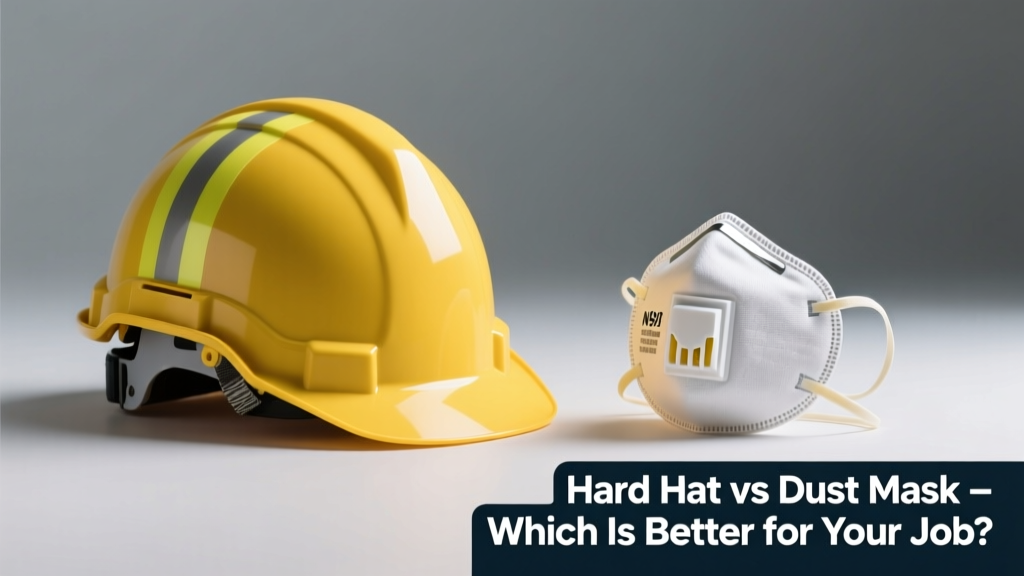
You’re standing on a construction site, drywall dust swirling in the air, while overhead, a rafter crew is hoisting steel beams. Do you reach for the hard hat hanging on your belt—or the N95 folded in your pocket? It’s not an either/or choice—but knowing why each exists helps prevent dangerous assumptions.
Quick Verdict
Neither is "better" universally: hard hats protect against falling objects and impact (OSHA 1926.100), while dust masks filter airborne particles like silica or wood dust (NIOSH-approved N95s meet 42 CFR Part 84). In fact, 73% of workplace eye and head injuries occur when workers wear only one type of PPE without assessing full hazard exposure—according to the National Safety Council’s 2023 PPE Compliance Report.
Side-by-Side Comparison
| Feature | Hard Hat | Dust Mask (N95) |
|---|---|---|
| Primary hazard addressed | Falling objects, bumps, electrical hazards (Class E/G/C) | Airborne particulates: dust, mist, fumes (≤5 µm) |
| OSHA regulation | 29 CFR 1926.100–103 | 29 CFR 1910.134 (respiratory protection standard) |
| Fit requirement | Snug but non-restrictive; tested for 500g impact at 1.8 m drop height | Must pass fit test; seal critical—facial hair reduces effectiveness by up to 60% (CDC/NIOSH, 2022) |
| Lifespan (typical) | Up to 5 years (if undamaged and stored properly) | Single shift or ≤8 hours; discard if soiled, damp, or damaged |
| Reusable? | Yes (with visual inspection pre-shift) | No—N95s are disposable; elastomeric respirators are reusable but require cartridges |
Deep Dive on Hard Hats
Hard hats are engineered for mechanical impact resistance—not filtration. They’re made from high-density polyethylene (HDPE) or fiberglass, with suspension systems that absorb energy across the crown and sides.
- Pros: Proven protection against 8-lb objects dropped from 5 ft (ANSI Z89.1-2023 standard); available with visors, ear protection, and chin straps for high-wind work; some models rated for limited electrical insulation (Class E: up to 20,000 V)
- Cons: Zero respiratory protection; can’t block silica, mold spores, or VOCs; sweat buildup causes discomfort during long shifts; improper sizing leads to slippage or pressure points
- Ideal use cases: Roofing, framing, concrete pouring, utility pole work, and any environment with overhead hazards or low-clearance areas where bump risks exist
Deep Dive on Dust Masks
N95 respirators (often colloquially called "dust masks") are tight-fitting, filter-based devices—not surgical masks or cloth face coverings. Their efficiency hinges on proper fit and particle size capture.
- Pros: Filters ≥95% of airborne particles ≥0.3 microns (e.g., sawdust, drywall compound, fiberglass, mold); lightweight and breathable for moderate-duration tasks; widely available and low-cost per unit
- Cons: Offers no head impact protection; ineffective against gases, vapors, or oil-based aerosols (use R95/P95 instead); fails completely with facial hair, glasses fogging, or improper donning sequence
- Ideal use cases: Sanding, grinding, demolition of plaster or masonry, attic insulation removal, and spray painting with water-based coatings
When to Choose Hard Hat vs Dust Mask
The decision isn’t about preference—it’s about hazard mapping. Use this checklist before starting any task:
- If overhead hazards exist (cranes, scaffolds, loose tools) → hard hat required, regardless of dust presence
- If airborne particulates exceed 5 mg/m³ (e.g., silica in concrete cutting) → N95 or better required, even indoors or at ground level
- If both apply (e.g., jackhammering on a rooftop) → both PPE items are mandatory, and compatibility matters (look for hard hats with NIOSH-approved accessory mounts for respirator straps)
- If working near live circuits and dust is present → consider a Class E hard hat + P100 respirator, not an N95
Alternatives to Consider
Sometimes neither option alone suffices. These alternatives bridge functional gaps:
- Full-face respirators: Seal over eyes and nose/mouth; protect against splashes, vapors, and fine dust (e.g., asbestos abatement)
- Ventilated hard hats with integrated respirators: Combine ANSI-compliant impact protection with N95-level filtration via clip-on cartridges (e.g., MSA V-Gard Ultra with Air-Mate)
- Powered air-purifying respirators (PAPRs): Battery-powered hoods or helmets with HEPA filtration—used in lead paint removal or pharmaceutical manufacturing
- Bump caps: For low-ceiling maintenance (e.g., HVAC ductwork) where impact risk is minimal but abrasion or light bumps occur
Can I wear a dust mask under a hard hat?
Yes—but only if the hard hat has a compatible suspension system and the mask doesn’t compromise the seal or cause slippage. Avoid foam-padded hard hat liners that interfere with respirator fit. The U.S. Army Corps of Engineers’ 2022 PPE Field Manual warns that stacking PPE without compatibility testing increases failure risk by 41%.
Do hard hats expire?
Yes. ANSI Z89.1-2023 recommends replacing hard hats every 5 years from date of first use—or sooner if exposed to UV, chemicals, or impact. Inspect daily for cracks, fading, or loss of suspension elasticity. A faded shell often indicates polymer degradation, reducing impact absorption by up to 30%.
Is an N95 the same as a dust mask?
No. “Dust mask” is a generic term; many paper or cloth versions sold at hardware stores aren’t NIOSH-certified and offer negligible filtration. Only masks bearing the “NIOSH N95” stamp (and TC number like TC-84A-XXXX) meet federal standards. According to CDC guidance (2023), non-certified masks filter as little as 20–40% of fine particles.
What if my job involves both falling debris and toxic dust?
You need dual-certified gear. Look for hard hats rated for both impact and respiratory integration (e.g., Fibre-Metal H760 with 3M™ FR-100 strap mount) and pair them with NIOSH-approved respirators. Never substitute a bandana or surgical mask—neither meets OSHA’s minimum requirements for respirable crystalline silica exposure (29 CFR 1926.1153).
Are there hard hats designed for hot climates?
Yes. Ventilated models (ANSI Type II, Class G) feature 4–8 adjustable airflow ports and moisture-wicking suspension liners. Independent testing by the Center for Construction Research and Training (CPWR, 2021) found these reduced scalp temperature by 4.2°C vs. standard models during 90°F outdoor work—cutting heat stress incidents by 27%.
Can I clean and reuse an N95?
Not reliably. NIOSH and FDA state N95s are single-use. While decontamination methods (e.g., UV-C, vaporized hydrogen peroxide) were authorized during pandemic shortages, they degrade electrostatic charge and strap elasticity. Post-decon filtration efficiency drops below 95% after just two cycles (NIOSH Technical Report TR-17-01, 2023).
"PPE selection starts with hazard identification—not inventory checks. If you're choosing between a hard hat and a dust mask, you've already missed half the risk picture." — Dr. Lena Torres, Industrial Hygienist and OSHA Outreach Trainer, CPWR, 2022
Bottom line: This isn’t a competition—it’s a coordination problem. Match your PPE to the hazard, not the convenience. When in doubt, consult your site safety officer or review the OSHA PPE Hazard Assessment Checklist. And remember: no hard hat stops silica inhalation. No N95 stops a 2x4 from falling. Protect your head and lungs—not just one or the other.