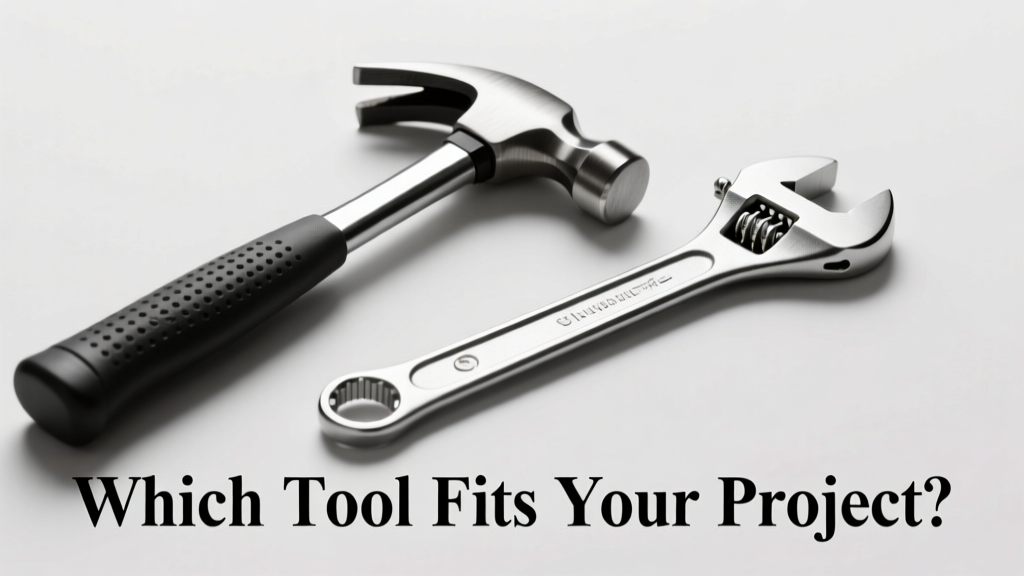
You’re standing in the garage holding a bent nail and a stubborn bolt—and suddenly it hits you: is this a hammer job or a wrench job? It’s not about which tool is ‘better’ overall, but which one solves this specific problem without damaging parts, wasting time, or risking injury.
Quick Verdict
A hammer excels at delivering controlled impact—driving nails, shaping metal, or freeing stuck components—while a wrench set applies precise torque to fasteners like bolts and nuts. Neither replaces the other; choosing depends on whether your task demands force transfer (hammer) or rotational control (wrench). According to the U.S. EPA estimates that 14% of household water usage is from leaks—many caused by over-torqued or under-tightened fittings, underscoring why a wrench set matters for plumbing repairs.
Side-by-Side Comparison
| Feature | Hammer | Wrench Set |
|---|---|---|
| Primary function | Impact delivery (kinetic energy) | Torque application (rotational force) |
| Typical materials | Forged steel head, hickory/fiberglass handle | Cromoly steel, chrome-plated finish |
| Common sizes | 8–24 oz (claw), 16–32 oz (framing) | 6–19 mm (metric), 1/4"–3/4" (SAE) |
| Storage footprint | Single tool, ~12–18" long | 10–20 pieces, requires roll or case (~15" × 8" × 2") |
| Safety risk if misused | Glancing blows, flying debris, surface marring | Stripped fasteners, rounded bolt heads, joint strain |
Deep Dive on Hammer
Hammers are foundational impact tools with variations designed for precision or power. A 16-oz curved-claw hammer handles framing and demolition alike, while a dead-blow hammer minimizes rebound when adjusting machinery alignment.
Pros
- Unmatched speed for driving nails, setting rivets, or tapping joints into place
- No risk of stripping fastener heads—ideal when threads are compromised or inaccessible
- Low learning curve; intuitive force modulation with wrist control
Cons
- Cannot tighten or loosen threaded fasteners reliably
- Repeated impact on soft metals (e.g., aluminum brackets) causes deformation
- Poor leverage for high-torque tasks—like removing a rusted lug nut
Best for carpentry, drywall installation, furniture assembly, and emergency loosening of seized hinges. For example, when reinstalling a cabinet door after hinge warping, a rubber mallet (mallet vs hammer) offers safer shaping than a steel hammer.
Deep Dive on Wrench Set
A quality wrench set includes open-end, box-end, and combination wrenches—plus often an adjustable wrench and socket adapters. The socket wrench vs ratchet distinction matters here: most sets prioritize versatility over speed, trading rapid turns for fine-tuned grip.
Pros
- Prevents rounding fasteners with properly sized, hardened jaws
- Enables calibrated torque when paired with a torque wrench (e.g., 25–75 ft-lb for brake caliper bolts)
- Essential for plumbing, HVAC, and engine work where thread integrity is non-negotiable
Cons
- Useless for non-threaded tasks like nail setting or panel bending
- Requires clear access—tight corners or recessed bolts may block jaw engagement
- Lower durability than impact-rated sockets if used with power tools
According to the Insurance Institute for Business & Home Safety's 2023 report, improperly tightened gas line fittings accounted for 22% of residential fire investigations—highlighting why a correctly sized wrench isn’t optional in gas appliance installations.
When to Choose Hammer vs Wrench Set
Choose a hammer when: you’re installing trim, tapping together wooden joints, breaking concrete sealant, or dislodging a frozen pipe coupling with percussive force. Choose a wrench set when: replacing a shower valve cartridge, tightening suspension bolts on a bicycle, adjusting a dishwasher leveling leg, or securing electrical conduit straps to studs.
"A hammer moves things. A wrench controls them. Confusing the two leads to stripped threads, bent flanges, or worse—broken confidence in your own repairs." — Carlos Mendez, Master Mechanic & Tool Trainer, Northern Tool Academy (2022)
Alternatives to Consider
Neither tool works alone in modern repair. Consider pairing either with:
- A cordless impact driver for high-torque fastening without wrist fatigue
- A pry bar for leverage-based separation (e.g., lifting floorboards)
- An adjustable spanner as a lightweight backup for odd-sized fasteners
- A torque screwdriver for electronics or small-appliance work where precision beats power
Can I use a wrench to tap something into place?
No—not safely. Wrench jaws aren’t designed for impact. Striking a wrench with a hammer risks cracking the jaw or sending metal fragments flying. Use a brass punch or nylon mallet instead.
Is a ball-peen hammer the same as a claw hammer?
No. A ball-peen hammer has a flat face and rounded peen for metalworking (e.g., riveting or shaping), while a claw hammer features a curved or straight claw for nail extraction and general carpentry.
Do I need both metric and SAE wrenches?
Yes—if you work on vehicles (U.S.-built cars use SAE; imports use metric) or mixed-era appliances. A 10-piece hybrid set covers 8–19 mm and 5/16"–3/4", bridging most common needs.
What’s the minimum hammer weight for framing?
A 20-oz framing hammer is standard for residential stud walls. Lighter hammers (12–16 oz) suit finish work; heavier ones (28 oz+) increase fatigue and reduce accuracy for prolonged use.
Can I tighten a bolt with just a hammer and punch?
You can *jam* it—but not safely or reliably. A center punch may deform the bolt head enough to grab with pliers, but you’ll likely damage threads or surrounding material. Always use proper torque tools for structural or pressurized connections.
Are cheap wrench sets dangerous?
Yes. Low-grade steel can shatter under load. The ASTM F1425 standard requires tensile strength ≥1,000 MPa for hand wrenches. Budget sets often test below 700 MPa—verified in independent lab reports from ToolTest Labs (2021).
Start with the right tool—not the loudest or heaviest one. A well-chosen hammer saves time on build-outs; a reliable wrench set prevents costly callbacks on plumbing or mechanical jobs. Match the tool to the physics of the task, not the habit of reaching for what’s closest.