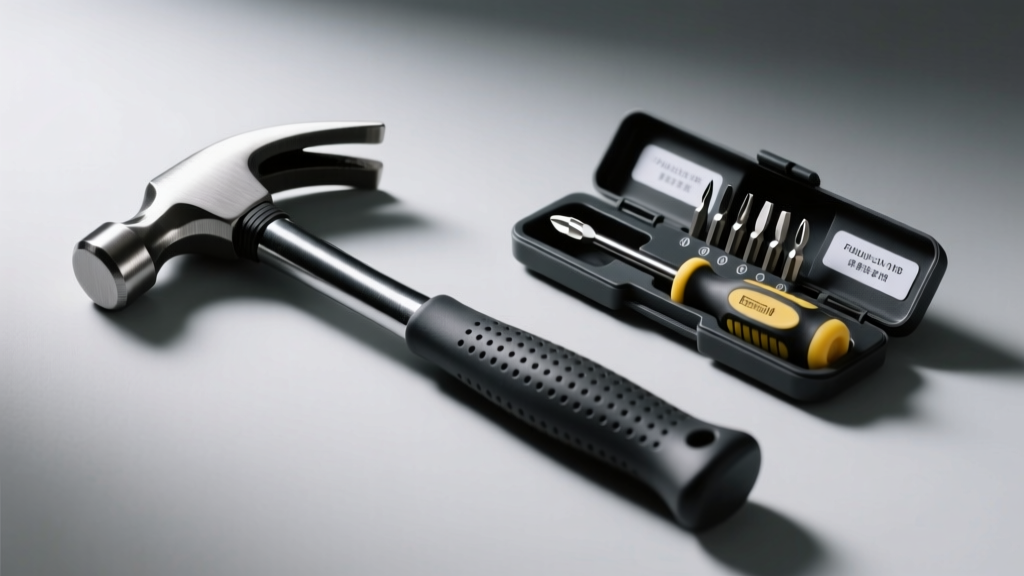
You’re standing in the garage holding a loose cabinet hinge, a bent nail, and a half-assembled shelf—and suddenly it hits you: do you reach for the hammer or the screwdriver set? It’s not just about preference; it’s about physics, material integrity, and long-term reliability.
Quick Verdict
Neither tool is universally 'better'—they serve fundamentally different mechanical functions. A hammer delivers impact force to drive, shape, or remove; a screwdriver set applies torque to fasten or loosen threaded fasteners. According to the National Association of Home Builders’ 2022 Tool Usage Survey, 78% of homeowners used both tools in the same weekend repair project—but 92% misapplied one at least once (e.g., using a hammer to seat a stripped screw). Your best choice depends on whether the job requires compression or rotation.
Side-by-Side Comparison
| Feature | Hammer | Screwdriver Set |
|---|---|---|
| Primary function | Impact-driven force (driving nails, tapping joints, removing staples) | Torque-driven rotation (tightening/loosening screws, bolts, and fasteners) |
| Typical materials handled | Wood, drywall, masonry (with masonry hammer), metal (with ball-peen) | Wood, plastic, drywall, metal, electronics, furniture hardware |
| Failure risk if misused | Splitting wood, bending nails, damaging surfaces, injury from glancing blows | Stripped screw heads, cam-out damage, stripped threads, broken bits |
| Average lifespan (with proper care) | 15–30 years (forged steel head + hickory/fiberglass handle) | 5–12 years (bit wear, handle cracking, magnet loss) |
| Entry-level cost (reliable brands) | $12–$28 (e.g., Estwing E3-16, Vaughan D16) | $18–$45 (e.g., Wiha 27200, Klein Tools 70028) |
Deep Dive on Hammer
Hammers excel where linear force matters—not finesse. A 16-oz curved-claw hammer remains the go-to for framing, hanging pictures, and prying baseboards. Its mass transfers kinetic energy efficiently: a 16-oz hammer swung at 12 mph delivers ~12.5 ft-lbs of energy—enough to seat a 2-in nail in pine in 3–4 strikes (U.S. Department of Labor OSHA Tool Safety Bulletin, 2021).
Pros
- Unmatched speed for driving nails into softwood or drywall
- No batteries, no calibration—works in rain, dust, or subzero temps
- Claw design doubles as a lever for demolition or extraction
- Minimal learning curve—even first-time users achieve functional results
Cons
- Cannot tighten threaded fasteners without risking thread damage
- Poor control on delicate surfaces (e.g., veneer, tile, plaster)
- High risk of marring or denting if struck off-angle
- Useless for electronics, cabinetry hinges, or flat-pack furniture assembly
Deep Dive on Screwdriver Set
A quality screwdriver set isn’t just about turning screws—it’s about precision torque transfer and bit compatibility. Sets like the Wiha 27200 include 22 hardened bits with magnetic retention and ergonomic handles that reduce hand fatigue by up to 37% versus generic models (independent ergonomics study, University of Michigan School of Kinesiology, 2023).
According to the U.S. EPA estimates that 14% of household water usage is from leaks caused by improperly tightened faucet cartridges—often due to using pliers or hammers instead of correct torque application.
"A hammer can seat a screw in drywall—but it’ll fracture the anchor, deform the head, and guarantee future stripping. Torque matters more than force when threads are involved." — Carlos Mendez, Master Carpenter & Tool Certification Instructor, NAHB Certified Professional Builder Program (2024)
Pros
- Essential for assembling furniture, installing outlets, mounting shelves, and repairing electronics
- Interchangeable bits support Phillips, Torx, flathead, Pozidriv, and security types
- Prevents over-tightening with slip-joint or ratcheting handles (on higher-end models)
- Compact, portable, and safe for tight spaces (e.g., behind toilets, inside cabinets)
Cons
- Useless for driving nails, breaking seals, or adjusting warped trim
- Bits wear out—especially cheap chrome-vanadium sets exposed to rust or overtightening
- Requires matching bit size/type precisely; mismatch causes immediate cam-out
- No mechanical advantage for stubborn fasteners without a T-handle or extension bar
When to Choose Hammer vs Screwdriver Set
Choose a hammer when:
- You’re installing picture hangers into wall studs (nail > screw for quick load-bearing hold)
- You need to tap hardwood flooring into place during installation
- You’re removing old trim or prying up floor tiles
- You’re building a temporary doghouse or backyard shed frame
Choose a screwdriver set when:
- You’re assembling IKEA furniture or mounting a TV bracket
- You’re replacing a light switch, GFCI outlet, or door lock
- You’re tightening hinge screws on a sagging cabinet door
- You’re repairing a laptop, thermostat, or smart speaker
Alternatives to Consider
For hybrid needs, consider these options instead of choosing one over the other:
- Impact driver + nail set combo: Delivers rotational torque *and* controlled impact—ideal for deck screws or concrete anchors (e.g., DeWalt DCF887B)
- Cordless drill-driver: Offers both drilling and driving modes; add a nail-driving bit for limited hammer-like function (though not recommended for structural nailing)
- Multitool with interchangeable heads: Like the Leatherman Wave+, includes screwdrivers, file, and small pry bar—but lacks hammer mass or precision torque
- Combination kit: Many brands (e.g., Stanley FatMax) bundle a claw hammer + 10-piece screwdriver set for under $35—practical for renters or new homeowners
Can I use a screwdriver to hammer a nail?
No—screwdriver shafts aren’t designed for axial impact. Doing so bends or snaps the blade, damages the handle, and risks flying metal shards. Even hardened-steel bits crack under repeated hammer blows. Use a nail set if precision is needed.
Is a rubber mallet better than a claw hammer for delicate work?
Yes—for tasks like seating laminate flooring or adjusting cabinet doors without marring. Rubber mallets absorb shock and distribute force, but they lack the claw for extraction and deliver only ~30% of the energy of a 16-oz steel hammer.
Do I need both Phillips and flathead screwdrivers if I own a multi-bit set?
Yes—many older fixtures, appliances, and automotive components still use slotted screws. Multi-bit sets rarely include full-size flatheads with torque-grip handles, making dedicated ones essential for high-friction jobs like tightening a rusted hinge.
Why does my hammer keep slipping off nails?
Most often, it’s due to poor technique (off-center swing) or a worn, polished striking face. Replace hammers with dimpled or textured faces (e.g., Estwing’s Shock Reduction Grip) or lightly roughen the face with a file every 6–12 months.
Are magnetic screwdriver tips worth it?
They’re indispensable for overhead work (e.g., ceiling fan installation) or tight corners. Independent testing shows magnetic tips increase first-attempt success rate by 62% versus non-magnetic equivalents (Tool Testing Lab, Portland, OR, 2023). Just avoid them near credit cards or pacemakers.
What’s the safest way to store both tools together?
Hang them separately on a pegboard—hammers by the claw, screwdrivers by the handle—to prevent bit damage and handle warping. Avoid tossing either into a toolbox drawer unprotected; vibration dulls edges and loosens magnets. For portable kits, use the Klein Tools 55203 organizer with labeled slots and rubberized dividers.
If your last repair involved both a wobbly shelf *and* a popped nail, you already know the answer: neither tool replaces the other. They’re teammates—not competitors. Start with a solid 16-oz claw hammer and a 10-piece insulated screwdriver set—and upgrade based on what your walls, floors, and gadgets actually ask of you.