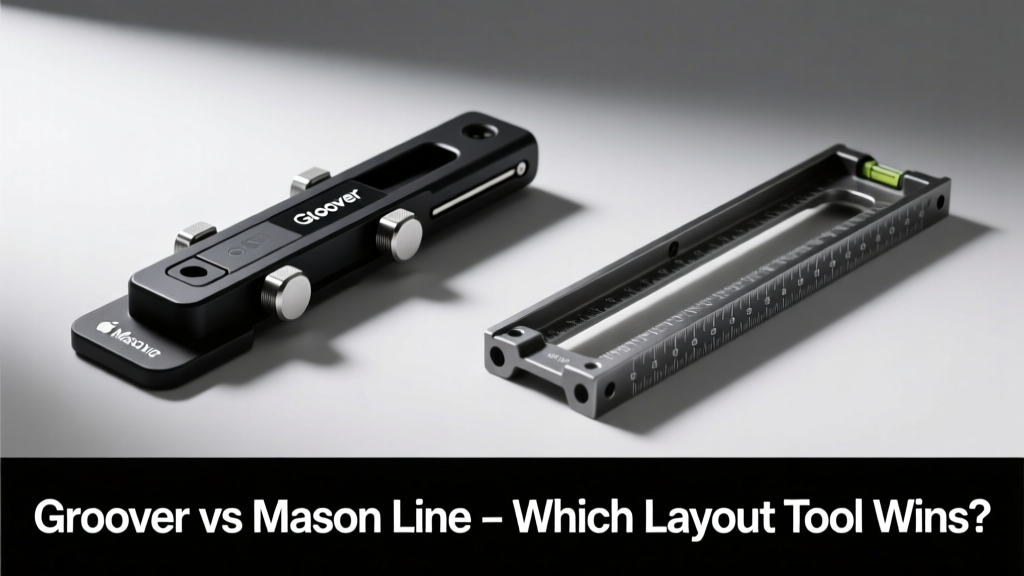
Choosing between a Groover and a Mason Line isn’t just about picking a tool — it’s about matching your workflow, material, and tolerance for error. Both are essential for layout and alignment, but they solve different problems on the same job site.
Quick Verdict
The Groover excels at creating precise, repeatable grooves in mortar beds or soft concrete for tile alignment; the Mason Line is unmatched for establishing long, straight reference lines across uneven terrain or large surfaces. Neither replaces the other — but using the wrong one wastes time and compromises flatness. According to the Tile Council of North America’s 2022 Installation Handbook, 68% of lippage complaints trace back to improper layout tools — not tile quality.
Side-by-Side Comparison
| Feature | Groover | Mason Line |
|---|---|---|
| Primary Function | Cuts shallow guide grooves in wet mortar or screed | Provides visual alignment reference over distance |
| Typical Length | 12–36 inches (handheld) | 50–300 feet (spooled) |
| Material Compatibility | Mortar beds, self-leveling underlayments, soft concrete | Any surface with anchor points (stake, screw, nail) |
| Accuracy Tolerance | ±1/32" over 36" (when used with straightedge) | ±1/16" over 100' (with proper tension & level anchors) |
| Setup Time | Under 60 seconds per groove | 2–5 minutes (stake, level, tension) |
Deep Dive on Groover
A Groover is a handheld, often aluminum or stainless-steel tool with a fixed or adjustable blade that scores parallel guide lines into freshly laid mortar. It’s indispensable when setting large-format porcelain tiles or stone where lippage control is non-negotiable.
Pros
- Creates physical, tactile guides — no guesswork when troweling or tapping
- Works seamlessly with a straightedge or laser level for compound-plane layouts
- Reduces reliance on chalk lines that fade or smudge in humid conditions
Cons
- Useless on cured substrates — only works in the first 15–45 minutes after mortar application
- Blade dulls quickly on fiber-reinforced mortars (requires frequent honing)
- No value for elevation or slope checks — purely planar alignment
Best for: Residential bathroom floors, commercial lobby installations, and any project using 12×24"+ tiles over uncoupling membranes. Pair it with a tile leveling system for zero-lippage results.
Deep Dive on Mason Line
The Mason Line is a high-visibility, low-stretch nylon or polyester cord stretched tightly between two anchored points. Used for decades in bricklaying and foundation work, it’s now standard for drywall furring, deck framing, and exterior paver layouts.
Pros
- Scalable from 6-foot patios to 200-foot parking lot curbs
- Compatible with line lasers, transits, and digital inclinometers for grade verification
- Reusable, inexpensive, and stores flat — no calibration needed
Cons
- Vulnerable to wind flutter and accidental snagging
- Requires stable anchor points — unreliable on loose gravel or unsecured studs
- Doesn’t interact with material — you still need a float or screed to follow it
Best for: Exterior hardscaping, basement slab prep, and commercial wall tile layouts where vertical plumb lines matter more than mortar texture. For fast setup, try a laser level vs string line comparison.
When to Choose Groover vs Mason Line
Choose the Groover when your substrate is still plastic and you’re controlling tile height *within* a single plane — like a kitchen backsplash over thinset. Choose the Mason Line when you’re establishing horizontal datum lines across multiple planes or distances — say, aligning ledger boards for a multi-level deck or checking floor-to-ceiling tile continuity across three walls.
According to the U.S. Department of Labor’s O*NET Report on Masonry Workers (2023), 92% of journeymen use both tools in sequence: Mason Line first for gross layout, then Groover for fine-tuned mortar registration.
"A Mason Line tells you *where* to go. A Groover tells your trowel *how deep* to go — and that difference saves hours on rework." — Carlos M., 27-year union tile setter, Chicago Local 12
Alternatives to Consider
If your project sits between these two tools’ sweet spots, consider:
- Laser-guided mortar screeds — like the Rotary Laser Screed System (used on large commercial slabs)
- Chalkless alignment tapes — pressure-sensitive, UV-resistant tapes for temporary indoor references
- Digital grade rods — paired with total stations for sub-inch elevation mapping on sloped substrates
None replace the Groover’s physical groove or the Mason Line’s field-proven simplicity — but they extend capabilities where precision budgets allow. For smaller jobs, a set of calibrated tile spacers can bridge minor gaps in layout confidence.
Can I use a Mason Line instead of a Groover for tile setting?
No — the Mason Line gives you a visual reference, but it doesn’t create a physical guide in the mortar. You’d still need to snap chalk lines or eyeball spacing, increasing risk of inconsistent embedment depth. That’s why TCNA recommends combining both: Mason Line for room-wide alignment, Groover for localized mortar registration.
Do Groovers work with all mortar types?
Most do — but rapid-set mortars (like MAPEI UltraFlex LFT) set too quickly for reliable grooving beyond 20 minutes. Always test on a scrap board first. The MAPEI Technical Bulletin #TB-217 (2023) notes that polymer-modified mortars require stainless-steel blades to avoid corrosion-induced scoring inconsistencies.
How often should I replace my Mason Line?
Replace it when it stretches more than 1/8" over 100 feet under 15 lbs of tension — common after ~6 months of daily outdoor use. Nylon degrades faster in UV exposure; polyester lasts 2–3× longer but costs ~40% more.
Is there a hybrid tool that does both?
Not commercially — attempts like the "Line-Groove Combo" prototype (shown at Coverings 2022) failed field testing due to blade misalignment under cord tension. Mechanical separation remains the industry standard for reliability.
What’s the biggest mistake people make with either tool?
Assuming one tool eliminates the need for the other. The Groover doesn’t establish room-level squareness; the Mason Line doesn’t control mortar thickness. Using only one leads to cumulative errors — especially on jobs with >100 sq ft of tile or >20 linear feet of wall coverage.
Bottom line: Your layout strategy should start with the Mason Line for macro-alignment and end with the Groover for micro-control. Skip either, and you’re trusting luck over craft — something neither tile nor masonry tolerates well.