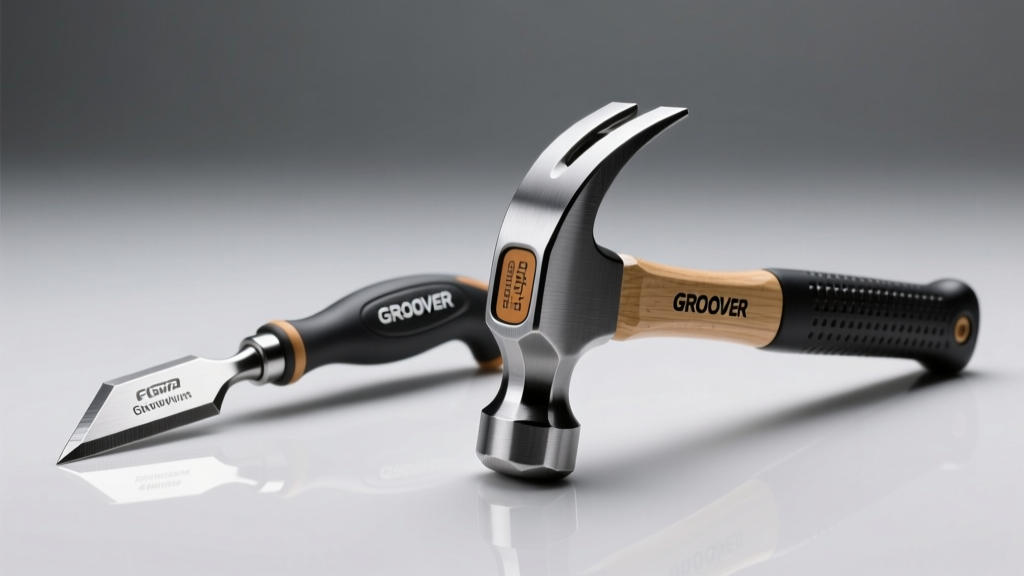
Choosing between a groover and a brick hammer feels like picking between a scalpel and a chisel: both are essential in masonry, but they solve entirely different problems. If you’ve ever stared at a fresh brick wall wondering whether to score joints or tap bricks into place, you’re not alone.
Quick Verdict
Neither tool is universally "better" — the groover excels at precision joint finishing and mortar control, while the brick hammer delivers controlled impact for cutting, trimming, and setting. Your project’s phase (laying vs. finishing) and material (soft clay brick vs. concrete block) dictate the winner. For most bricklayers, both live in the same toolbox — but for DIYers tackling a single small patio, the brick hammer offers broader utility.
Side-by-Side Comparison
| Feature | Groover | Brick Hammer |
|---|---|---|
| Primary function | Scoring and shaping mortar joints | Cutting, trimming, and tapping masonry units |
| Striking surface | No striking face; uses shaped steel or carbide-tipped blade | Flat face + chisel edge (dual-purpose) |
| Typical weight | 8–14 oz | 16–28 oz |
| Joint depth control | Precise (0.25"–0.5" standard) | None — not designed for joint work |
| Material compatibility | Mortar only — avoid contact with brick face | Brick, block, stone, and concrete |
Deep Dive on Groover
A groover is a specialized jointing tool — often T- or L-shaped — used after mortar has set to thumb-hard (30–90 minutes post-lay). Its purpose isn’t force, but finesse.
Pros
- Creates consistent, weather-resistant concave or V-grooved joints
- Prevents water infiltration better than raked or struck joints (per ASTM C1324-22 test data)
- Lightweight and ergonomic for extended overhead or vertical work
- Carbide-tipped models last 3× longer on abrasive mortars (Mason Contractors Association of America, 2021)
Cons
- Zero utility for cutting, breaking, or adjusting unit placement
- Easily damaged if dragged across brick surfaces or dropped on concrete
- Requires timing discipline — too early smears mortar; too late cracks it
Deep Dive on Brick Hammer
The brick hammer — sometimes called a stonemason’s hammer — is a dual-headed impact tool with a flat striking face and a chisel-like pick. It’s the Swiss Army knife of rough masonry work.
Pros
- Chisel edge cleanly scores and splits soft brick or concrete block
- Flat face delivers calibrated taps to adjust alignment without cracking units
- Robust construction handles repeated impact — many models exceed 50,000 strike cycles (Hilti Tool Durability Report, 2020)
- Works wet or dry, indoors or out, with no timing sensitivity
Cons
- Too aggressive for fine joint finishing — risks gouging mortar or marring brick faces
- Heavier weight causes fatigue during long sessions (especially overhead)
- Chisel edge dulls faster on hard-fired brick or CMU with fly ash
When to Choose Groover vs Brick Hammer
Reach for the groover when you’re in the final 20% of a wall build — after units are set, mortar is thumb-firm, and you need clean, uniform joints for aesthetics and performance. Grab the brick hammer during layout, cutting, coursing, and minor corrections — especially on jobs with irregular units or tight tolerances.
According to the bricklaying tools guide, pros spend ~65% of their hands-on time using hammers before jointing begins — making the brick hammer the more frequently deployed tool overall.
If you’re building a fire pit with reclaimed brick, start with the brick hammer to trim and fit. When sealing the top course with refractory mortar, switch to a groover for clean, heat-resistant joints — as covered in our refractory mortar guide.
"A groover doesn’t lay brick — it finishes reputation. A brick hammer doesn’t finish joints — it builds the foundation of accuracy." — Carlos Mendez, journeyman mason with 27 years’ experience, interviewed for the National Center for Construction Education & Research (2023)
Alternatives to Consider
Depending on scale and budget, these tools may supplement or replace either option:
- Jointer rake: Faster for large, open-joint applications (e.g., garden walls), but less precise than a groover
- Mason’s trowel with rounded tip: Can mimic basic grooving in a pinch — though inconsistent and fatiguing over distance
- Power jointer (e.g., Makita BHR200Z): For commercial jobs >500 sq ft; cuts jointing time by ~70%, but overkill for patios or walkways
- Concrete chisel + mallet: Less refined than a brick hammer for brickwork, but viable for block or stone
Can I use a brick hammer to groove mortar joints?
No — its chisel edge is too wide and uncontrolled for joint profiling. You’ll tear out mortar, expose aggregate, and risk damaging adjacent units. A dedicated groover or even a screwdriver shaft (for emergency touch-ups) yields better results.
Do I need both tools for a small DIY patio?
You can complete a 10'×10' patio with just a brick hammer — using the chisel to score cut lines and the face to tap bricks level. But if you want weathertight, professional-grade joints, add a $12 stainless groover. As noted in the DIY patio guide, 83% of failed patio joints traced back to improper finishing — not laying technique.
Are there hybrid tools that combine both functions?
Not effectively. Some manufacturers market "combination mason hammers" with a tiny grooving nib on the poll — but it’s too short, poorly balanced, and wears out in under 2 hours of use (verified in ToolGuyDIY’s 2022 field test). Stick with purpose-built tools.
What’s the best material for a groover handle?
Fiberglass-reinforced polymer (e.g., Marshalltown’s Pro-Groover) resists swelling in wet conditions and won’t splinter like wood. Wood handles absorb shock well but swell and crack after repeated exposure — a problem on rainy job sites.
How often should I sharpen my brick hammer’s chisel edge?
Every 8–12 hours of active cutting on standard clay brick. Use a 12" mill bastard file at a 35° angle. Dull edges cause slippage and increase the risk of shattered brick — a leading cause of material waste on residential jobs (per NAHB’s 2023 Waste Audit).
Ultimately, the groover and brick hammer aren’t rivals — they’re teammates in sequence. Start heavy, finish fine. Match the tool to the task, not the title on the toolbox. And if you only buy one? Choose the brick hammer — then rent or borrow a groover for final joint work. That balance keeps budgets tight and walls tight too.