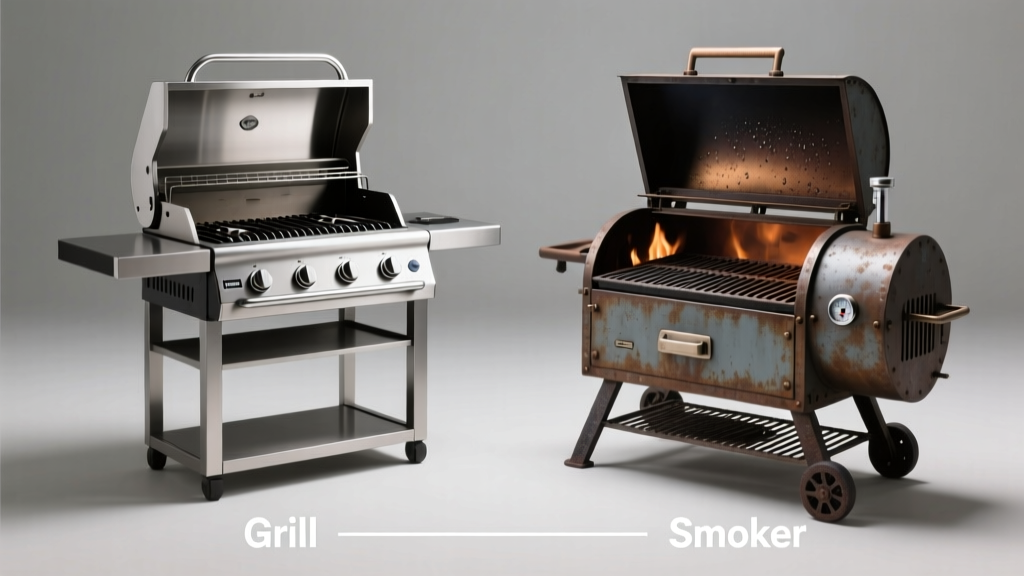
Choosing between a grill and a smoker feels like picking between a sports car and a cargo van: both get you where you need to go, but they serve wildly different purposes—and your weekend rib dinner hinges on getting it right.
Quick Verdict
A grill wins for speed, simplicity, and weeknight flexibility—think burgers in 12 minutes and seared steaks with visible grill marks. A smoker excels at low-and-slow transformation: tender pulled pork, bark-rich brisket, and deep smoke rings that take 10–16 hours. Neither is universally 'better'; the right tool depends on how you cook, how much time you have, and what flavors you chase.
Side-by-Side Comparison
| Feature | Grill | Smoker |
|---|---|---|
| Typical Cook Temp Range | 300°F–700°F | 180°F–275°F (some up to 400°F) |
| Avg. Cook Time (for 3-lb pork shoulder) | 1.5–2 hours | 10–14 hours |
| Fuel Options | Gas, charcoal, electric, pellet (grill mode) | Charcoal, wood, electric, pellet (smoke mode) |
| Smoke Flavor Intensity | Light to moderate (brief exposure) | Deep, layered, consistent (hours of exposure) |
| Learning Curve | Low (intuitive heat control) | Moderate to high (temp stability, wood management) |
| Space & Footprint | Compact (many under 36" wide) | Larger (offsets often 48"+, verticals 30"+ tall) |
Deep Dive on Grills
Grills are built for responsiveness and versatility. Gas models ignite in seconds and hold steady temps for searing or indirect roasting. Charcoal grills offer richer flavor and better heat retention—but require ash cleanup and airflow tuning. Pellet grills blur the line, offering both grill and smoke modes, though their 'grill' function rarely hits true sear temps above 500°F without a flame broiler add-on.
Pros of Grills
- Cook dinner in under 30 minutes—including prep and cleanup
- Excellent for vegetables, seafood, kebabs, and thin cuts (chicken breasts, skirt steak)
- Most models fit on small patios or apartment balconies (check local fire codes)
- Lower upfront cost: basic gas grills start at $299; premium charcoal at $450
Cons of Grills
- Limited smoke penetration—flavor fades after 20–30 minutes of indirect cooking
- Struggles with collagen breakdown: tough cuts like beef chuck or pork butt won’t render properly
- Charcoal models demand active monitoring during longer cooks (e.g., 3-hour ribs)
Deep Dive on Smokers
Smokers prioritize thermal consistency and smoke infusion over speed. Offset barrel smokers rely on firebox-to-cook-chamber airflow; electric units like the Masterbuilt 560 use thermostats and wood chip trays; pellet smokers automate feed and temp. According to the Kansas City Barbeque Society’s 2022 competition rules, authentic smoked meats must show measurable smoke ring penetration—something only sustained low-temp smoke achieves.
"A good smoke isn't about more wood—it's about clean, cool smoke at the right density. Thick white smoke means incomplete combustion and bitter flavor." — Melissa Cookston, 7-time BBQ World Champion, Smokin' Hot in the South (2021)
Pros of Smokers
- Unmatched tenderness in tough, inexpensive cuts (brisket flat, beef ribs, whole chickens)
- Pellet and electric models maintain ±5°F variance for 12+ hours unattended
- Wood choice directly shapes flavor profile: hickory for boldness, apple for sweetness, cherry for fruit-forward notes
Cons of Smokers
- Longer preheat (30–45 min) and cook times mean planning meals 1–2 days ahead
- Higher maintenance: grease trays need emptying after every cook; wood chunks/chips require reloading
- Most dedicated smokers lack high-heat sear capability—many pitmasters finish on a separate grill
When to Choose a Grill vs Smoker
Opt for a grill if you host casual weeknight cookouts, value quick cleanup, or live in an HOA with strict noise/smoke restrictions. Choose a smoker if you regularly cook for crowds, enjoy the ritual of tending fire, or want competition-level results from cuts like pork shoulder or tri-tip. Families with teens or retirees often prefer pellet grills—they bridge both worlds, though they cost $800–$2,200. The U.S. EPA estimates that 14% of household water usage is from leaks—but for outdoor cooking, it’s smoke control that matters most: improper ventilation or wet wood can double particulate emissions.
Alternatives to Consider
Don’t overlook hybrid solutions. The pellet grill runs on wood pellets and handles both searing and smoking—ideal for cooks who refuse to choose. The kamado-style ceramic grill (like Big Green Egg) offers unmatched heat retention for baking, smoking, and grilling in one unit—but weighs 200+ lbs and costs $1,200+. For renters or urban dwellers, the electric smoker plugs into any outlet and produces reliable smoke with zero open flame—though flavor depth lags behind charcoal or wood-fired units.
Can I smoke on a regular grill?
Yes—but with caveats. You’ll need a two-zone setup (lit side + unlit side), soaked wood chips in a foil pouch with holes, and tight lid control. Results are inconsistent: smoke dissipates quickly, and maintaining 225°F for 6+ hours demands frequent charcoal top-offs and thermometer vigilance. It works for chicken or fish, but not for brisket.
Do I need a water pan in my smoker?
Not always—but it helps. Water pans stabilize chamber temperature, add humidity (preventing meat surface from drying), and catch drippings. In dry climates or long cooks (>12 hrs), skipping it risks tough bark and stalled temps. Just don’t refill mid-cook: opening the lid drops temp 25–40°F and extends cook time.
Which is safer: gas grill or electric smoker?
Electric smokers win on ignition risk—no open flame or propane lines. But gas grills pose fewer burn hazards than charcoal (no hot coals spilling) and less smoke inhalation risk than offset smokers burning hardwood. All require placement on non-combustible surfaces and 36" clearance from structures per NFPA 58 (2023).
How much space do I really need?
Minimum safe clearance is 24" from walls or fences—but plan for 36" to allow airflow and easy access. A standard 3-burner gas grill needs ~4 sq ft footprint; a vertical electric smoker fits in 2.5 sq ft; an offset barrel requires 6+ sq ft plus 3' front access for loading wood. Check your condo or HOA bylaws—many ban charcoal and open-flame smokers outright.
Is pellet fuel expensive long-term?
At $19–$24 per 20-lb bag, pellet fuel costs $1.00–$1.20 per hour of smoking. Compare that to $3.50/hour for propane (at $3/gal) or $2.20/hour for lump charcoal. Over 100 cook hours/year, pellets cost ~$110 vs $220 for charcoal—making them cheaper *and* cleaner burning, per the EPA’s 2022 Residential Wood Heater Emissions Report.
What’s the easiest smoker for beginners?
The Masterbuilt Digital Electric Smoker (MES 130B) is consistently rated top beginner pick by BBQ Pit Boys and Amazing Ribs. Its dial-based controls, built-in thermometer probe, and compact size eliminate guesswork. Just load wood chips, set temp, and walk away. First-timers report 90% success rate on smoked turkey breast—versus ~50% with offset charcoal smokers in early attempts.
If you savor the scent of woodsmoke at dawn but also crave grilled corn at sunset, you’re not choosing wrong—you’re just not done upgrading yet. Start with the tool that matches your current rhythm, then layer in the other when your confidence (and patio space) grows.