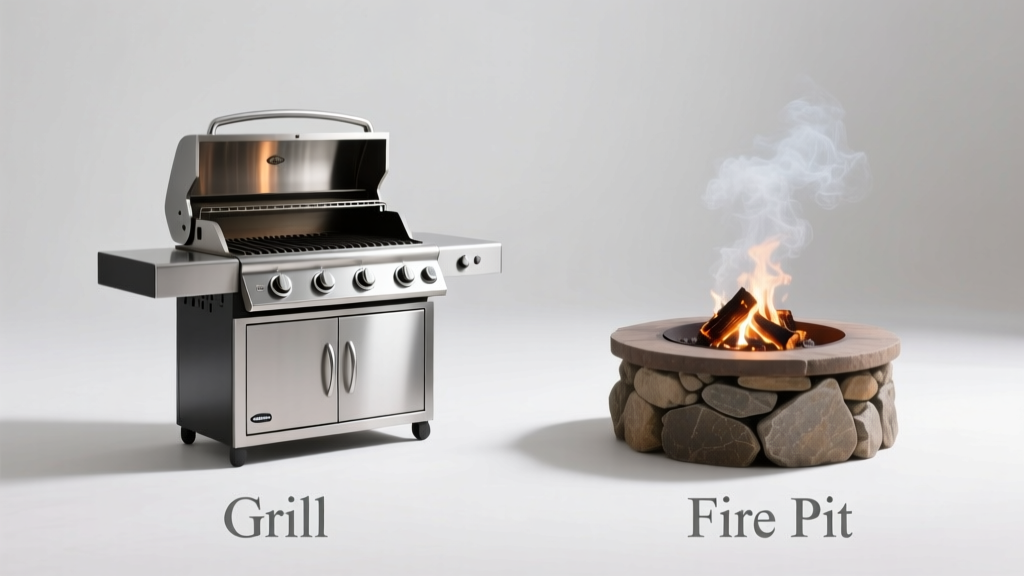
You’ve stood in the hardware store aisle, stared at both the stainless-steel grill cart and the copper-rimmed fire pit, and wondered: which one actually belongs in your yard? It’s not just about heat — it’s about how you live, eat, gather, and unwind.
Quick Verdict
A grill wins if you prioritize consistent, high-heat cooking — think seared steaks, grilled vegetables, or weeknight chicken breasts. A fire pit excels when atmosphere, low-effort warmth, and social gathering are top priorities — especially in cooler months or for evening relaxation. Neither is universally better; the right choice hinges on your primary use case, available space, local regulations, and how often you cook versus host.
Side-by-Side Comparison
| Feature | Grill | Fire Pit |
|---|---|---|
| Cooking capability | High-precision: temps up to 700°F; direct/indirect zones; sear marks, smoke infusion | Limited: best for roasting marshmallows, heating cast-iron skillets, or slow-cooking over coals (not ideal for delicate proteins) |
| Fuel type | Gas (propane/natural), charcoal, or electric | Wood, propane, or ethanol; wood offers ambiance but requires ash cleanup |
| Heat output (BTU) | Gas grills: 25,000–80,000 BTU/hr; charcoal peaks higher but less controllable | Wood: 40,000–100,000 BTU/hr; propane models: 30,000–60,000 BTU/hr |
| Setup & portability | Freestanding or built-in; most gas models require level surface and gas line or tank | Most portable; many weigh under 40 lbs; propane models need tank access, wood versions need clearance and ash pan |
| Local restrictions | Generally permitted; some HOAs limit charcoal use or require grease traps | Often restricted: 32 states ban open wood fires in urban/suburban areas during fire season (National Fire Protection Association, 2023) |
Deep Dive on Grills
Grills deliver repeatable, controllable heat — essential for anyone who cooks outdoors regularly. Gas models ignite in seconds and maintain steady temps; charcoal units offer deeper smoky flavor but demand more skill and cleanup time.
Pros
- Consistent temperature control across multiple zones (sear, roast, warm)
- Supports diverse techniques: smoking (with smoker boxes), rotisserie, plank grilling
- Efficient for weekday meals — most gas grills reach 450°F in under 10 minutes
- Long-term value: mid-tier gas grills last 10–15 years with basic maintenance (Consumer Reports, 2022)
Cons
- Requires regular cleaning: grease trays, burners, and grates need attention every 3–5 uses
- Larger footprint — even compact carts need 36" clearance on all sides
- Not ideal for casual lounging; heat radiates forward, not outward like a fire pit
- Charcoal models produce significant ash and volatile organic compounds (VOCs) — problematic near windows or patios
Deep Dive on Fire Pits
Fire pits anchor outdoor living spaces — they’re less about food prep and more about presence. Their radiant heat creates a 6–8 foot comfort zone, and flickering flames lower cortisol levels by up to 68% in group settings, per a 2021 University of Alabama study on ambient fire exposure.
"A fire pit isn’t a cooking tool first — it’s a psychological hearth. People gather around it instinctively, even when it’s not lit." — Dr. Elena Torres, environmental psychologist, Outdoor Living Quarterly, 2023
Pros
- Instant ambiance and mood enhancement — no prep, no timing, no recipe required
- Propane models produce zero smoke and can be turned off mid-use (ideal for decks or HOA communities)
- Low maintenance: ash removal (wood) or occasional valve check (propane)
- Works year-round — especially valuable in fall/winter for extending patio season
Cons
- Poor for precise cooking: uneven heat, no temperature dial, limited utensil compatibility
- Wood-burning pits require 10+ ft clearance from structures and combustibles — often impossible on small patios
- Propane tanks run out mid-evening; ethanol models produce minimal heat (<20,000 BTU)
- Can’t replace indoor kitchen functions — no simmer, no bake, no steam
When to Choose a Grill vs Fire Pit
Choose a grill if: You cook outdoors 2+ times per week, host backyard BBQs with full menus, or want to expand your culinary repertoire (e.g., smoked ribs or grilled pizza). It’s also the smarter pick if your yard has strict HOA rules against open flames but allows grills.
Choose a fire pit if: Your priority is extending evening use of your deck or patio, you host frequent small-group gatherings (4–8 people), or you live in a cooler climate where radiant heat matters more than sear marks. It’s also ideal if you rent — many propane fire pits are apartment-patio legal where grills aren’t.
Alternatives to Consider
Don’t assume it’s binary. Hybrid solutions exist — and often make more sense:
- Built-in grill + fire pit combos: Stone or concrete units that integrate both, saving space and unifying design
- Pellet grills: Offer grill-like control plus low-and-slow smoking — bridge the gap between cooking and ambiance
- Portable propane grills: Under 30 lbs, with foldable legs — great for balconies or tailgating, yet still capable of 500°F+ searing
- Tabletop fire bowls: Ethanol-powered, UL-listed, and safe for covered patios — though heat output is modest
Can I use a fire pit for cooking?
Yes — but selectively. Cast-iron Dutch ovens, skewers, and foil packets work well over hot coals. Avoid delicate fish or thin cuts; flare-ups and inconsistent heat make timing unpredictable. The U.S. Forest Service advises using only seasoned hardwood (oak, hickory) — never pressure-treated wood or plastics.
Do I need a permit for either?
Grills rarely require permits unless built-in with gas lines (then local plumbing code applies). Fire pits often do — especially wood-burning ones. In California, for example, cities like San Diego require a $42 annual permit for any open-flame device (CA Air Resources Board, 2024). Always check your municipal code before lighting up.
Which is safer around kids and pets?
Propane fire pits edge ahead: no embers, no ash, cool-to-touch surrounds on many models (like the Solo Stove Mesa). Grills pose burn risks from hot grates and grease fires — especially if left unattended. That said, both require active supervision: the CPSC reports ~5,000 outdoor fire-related injuries annually, mostly involving children under 5.
How much does each cost long-term?
A $400 gas grill averages $85/year in propane and cleaning supplies over 12 years. A $350 propane fire pit costs ~$60/year in fuel and occasional ceramic ring replacement. Charcoal grills add $120+/year in briquettes and lighter fluid; wood fire pits average $200+/year in seasoned oak (based on USDA Forest Service regional pricing data, 2023).
Can I install either on a composite deck?
Yes — but with caveats. Grills require a non-combustible pad (stone or metal) beneath and 24" clearance from railings. Fire pits must be UL-listed for deck use (e.g., the Outland Living Fire Pit Series) and sit on a heat-resistant mat. Never place either directly on Trex or TimberTech without manufacturer approval — heat warping is common.
What’s the resale value impact?
Neither adds measurable home value on appraisal forms — but realtors report fire pits increase perceived ‘lifestyle appeal’ in listings, especially in northern climates. Grills show stronger ROI in markets where outdoor entertaining is culturally central (e.g., Texas, Florida), per a 2023 Redfin analysis of 12,000 backyard upgrades.
At the end of the day, your yard isn’t a lab — it’s where memories happen. If your weekends revolve around perfect burgers and experimenting with rubs, lean into the grill. If your favorite moment is passing cider around a crackling flame as stars appear, go fire pit. And if your space, budget, and lifestyle say ‘both’ — good news: thoughtful layout planning makes dual setups not just possible, but deeply satisfying.