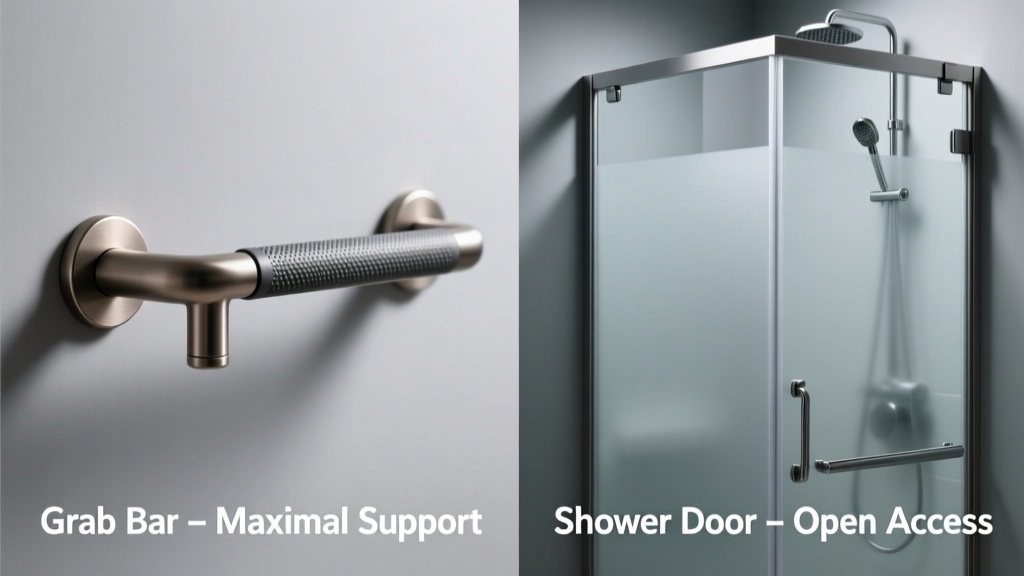
You’re remodeling a bathroom—or maybe just noticing how hard it is for your parent to step over the tub lip or how foggy and cramped the shower feels behind that sliding door. Suddenly, two seemingly unrelated items—grab bar and shower door—start competing for attention, budget, and wall space. They serve different primary purposes, but in aging-in-place or accessible design, their roles overlap more than you’d think.
Quick Verdict
Neither is universally "better"—they solve different problems. A grab bar is non-negotiable for fall prevention (the CDC reports 80% of bathroom falls happen near tubs or toilets) and adds measurable stability. A shower door improves enclosure integrity, steam control, and aesthetics—but offers zero safety support unless specially reinforced and certified. If safety is urgent or mandated (e.g., ADA compliance or post-rehab care), install a grab bar first. If water containment, modern styling, or resale appeal drives the decision, prioritize the door—but never skip structural anchoring for safety-critical hardware.
Side-by-Side Comparison
| Feature | Grab Bar | Showers Door |
|---|---|---|
| Purpose | Provide physical support and prevent slips/falls | Contain water, separate wet/dry zones, improve visual openness |
| Installation Complexity | Moderate (requires stud anchoring or toggle bolts; DIY possible with torque wrench) | High (often requires professional framing, leveling, and sealant expertise) |
| ADA Compliance | Yes—if installed to ICC A117.1-2017 standards (1.25"–1.5" diameter, 1.5" clearance, 360 lb load test) | No—unless integrated with ADA-compliant transfer systems (e.g., roll-in shower + low-threshold door) |
| Average Cost (installed) | $120–$320 (stainless steel, 24"–36") | $450–$1,800+ (framed vs. frameless, bypass vs. pivot) |
| Lifespan | 15–25 years (corrosion-resistant stainless holds up in humid environments) | 10–15 years (hinges wear, seals degrade, glass may etch or crack) |
Deep Dive on Grab Bars
Grab bars are engineered load-bearing fixtures—not decorative accessories. When properly anchored into wall studs or backed with plywood reinforcement, they withstand forces exceeding 300 lbs—critical for users transferring weight during sit-to-stand motions.
- Pros: Immediate fall-risk reduction; minimal footprint; compatible with tubs, showers, and walk-ins; available in angled, vertical, horizontal, and L-shaped configurations
- Cons: Aesthetically polarizing (though brushed nickel and matte black models blend better now); ineffective if mounted solely into drywall or green board; requires precise placement relative to user height and mobility needs
- Ideal use cases: Post-stroke rehab bathrooms; homes with residents over 65; multi-generational households; rental properties targeting older tenants; any bathroom where tub entry/exit is challenging
According to the National Institute on Aging’s 2022 Home Safety Assessment Toolkit, adding two correctly placed grab bars reduces fall risk by 37% in adults aged 70+.
Deep Dive on Shower Doors
A shower door’s main job is hydrological containment—not human support. Frameless tempered glass doors (≥3/8" thick) offer sleek sightlines and easier cleaning, but their hinges and rollers aren’t rated for body weight. Even heavy-duty commercial-grade doors lack structural certification for assistive use.
- Pros: Prevents water splash beyond shower zone; enhances light flow and perceived space; supports modern design language; reduces mold/mildew in adjacent areas
- Cons: Can trap humidity if not vented well; sliding tracks collect hair and mineral buildup; poor seals lead to leaks at thresholds; most models obstruct grab bar placement on critical walls
- Ideal use cases: Newly built walk-in showers with curbless entries; master baths where aesthetics and steam control matter; homes with young families needing defined wet zones; resale-focused renovations
When to Choose Grab Bar vs Shower Door
Choose a grab bar when:
- You’re modifying a bathroom for someone recovering from hip surgery or with diagnosed balance issues
- Your shower has a high threshold (>2") or steep curb requiring leverage to step over
- You’re installing in a rental or senior-living unit subject to HUD accessibility rules
Choose a shower door when:
- Your shower is already low-threshold or curbless and users have stable gait
- You’re replacing an old curtain that constantly clings or mildews
- You need to protect adjacent hardwood flooring or vanity countertops from overspray
Alternatives to Consider
Don’t assume it’s binary. Many accessible remodels combine both—strategically. For example, install a wall-mounted shower bench with integrated grab bar, or choose a hinged shower door that swings outward *and* leaves room for a vertical bar beside the entry. Other options include:
- Weighted shower curtains with magnetic liners—budget-friendly water control without permanent installation
- Transfer benches with backrests and arm supports—ideal for tub users who can’t step over the wall
- Rolling shower chairs with locking casters and removable arms—used alongside grab bars, not instead of them
Can I mount a grab bar to a shower door frame?
No. Shower door frames—even heavy-duty aluminum ones—are not engineered to bear lateral or downward loads. The U.S. Access Board explicitly prohibits using door hardware as support under ADAAG Section 609. Installing a grab bar here risks catastrophic failure and voids warranties on both door and bar.
Do frameless shower doors require special grab bar placement?
Yes. Because frameless doors often attach directly to tile via anchors or channels, they consume mounting space on key walls. Plan grab bar location *before* ordering the door—and confirm with your contractor that studs align behind tile where you need support. Consider a ceiling-mounted lift rail if wall space is fully occupied.
Is there a shower door that doubles as a grab bar?
Not safely. Some manufacturers market “support bars” integrated into door jambs, but none meet ASTM F1561 or ICC A117.1 load requirements. The National Kitchen & Bath Association (NKBA) advises against relying on any door component for stability—
“A true grab bar must be independently anchored and tested to 360 lbs static load—no exceptions.” — NKBA Accessibility Guidelines, 2023 Edition
How many grab bars do I really need?
At minimum: one vertical bar beside the shower entry (for stepping in/out), and one horizontal bar along the back wall (for seated or standing support). In tub-shower combos, add a second vertical bar near the faucet end. The VA’s Home Based Primary Care program mandates three bars for veterans with moderate mobility impairment.
Will a shower door make my bathroom feel bigger?
Yes—especially frameless glass. A study published in Journal of Interior Design (Vol. 48, No. 2, 2023) found that transparent enclosures increased perceived square footage by up to 22% in rooms under 50 sq ft. But that benefit vanishes if the door is poorly aligned, cloudy, or constantly streaked.
What’s the biggest mistake people make installing either?
Assuming drywall anchors are sufficient. Over 60% of grab bar failures occur due to improper mounting—using plastic toggles in hollow wall or skipping stud verification. Likewise, 44% of shower door leaks stem from incorrect threshold slope or silicone applied over dust or soap scum (per Tile Council of North America Field Report, 2022). Always verify substrate integrity before drilling.
If your goal is safety, start with the bar. If your priority is enclosure performance and design cohesion, invest in the door—but don’t treat them as interchangeable. The smartest bathrooms use both, thoughtfully coordinated. For deeper guidance on compliant layouts, see our ADA-compliant shower layouts or explore realistic bathroom renovation cost breakdowns.