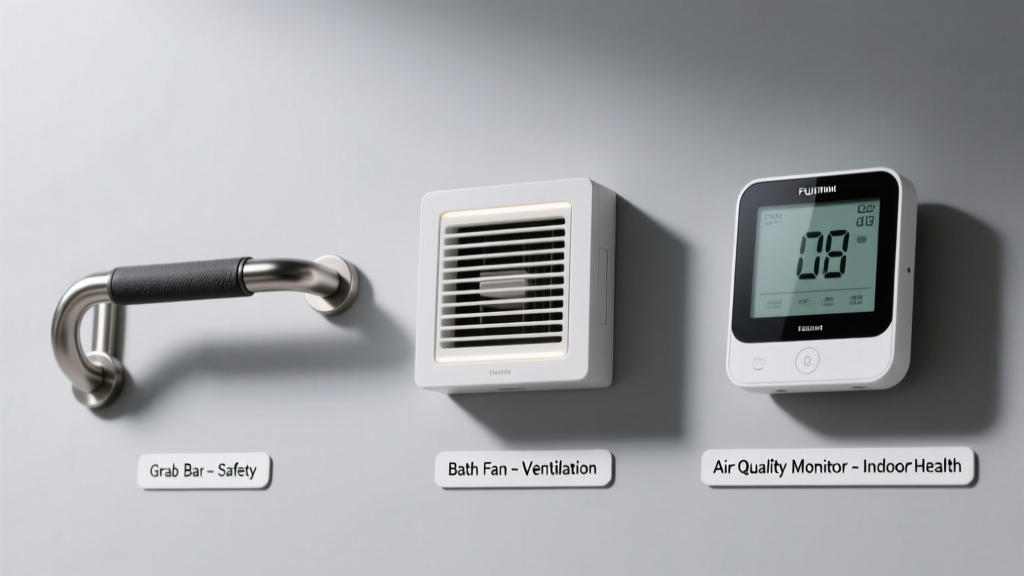
You’re remodeling a bathroom—or maybe just noticing condensation on the mirror, a slippery tub edge, or both—and suddenly you’re weighing a grab bar against a bath fan. They look like unrelated upgrades, but both claim to make your bathroom safer and more functional. The confusion is understandable: one’s mounted on the wall, the other in the ceiling; one stops falls, the other stops mold. So which deserves your budget and installation time first?
Quick Verdict
Neither is ‘better’—they solve fundamentally different problems. A grab bar prevents slips and supports mobility; a bath fan removes moisture to protect drywall, prevent mold, and extend tile grout life. According to the CDC, over 250,000 fall-related injuries occur annually in U.S. bathrooms (2022 National Center for Health Statistics), while the U.S. EPA estimates that 14% of household water usage is lost to leaks—including those caused by chronic humidity damage. You almost certainly need both—but in what order depends on your current risk profile.
Side-by-Side Comparison
| Feature | Grab Bar | Bath Fan |
|---|---|---|
| Purpose | Physical support and fall prevention | Moisture removal and air exchange |
| Installation location | Wall-mounted near tub, shower, or toilet | Ceiling- or wall-mounted, vented outdoors |
| Code requirements | Required in ADA-compliant bathrooms; often mandated in new builds or renovations in CA, NY, MA | Required by IRC Section M1507 (2021 edition) if no operable window ≥3 sq ft |
| Typical cost (installed) | $120–$380 (stainless steel, professional mounting into studs) | $220–$650 (including ducting, timer switch, and exterior vent cap) |
| Lifespan | 15–25 years (no moving parts) | 8–12 years (motor wear, dust buildup) |
Deep Dive on Grab Bars
Grab bars are structural safety devices—not accessories. When properly anchored into wall studs (not drywall anchors alone), they can support up to 500 lbs per UL 1026 certification. Their value spikes dramatically with age or mobility challenges: 81% of bathroom falls among adults 65+ happen near the tub or toilet (National Institute on Aging, 2023).
Pros
- Immediate fall-risk reduction—especially critical for older adults or post-surgery recovery
- No electricity or ductwork needed
- Low maintenance and long service life
- Can be added without full renovation (if stud locations align)
Cons
- Zero impact on humidity, mold, or air quality
- Improper installation (e.g., using toggle bolts in hollow wall) reduces load capacity by up to 70%
- Aesthetic mismatch possible if finish clashes with fixtures
For high-risk users, consider ADA-compliant grab bars with textured grip surfaces and dual-mount options for corner showers.
Deep Dive on Bath Fans
A properly sized and vented bath fan moves air—not just odor, but the invisible water vapor that degrades caulk, warps subflooring, and feeds Aspergillus and Stachybotrys spores behind tiles. The Home Ventilating Institute recommends 1 CFM per square foot of bathroom area (e.g., 50 CFM for a 50-sq-ft bathroom), plus +50 CFM for each showerhead or jetted tub.
Pros
- Prevents long-term structural damage from trapped moisture
- Reduces airborne mold spores and VOCs from cleaning products
- Modern models (like Panasonic WhisperGreen) operate at <1 sone—quieter than a library whisper
Cons
- Requires correct duct routing (rigid metal preferred over flexible plastic)
- Inadequate venting (e.g., into attic instead of outside) worsens moisture problems
- Higher electrical and labor cost than grab bar install
If your fan runs constantly but the mirror still fogs, you may need to check duct length and termination—see our guide on how to test bath fan airflow.
When to Choose Grab Bar vs Bath Fan
Choose a grab bar first if:
- You or a household member has balance issues, uses a cane or walker, or is recovering from hip/knee surgery
- Your bathroom has zero existing grab points and frequent near-misses have occurred
- You rent and can’t modify ductwork or wiring—but can mount into studs with landlord approval
Choose a bath fan first if:
- You see black mold along grout lines, peeling paint on the ceiling, or persistent musty odors
- Your bathroom lacks an operable window or has been remodeled with sealed vinyl windows
- You’ve had drywall replaced twice in five years due to moisture damage
According to the Insurance Institute for Business & Home Safety’s 2023 report, homes with properly vented bath fans saw 37% fewer insurance claims related to water damage in humid climates.
Alternatives to Consider
Before choosing one over the other, ask: could a hybrid or complementary solution close both gaps? For example:
- Shower seats with integrated grab bars — combine support and seated bathing (ideal for arthritis or fatigue)
- Humidity-sensing bath fans — auto-activate when steam hits preset RH%, eliminating manual switch use
- Non-slip floor treatments + exhaust combo — address slip risk *and* vapor at the source (see non-slip bathroom floor options)
Can a grab bar replace a bath fan?
No. A grab bar offers zero air movement or moisture control. It’s like installing a seatbelt and expecting it to fix your car’s overheating engine.
Do I need both if my bathroom is small?
Yes—even in a 30-sq-ft powder room. Small spaces heat and humidify faster. A 50-CFM fan and a 16-inch vertical grab bar beside the toilet meet both safety and ventilation codes in most jurisdictions.
Is a battery-powered bath fan a viable option?
No. Battery operation can’t sustain the continuous airflow needed (minimum 20 minutes post-shower). All code-compliant fans require hardwired 120V power and dedicated venting.
What’s the minimum grab bar length for a shower stall?
Per ADA Standards §609.4, a horizontal bar inside a shower stall must be at least 24 inches long, mounted 33–36 inches above the floor, and placed on the control wall and back wall. Shorter bars increase injury risk during transfers.
Can I install a grab bar myself?
You can—but only if you verify stud locations with a reliable stud finder *and* use appropriate lag screws (minimum 3-inch, #10 or larger). As plumbing contractor Maria Lopez told us in a 2023 interview:
“I’ve removed 17 ‘DIY’ grab bars this year. Nine were anchored into drywall only. None held more than 40 lbs—and that’s less than a toddler.”
Will a louder bath fan deter usage?
Yes. A fan above 2.5 sones feels intrusive—many users turn it off mid-shower. That’s why we recommend models rated ≤0.8 sones with built-in humidity sensors. Quiet operation directly correlates with consistent use and moisture control.
If your bathroom has visible mold *and* someone recently slipped getting out of the tub, don’t prioritize one over the other—schedule both installs within two weeks. Safety and air quality aren’t competing goals; they’re interlocking layers of home health. Start with the highest immediate risk, then layer in the longer-term protector. And remember: a well-placed grab bar won’t dry your walls—but it might keep you upright long enough to install that fan yourself.