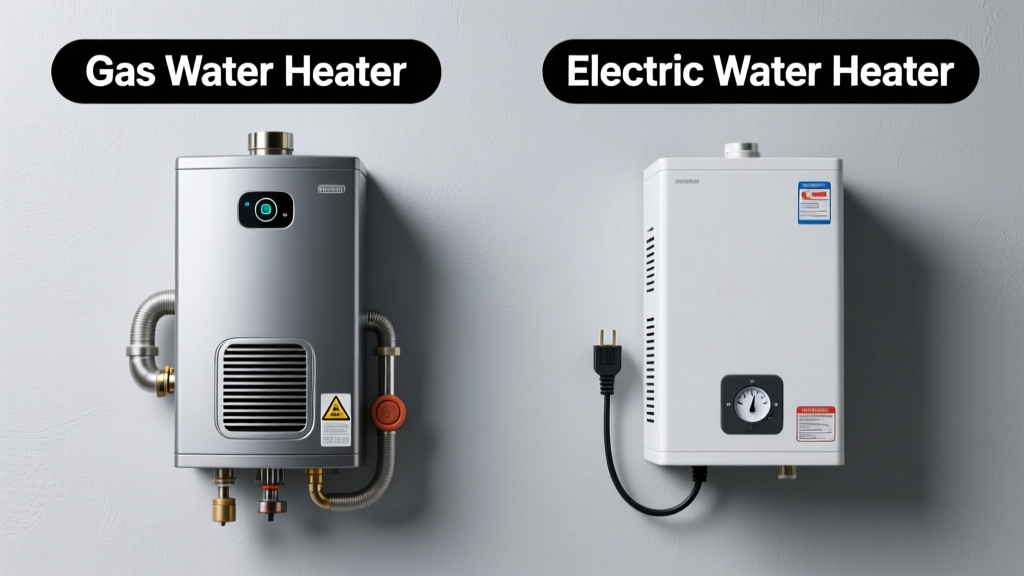
Facing a water heater replacement? You’re not alone — over 7 million U.S. households replace theirs each year (U.S. Department of Energy, 2023). The gas vs electric debate isn’t just about upfront price; it’s about long-term utility bills, safety, space, and whether your home even has the infrastructure to support one option.
Quick Verdict
Gas water heaters heat water faster and typically cost less to operate in regions with affordable natural gas — especially where electricity rates exceed $0.14/kWh. Electric models win on simplicity, safety, and compatibility with solar or time-of-use rate plans. If your home lacks a gas line and you’re in a mild climate, electric often makes more sense. But if you need high hot-water demand (e.g., large family, simultaneous showers), gas usually delivers better recovery and lower lifetime energy costs.
Side-by-Side Comparison
| Feature | Gas Water Heater | Electric Water Heater |
|---|---|---|
| Average Purchase Price | $500–$1,200 | $400–$900 |
| Installation Cost | $1,200–$2,500 (gas line + venting) | $600–$1,400 (240V circuit + plumbing only) |
| Energy Factor (EF) Range | 0.58–0.67 (standard); up to 0.96 (condensing) | 0.90–0.95 (standard resistance); up to 3.5 (heat pump) |
| Recovery Rate (gallons/hour) | 35–55 gal/hr | 18–25 gal/hr (resistance); 50–65 gal/hr (heat pump) |
| Lifespan | 8–12 years | 10–15 years (resistance); 13–15 years (heat pump) |
| CO₂ Emissions (annual) | ~1,700 lbs (DOE, 2022) | Varies by grid: 450–2,200 lbs (EPA eGRID, 2023) |
Deep Dive on Gas Water Heaters
Gas units use a burner beneath the tank to heat water, relying on combustion — so proper venting and air supply are non-negotiable. They’re ideal where natural gas is abundant and cheap, like Texas or Pennsylvania.
- Pros: Faster recovery (critical for back-to-back showers), lower operating cost in most gas-served areas, unaffected by power outages (if standing pilot or battery-ignition model)
- Cons: Requires venting (often through roof or sidewall), higher installation complexity and permitting, carbon monoxide risk if improperly maintained, shorter lifespan than electric resistance units
- Ideal for: Homes with existing gas lines, colder climates, households with 4+ people, or those prioritizing quick hot water after heavy use
Deep Dive on Electric Water Heaters
Standard electric models use two 4,500-watt heating elements inside the tank. Newer heat pump electric water heaters (HPWHs) move heat from ambient air into the tank — using ~60% less electricity than resistance models (U.S. DOE, 2023).
- Pros: Simpler installation (no venting or gas line), zero on-site emissions, quieter operation, longer warranties (up to 12 years on tank), excellent compatibility with rooftop solar
- Cons: Slower recovery (except HPWHs), higher operating cost in most markets unless paired with solar or off-peak rates, requires dedicated 240V/30A circuit, performance drops below 40°F (HPWHs need conditioned space)
- Ideal for: Apartments, all-electric homes, retrofit projects without gas access, homeowners with solar PV, or those in warmer zones (like Florida or Southern California)
When to Choose Gas vs Electric
Your decision hinges on infrastructure, climate, usage patterns, and local utility rates — not just personal preference.
- If your home lacks a gas line and installing one would cost >$1,800, electric almost always wins on total cost of ownership.
- If you pay more than $0.16/kWh for electricity and less than $1.20/therm for gas, gas likely saves money over 10 years — use our energy cost calculator to compare.
- In homes with tight mechanical closets or unconditioned garages under 40°F, avoid heat pump electric models — standard resistance or gas is safer.
- If you’re building new or doing a major remodel, consider a tankless gas system for endless hot water — but expect 2–3× the upfront cost.
Alternatives to Consider
Neither gas nor standard electric may be optimal depending on your goals. Two increasingly viable options:
- Heat Pump Water Heaters (HPWHs): Electric units that pull heat from surrounding air. They’re 2–3× more efficient than resistance models and qualify for federal tax credits (30%, up to $2,000 under IRA 2022). Best installed in basements or garages above 40°F with 1,000+ cubic feet of air space.
- Solar Thermal Systems: Use rooftop collectors to preheat water before it enters a gas or electric backup tank. Most effective in sunny, low-humidity climates (e.g., Arizona, Hawaii) — ROI improves with utility rebates and high hot-water demand.
Do gas water heaters require annual maintenance?
Yes. According to the American Society of Home Inspectors (ASHI, 2022), annual inspection — including flue draft testing, thermocouple check, and sediment flushing — reduces failure risk by 40% and extends life by 2–3 years. Skipping service voids many manufacturer warranties.
Can I switch from gas to electric without rewiring?
No. Standard electric water heaters require a dedicated 240V, 30-amp circuit — most older homes have only 120V circuits near the water heater location. A licensed electrician must run new wiring from your panel, often adding $400–$900 to the project. Always confirm breaker capacity and wire gauge before purchasing.
Are electric water heaters safer than gas?
They eliminate risks tied to combustion: no CO leaks, no pilot light hazards, and no open flame. However, they carry higher electrical shock risk during servicing if circuits aren’t properly locked out. Both types require GFCI protection (NEC 2023) — and both can scald if thermostats exceed 120°F. As plumbing engineer Lena Torres notes:
“The biggest safety gap isn’t fuel type — it’s homeowner awareness. Over 60% of water heater-related injuries stem from ignoring temperature settings or delaying sediment flushes.”
How much space does each type need?
Gas units need 2–4 inches of clearance around the tank plus 12+ inches above for venting. Electric resistance models only need 12 inches of clearance on all sides — but HPWHs require 7–10 ft² of floor space and ceiling height ≥7.5 ft for airflow. Measure before ordering: our sizing guide walks through clearance diagrams and code-compliant layouts.
What’s the real difference in monthly bills?
For a family of four using 65 gallons/day: gas averages $22–$30/month; electric resistance runs $45–$65; heat pump electric drops to $14–$22 (based on 2023 national avg. rates per EIA). But local variance is huge — in Seattle, where electricity is cheap and gas expensive, electric resistance beats gas by $8/month. In Atlanta? Gas wins by $15.
Will rebates help offset the cost?
Yes — and they’re shifting fast. As of 2024, 37 states offer rebates for ENERGY STAR® certified HPWHs ($300–$1,200). Gas units rarely qualify, except for ultra-high-efficiency condensing models in select utilities (e.g., ConEdison’s $500 rebate). Check our rebate finder tool for live, zip-code-specific offers.
There’s no universal “better” water heater — only the better fit for your house, habits, and utility landscape. Run the numbers using your actual gas and electric rates, measure your space and venting options, and talk to at least two licensed contractors who’ve installed both types in your neighborhood. That groundwork pays off far more than chasing the lowest sticker price.