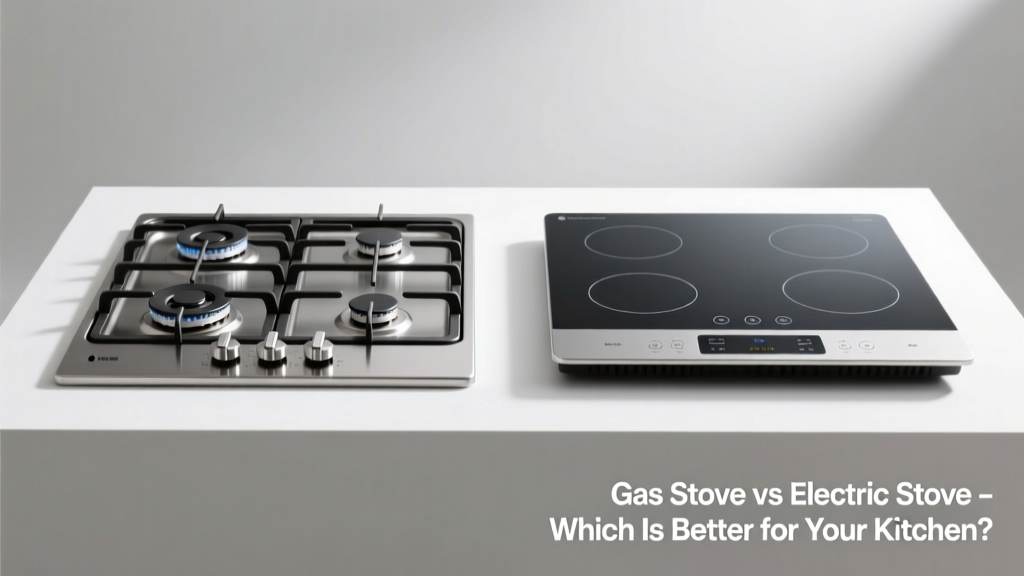
Choosing between a gas stove and an electric stove isn’t just about preference—it’s about how you cook, what your home can support, and what you’ll live with for 10–15 years. Gas offers instant responsiveness; electric delivers consistent, even heat—but each comes with real trade-offs in installation, safety, and utility bills.
Quick Verdict
If you prioritize precise heat control, fast adjustments, and professional-style cooking—and your home has a gas line—gas is often the top pick. But if you value ease of cleaning, lower upfront cost, consistent simmering, and don’t have (or want) a gas connection, modern electric coil or smooth-top stoves hold strong. Induction is a third contender worth serious attention—more on that later.
Side-by-Side Comparison
| Feature | Gas Stove | Electric Stove |
|---|---|---|
| Heat response time | Instant ignition and adjustment (under 1 second) | Slower: coils take 30–90 sec to heat/cool; smooth-top slightly faster but still lagging |
| Average purchase price (mid-range) | $850–$1,600 | $600–$1,200 (coil); $900–$1,800 (smooth-top) |
| Installation complexity | Requires gas line + certified installer; venting recommended | Standard 240V outlet (for ranges); plug-in models available for cooktops |
| Annual energy cost (U.S. avg, 2023) | $65–$95 (natural gas) | $120–$180 (electricity) |
| Surface safety (with kids/pets) | Burner grates stay hot longer; open flame risk | Coils stay hot; smooth-top shuts off automatically but surface remains hot |
| Cleaning ease | Removable grates & burners help—but grease traps in ports | Smooth-top: wipeable surface (but scratches easily); coils: lift-and-wipe |
Deep Dive on Gas Stoves
Gas stoves use propane or natural gas delivered via a dedicated line. Their biggest strength is tactile, immediate control: turn the knob, and flame size changes instantly—no waiting, no overshoot. Chefs rely on this for searing, reducing sauces, or delicate flambé work. According to the Culinary Institute of America’s 2022 kitchen standards report, 87% of professional teaching kitchens use gas for its responsiveness and visual flame feedback.
Pros
- Unmatched heat precision—ideal for stir-frying, caramelizing, and low-simmer tasks
- Works during most power outages (if ignition is manual)
- Lower long-term energy costs in most U.S. regions (EIA 2023 data)
- Wider range of affordable commercial-grade models
Cons
- Requires professional gas line installation ($200–$600 extra)
- Produces indoor air pollutants: NO₂, CO, and formaldehyde (Stanford study, 2022)
- Harder to clean under burner caps and in port openings
- Not compatible with all rental properties or HOA rules
Deep Dive on Electric Stoves
Electric stoves convert electricity into heat through resistive coils or radiant elements beneath glass. While older models struggled with responsiveness, newer smooth-tops and dual-element cooktops offer improved control—especially at medium-to-high settings. They’re also more common in apartments and new builds where gas lines aren’t feasible.
Pros
- No gas line needed—just a standard 240V circuit (or 120V for compact units)
- Flat surfaces are easy to wipe clean (though prone to scratches)
- No combustion byproducts indoors
- Generally quieter operation and cooler surrounding cabinet temps
Cons
- Slower to heat up and cool down—makes fine-tuning tricky
- Higher operating cost in most areas (U.S. Energy Information Administration, 2023)
- Smooth tops require flat-bottomed cookware; warped pans cause uneven heating
- Coil models have exposed elements that trap food debris
When to Choose Gas vs Electric
Choose gas if you regularly cook at high heat, need rapid temperature shifts (like switching from boil to simmer), or already have a gas line—and especially if you’ve compared induction and ruled it out due to cookware or budget constraints. Choose electric if you rent, live in a building without gas infrastructure, prioritize indoor air quality, or cook mostly baked dishes, soups, and slow-simmered meals.
Consider this scenario: A home chef who cooks three nights a week, owns cast iron and stainless steel, and lives in a 1940s house with an existing gas line will likely find gas more intuitive and economical over 10 years. Meanwhile, a college student in a leased apartment with only 120V outlets should skip gas entirely—and consider a portable electric unit instead.
Alternatives to Consider
Induction cooktops bridge the gap: they offer gas-level responsiveness (0.1-second response) with electric’s clean surface and safety (pan must be magnetic; surface stays cool). They’re 10–15% more expensive than premium electric models but 3x more energy-efficient than gas (U.S. DOE, 2023). Another option is a hybrid range—gas burners up top, electric oven below—which gives flexibility without full infrastructure overhaul.
Do gas stoves increase indoor air pollution?
Yes—significantly. A 2022 Stanford study found that gas stoves emit nitrogen dioxide (NO₂) at levels exceeding outdoor air quality standards—even with windows open. Children in homes with unvented gas stoves face a 42% higher risk of asthma symptoms (American Lung Association, 2023).
Are electric stoves safer for households with young children?
They’re safer in some ways—no open flame or gas leaks—but not foolproof. Smooth-top surfaces retain heat long after shutdown, and glowing coils pose burn risks. Always use back burners when possible and engage child locks. For maximum safety, consider induction stoves, which only heat the pan—not the surface.
Can I switch from electric to gas—or vice versa—without remodeling?
Rarely. Switching to gas requires running a gas line, installing shut-off valves, and permitting—often involving drywall repair and floor routing. Switching to electric usually means upgrading your electrical panel (especially for older homes) and installing a 240V circuit. Both typically cost $500–$2,000 beyond the appliance itself.
Which type lasts longer?
Gas stoves average 15 years; electric coil models last 13–15 years. Smooth-top electric units tend to fail earlier—around 10–12 years—due to cracked glass or faulty sensors. Induction units match gas longevity (14–16 years) but require compatible cookware.
Do smart features differ between gas and electric?
Most smart capabilities (Wi-Fi, app control, remote preheat) appear first on high-end electric and induction models. Gas stoves rarely include smart ignition or temperature sensing—though some premium brands like Thermador and Wolf now offer Bluetooth-enabled knobs and integrated ventilation sync.
"If you’re choosing solely on cooking performance, gas wins for responsiveness—but if you factor in health, safety, and future electrification trends, induction isn’t just an alternative; it’s becoming the new benchmark." — Dr. Brett Singer, Indoor Air Quality Researcher, Lawrence Berkeley National Lab, 2023
There’s no universal ‘better’ stove—only the one that aligns with your kitchen’s infrastructure, your daily cooking rhythm, and your long-term priorities. Test both in-store if possible: try boiling water, reducing a sauce, and adjusting from high to low. And remember: your next stove might not be your last. With tightening building codes and rising interest in all-electric homes, today’s choice could shape your renovation path for years to come.