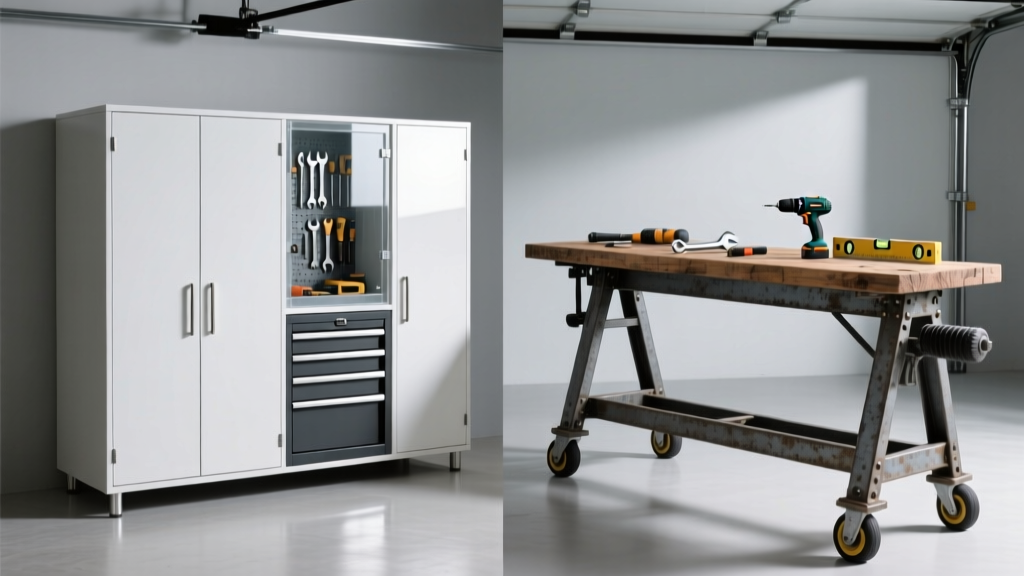
You’re standing in your garage, staring at a pile of tools, lumber, and half-finished projects — and wondering whether to invest in a heavy-duty cabinet or grab another sawhorse. It’s not just about cost; it’s about workflow, safety, and how you actually use the space.
Quick Verdict
A garage cabinet wins for organized, long-term tool storage and workshop stability — especially if you own power tools, hand tools, or need dust control. A sawhorse excels as a portable, low-cost work support for cutting, assembly, or temporary setups. Neither is universally better; your daily tasks and garage footprint decide which earns floor space.
Side-by-Side Comparison
| Feature | Garage Cabinet | Sawhorse |
|---|---|---|
| Primary function | Tool storage + workstation base | Temporary material support |
| Weight capacity (typical) | 150–600 lbs (per shelf) | 300–800 lbs (per pair) |
| Floor footprint | 24"–36" deep × 36"–72" wide | 12"–18" wide × 30"–36" long (per unit) |
| Assembly time | 1–3 hours (pre-assembled options available) | 0 minutes (ready to use) |
| Dust & debris management | Enclosed shelves reduce airborne particles | No containment — sawdust falls freely |
| Cost range (new) | $299–$1,800+ | $25–$120 per pair |
Deep Dive on Garage Cabinets
Garage cabinets — especially steel or high-density polyethylene (HDPE) models — are engineered for durability and organization. They often include adjustable shelving, lockable doors, integrated pegboard panels, and casters for mobility. Brands like Gladiator and Husky offer modular systems that bolt together, letting you expand over time.
- Pros: Keeps tools off the floor and out of reach of kids or pets; protects against moisture and rust; supports benchtops or vise mounts; improves resale value (National Association of Home Builders, 2022 survey found 68% of buyers value upgraded garage storage)
- Cons: High upfront cost; requires wall anchoring for safety (CPSC recommends anchoring all cabinets >30" tall); limited portability once installed
- Ideal for: Homeowners with consistent DIY habits, woodworkers storing routers and clamps, or garages used as multi-purpose spaces (e.g., workshop + car storage)
Deep Dive on Sawhorses
Sawhorses are minimalist, functional, and ruthlessly practical. Modern versions use aluminum frames or reinforced polymer legs, folding designs, and non-marring feet. You’ll find them in every contractor’s truck — not because they’re fancy, but because they get the job done fast.
- Pros: Lightweight (<15 lbs each), stackable, easy to store vertically; works on uneven surfaces; pairs well with workbench stands or portable table saw stands
- Cons: No storage capability; no built-in clamping or accessory mounting; can tip if overloaded asymmetrically; exposed legs pose tripping hazards in busy garages
- Ideal for: Weekend builders cutting sheet goods, renters needing temporary solutions, or anyone staging materials for outdoor projects like deck framing or fence repair
When to Choose Cabinet vs Sawhorse
Choose a garage cabinet if your top priority is reducing clutter, protecting expensive tools, or creating a dedicated build zone. Go with sawhorses if your work is episodic, mobile, or involves frequent material handling — like cutting drywall in a basement remodel or prepping landscape timbers in the driveway.
- You store >10 hand tools or >3 power tools regularly → cabinet
- You cut lumber more than twice a month outside your garage → sawhorse
- Your garage doubles as a home gym or EV charging station → cabinet (maximizes vertical space)
- You move residences every 2 years or less → sawhorse (no installation hassle)
Alternatives to Consider
Don’t limit yourself to just these two. Hybrid solutions often bridge the gap:
- Modular workbenches (e.g., Kreg KMS7000) combine storage drawers with built-in clamping points and fold-down sawhorse-style supports
- Wall-mounted track systems like FastCap’s TrackBar let you hang tools *and* slide sawhorses or jigs into position
- Rolling tool chests offer mobility like sawhorses but with lockable storage — though they rarely exceed 200 lbs capacity
Can I use a sawhorse inside a garage cabinet?
Not directly — most cabinets lack clearance for standard 32"-tall sawhorses beneath their lowest shelf. But some tall cabinets (like the Husky 72" H-Series) have 18"+ open bases, allowing compact folding sawhorses to nest underneath when not in use.
Do garage cabinets prevent tool rust better than sawhorses?
Yes — especially HDPE or powder-coated steel cabinets with gasketed doors. According to the U.S. EPA estimates that 14% of household water usage is from leaks, and uncontrolled humidity in garages accelerates corrosion. Cabinets limit airflow exposure; sawhorses leave tools fully exposed.
How much weight can a typical garage cabinet shelf hold?
Most mid-tier steel cabinets support 150–250 lbs per shelf (tested per ANSI/BIFMA X5.9-2021 standards). Heavy-duty commercial units like those from Lockers.com list 600-lb static load ratings — but only if anchored properly and loaded evenly.
Are folding sawhorses stable enough for power tools?
Only if rated for it. The DeWalt DWX726 folding model is tested to hold 1,000 lbs *static*, but vibration from circular saws or routers can cause leg wobble. For routing or sanding, professionals recommend bracing or using a fixed-base workbench instead.
Will a garage cabinet fit in a 9-foot-wide garage bay?
Yes — most single-width cabinets are 24"–30" deep and 36" wide. That leaves ~60" of clear floor space alongside it. Just avoid placing it directly in front of overhead door tracks or HVAC units.
Do sawhorses require maintenance?
Minimal, but yes. Aluminum legs should be wiped down after wet jobs to prevent oxidation; polymer feet wear faster on abrasive surfaces like concrete. Inspect leg pins and hinge bolts every 6 months — loose hardware causes instability.
"Sawhorses are the Swiss Army knife of the trades — simple, reliable, and never obsolete. But if your garage has become your second office, treat it like one: invest in storage that grows with your skills." — Carlos Mendez, certified carpenter and host of Build Smart Podcast, 2023
If your current setup forces you to dig through a toolbox every time you need a chisel, or if you’ve ever dropped a board because a sawhorse shifted mid-cut, it’s time to match your gear to your habits — not the other way around. Start small: try a single cabinet section next to your existing work area, or add a second sawhorse with integrated clamps. Either upgrade makes tomorrow’s project smoother than today’s.