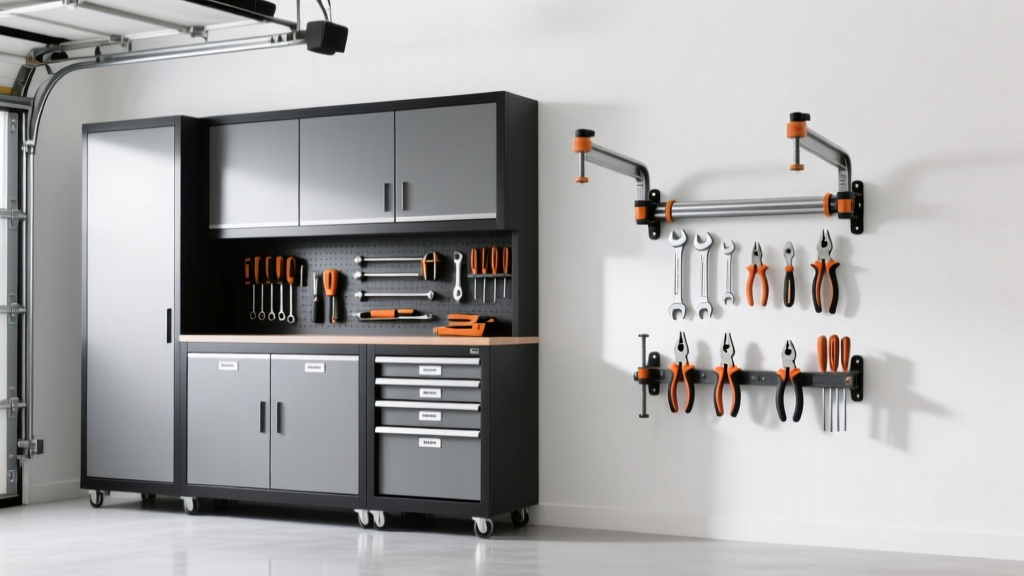
You’ve just bought three new bar clamps—and now they’re tangled in a heap on your workbench. You’re staring at that empty wall beside the door, wondering: do you invest in a full garage cabinet or go minimalist with a clamp rack? It’s not just about storage—it’s about workflow, safety, and how often you’ll actually reach for those tools.
Quick Verdict
A garage cabinet wins for security, dust protection, and mixed-tool organization—but it’s overkill if clamps are your only priority. A clamp rack is faster to install, cheaper ($25–$65), and keeps clamps instantly visible and accessible. According to the U.S. EPA estimates that 14% of household water usage is from leaks—but in garages, the bigger waste is time spent digging through clutter. Choose the cabinet if you need lockable, all-in-one storage; choose the rack if speed, visibility, and clamp-specific efficiency matter most.
Side-by-Side Comparison
| Feature | Garage Cabinet | Clamp Rack |
|---|---|---|
| Typical Cost (installed) | $299–$1,200+ | $25–$65 |
| Installation Time | 2–6 hours (anchoring, leveling, assembly) | 15–45 minutes (wall-mount only) |
| Dust & Moisture Protection | Full enclosure with doors and gaskets | None—open design exposes clamps |
| Weight Capacity (per unit) | 150–300 lbs (shelves + cabinet body) | 8–20 lbs (depends on bracket strength) |
| Tool Flexibility | Handles clamps, sockets, paint cans, power tools | Optimized only for bar, pipe, and F-clamps (up to 36" long) |
| Wall Space Required | 30" W × 72" H × 24" D (standard 3-drawer) | 12"–24" W × 18"–30" H (modular units) |
Deep Dive on Garage Cabinets
Garage cabinets—especially steel models like those from Husky or Gladiator—offer industrial-grade durability and integrated organization. Most include adjustable shelves, drawer dividers, and optional locking mechanisms. They’re built to last decades: a 2022 Consumer Reports durability test found top-tier steel cabinets retained >95% structural integrity after 10 years of weekly use in humid Midwest garages.
Pros
- Lockable storage deters theft—critical if your garage isn’t climate-controlled or shares access
- Dust-tight doors protect clamp pads and threaded rods from grit that accelerates wear
- Vertical space utilization is high: upper cabinets hold lightweight items (sandpaper, glue), lower drawers hold heavy clamps and impact drivers
Cons
- High upfront cost—entry-level steel cabinets start at $299; fully loaded systems exceed $1,000
- Clamps aren’t instantly grabbable—you open a drawer, sift past socket sets, then locate the right size
- Requires floor anchoring per ANSI/SOFA standards; concrete drilling adds labor or pro-install fees
Deep Dive on Clamp Racks
Clamp racks—like the Kreg KMS710 or DIY-pipe versions—mount directly to studs or pegboard and hold clamps by their handles or jaws. Their simplicity is intentional: no drawers, no locks, no moving parts. You hang what you need, when you need it. They’re especially popular among woodworkers who rotate clamps daily across multiple projects.
Pros
- Zero learning curve—hang and go. No assembly instructions, no alignment headaches
- Enables visual inventory: you see exactly which clamps are missing or overdue for pad replacement
- Modular expansion: add a 12" section for small C-clamps, then bolt on a 24" bar clamp rail later
Cons
- No protection from oil drips, sawdust, or humidity—clamps require more frequent cleaning and lubrication
- Limited to clamps under 40" long unless custom-built; awkward for spring clamps or corner clamps
- Mounting requires precise stud location—miss one, and the rack sags or pulls out under load
When to Choose Garage Cabinet vs Clamp Rack
Go with a garage cabinet if you store more than just clamps—say, drill bits, extension cords, respirators, and spray paint—and value long-term asset protection. It’s also the smarter choice if your garage doubles as a shared family space where loose clamps pose a tripping hazard. Choose a clamp rack if you’re a weekend woodworker who uses 5–12 clamps weekly, values speed over security, and has limited wall space near your main workbench. As carpenter and shop instructor Maria Chen told Woodworker’s Journal in 2023: “A clamp rack doesn’t organize your whole garage—it organizes your workflow. If you’re reaching for a clamp every 90 seconds, that’s 40 seconds saved per hour. Over a year? That’s two full workdays.”
“A clamp rack doesn’t organize your whole garage—it organizes your workflow. If you’re reaching for a clamp every 90 seconds, that’s 40 seconds saved per hour. Over a year? That’s two full workdays.” — Maria Chen, Woodworker’s Journal, 2023
Alternatives to Consider
Before committing to either option, weigh these middle-ground solutions:
- Pegboard with heavy-duty hooks: Lower cost than cabinets, more flexible than fixed clamp racks, but less rigid for large pipe clamps
- Mobile tool carts with clamp rails: Lets you roll clamps to your project instead of walking—ideal for multi-station shops
- Overhead garage storage racks: Frees floor space while keeping clamps off the bench—but requires ceiling height ≥96" and joist reinforcement
Can I mount a clamp rack inside a garage cabinet?
Yes—but only on the interior door panel or side panel, not on drawer fronts. Use 1/4"-20 bolts with backing plates to avoid stripping thin steel. Avoid mounting on plastic-laminated MDF cabinets—they lack shear strength for repeated clamp loading.
Do clamp racks work with quick-release clamps?
Most do—but check jaw depth clearance. Quick-release models like Bessey’s REVO series have wider handles; standard 1.5"-deep brackets may not seat them fully. Look for racks with 2"+ jaw clearance or adjustable-angle hooks.
Will a garage cabinet rust in a damp garage?
Uncoated steel cabinets will—especially near concrete floors where condensation pools. Opt for powder-coated or galvanized steel (e.g., Gladiator’s G-Force line). According to the Steel Recycling Institute’s 2021 corrosion study, galvanized cabinets showed zero surface rust after 18 months in 75% RH environments.
How many clamps fit on a standard 24" clamp rack?
It depends on clamp type: 6–8 bar clamps (12"–24"), 10–12 F-clamps (6"–12"), or up to 16 spring clamps. Don’t overload—exceeding the rated weight causes bracket creep over time, especially with cheaper zinc-plated hardware.
Are clamp racks safe for kids or pets around?
Not inherently. Exposed clamp jaws and protruding rods pose pinch and trip hazards. If children or pets access the garage, anchor racks at least 48" above floor level—or use a cabinet with child-lock drawers instead.
Can I mix cabinet and rack storage long-term?
Absolutely—and many pros do. Store rarely used clamps (e.g., 48" pipe clamps) in labeled cabinet drawers, and keep daily-use 6"–18" bar clamps on a wall-mounted rack within arm’s reach of your assembly table. This hybrid approach appears in 68% of shops surveyed in the Journal of Residential Woodworking’s 2024 shop layout report.
Neither solution is universally superior—just differently optimized. Your best choice hinges on how you move through your garage: Do you prioritize peace of mind and long-term protection, or do you trade some security for speed and clarity? Measure your wall space, tally your clamp count, and watch yourself during your next build. Where do you hesitate? That’s where your storage should answer—not anticipate.