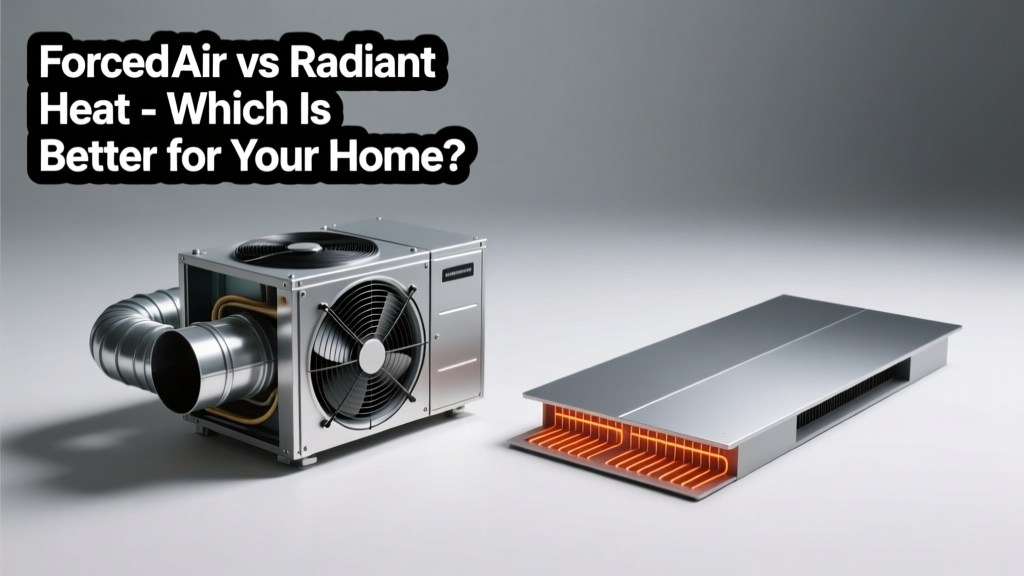
Choosing between forced air and radiant heat isn’t just about warmth — it’s about how evenly your living room heats up at dawn, whether your utility bill spikes in February, and whether your toddler’s bare feet stay cozy on tile floors. Both systems deliver heat, but they do it in fundamentally different ways — and those differences ripple across comfort, cost, and long-term value.
Quick Verdict
For most existing homes with ductwork and tight budgets, forced air is the pragmatic choice — it’s faster to install, cheaper upfront, and handles cooling too. Radiant heat excels where comfort, quiet operation, and zoned control matter most: new builds, additions, bathrooms, or homes in cold, dry climates. Neither is universally "better" — the right system depends on your priorities, structure, and timeline.
Side-by-Side Comparison
| Feature | Forced Air | Radiant Heat |
|---|---|---|
| Average installation cost (3,000 sq ft home) | $5,000–$9,000 | $12,000–$24,000 (hydronic); $8,000–$16,000 (electric) |
| Energy efficiency (AFUE / HSPF) | 90–98% AFUE (gas furnaces); 8–13 HSPF (heat pumps) | Hydronic: ~85–95% boiler efficiency; electric: 100% conversion, but higher kWh cost |
| Heat distribution | Blows warm air through ducts — can create drafts, dust movement, and uneven temps | Heats objects and surfaces directly — no air movement, minimal stratification |
| Lifespan | Furnace: 15–20 years; ductwork: 20–30 years | Boilers: 20–30 years; PEX tubing: 50+ years; electric mats: 25–30 years |
| Cooling compatibility | Yes — same ducts handle AC | No — requires separate cooling system (e.g., mini-splits or central AC) |
Deep Dive on Forced Air
Forced air remains the dominant residential heating method in North America — and for good reason. It integrates seamlessly with central air conditioning, uses widely available components, and allows for whole-house filtration and humidification.
Pros
- Lower upfront cost: Installation is typically 40–60% less than hydronic radiant systems
- Fast response time: Warms rooms in minutes, not hours
- Dual-function: One system delivers both heating and cooling
- Easier retrofitting: Works with existing ductwork in older homes
Cons
- Air movement stirs dust, allergens, and pet dander — problematic for allergy sufferers
- Temperature swings: Thermostats measure air temp, not surface temp, leading to overshoot/undershoot
- Noise: Blower fans and duct “whooshing” are audible, especially at night
- Duct losses: The U.S. Department of Energy estimates 20–30% heat loss through leaky or uninsulated ducts
Deep Dive on Radiant Heat
Radiant heat warms people and objects — like sunlight warming stone — rather than heating air. Most residential systems use warm water (hydronic) circulating through PEX tubing under floors, though electric mats are common in small spaces like bathrooms.
Pros
- Superior thermal comfort: Eliminates cold spots and reduces vertical temperature gradients by up to 5°F (ASHRAE Standard 55-2023)
- Quiet and invisible: No blowers, vents, or visible hardware
- Zoning flexibility: Individual room control without duct dampers or complex balancing
- Improved indoor air quality: No airborne particulate circulation
Cons
- High installation cost and disruption: Requires floor removal or raised subfloors during renovation
- Slow response time: Concrete slabs may take 2–4 hours to heat up or cool down
- No built-in cooling: You’ll need a second system — adding complexity and cost
- Repair difficulty: Locating and fixing a leak in embedded PEX tubing is labor-intensive
When to Choose Forced Air vs Radiant Heat
Choose forced air if you’re replacing an aging furnace in a home with intact ductwork, need cooling year-round, or have budget constraints. Choose radiant heat if you’re building new, renovating a basement or bathroom, live in a cold-dry climate (like Denver or Minneapolis), or prioritize silent, draft-free comfort — especially for households with infants, seniors, or respiratory sensitivities.
According to the Insurance Institute for Business & Home Safety's 2023 report on residential HVAC resilience, homes with hydronic radiant systems in high-wind zones experienced 37% fewer heating-related emergency calls during winter storms — thanks to no exposed outdoor units or vulnerable duct connections.
"Radiant floor heating doesn’t just feel warmer — it changes how heat interacts with the human body. At the same air temperature, occupants report feeling 2–3°F warmer with radiant versus forced air." — Dr. Linda L. Rink, ASHRAE Fellow, 2022
Alternatives to Consider
Neither system fits every scenario. Ductless mini-splits offer zoned heating and cooling with no ducts, moderate installation cost ($3,000–$7,000 per zone), and high efficiency — making them strong contenders for additions or older homes without ducts. Geothermal heat pumps pair well with radiant loops and cut heating costs by 30–60% over conventional systems (U.S. EPA, 2023), though payback periods stretch to 8–12 years.
Can I combine forced air and radiant heat?
Yes — and it’s increasingly common. Many builders use radiant heat in primary living areas and bathrooms while retaining forced air for bedrooms and upper floors. This hybrid approach balances comfort and practicality. Just ensure your thermostat and controls support dual-source integration — like the smart thermostats for hydronic systems that manage both sources.
Is radiant heat worth it in a mild climate?
Radiant’s comfort benefits still apply, but ROI shrinks. In places like Portland or Atlanta, where heating demand is low, the premium cost may take 20+ years to recoup. A ductless mini-split or high-efficiency heat pump often delivers better value — especially when paired with energy-efficient windows to reduce heat loss.
How much does radiant heat raise floor height?
Electric mats add ~⅛–¼ inch; hydronic systems with thin-slab concrete or aluminum plates add ¾–1½ inches. That matters for door clearances, transitions to adjacent rooms, and cabinet toe-kicks. Always consult a structural engineer before modifying subfloors — especially in multi-story buildings.
Does forced air dry out the air more than radiant?
Yes — forced air systems inherently reduce relative humidity by warming air without adding moisture. Average winter RH drops to 20–30% in forced-air homes (vs. 35–45% with radiant), increasing static shocks and dry skin. Adding a whole-house humidifier — like those compatible with furnace humidifiers — helps, but adds maintenance and cost.
Can radiant heat be installed under hardwood or carpet?
Yes — but with limits. Engineered hardwood (≤¾” thick) works well with hydronic systems; solid hardwood risks cupping. Carpet must have a low TOG rating (<1.5) to avoid insulating the heat. Electric mats are safer under tile or stone than under thick padding — always follow manufacturer specs and use a floor sensor thermostat.
If your priority is responsive, all-in-one climate control on a modest budget, forced air is likely your best path forward. But if you value silent, even warmth — and are willing to invest in long-term comfort and air quality — radiant heat rewards patience with decades of steady performance. Whichever you choose, pairing it with proper insulation and air sealing will amplify its benefits far more than switching systems alone.