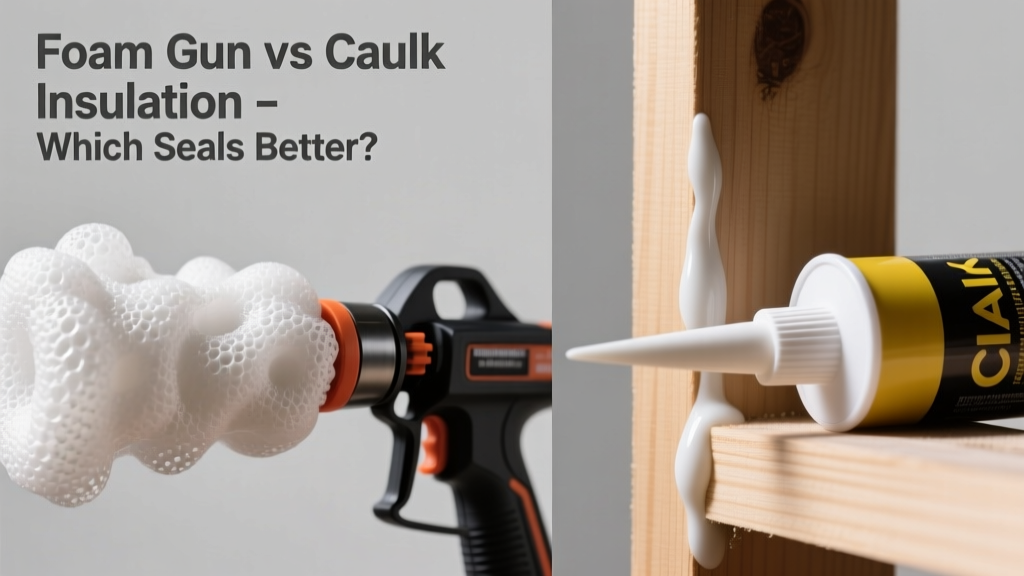
You’re standing in your garage holding a foam gun and a tube of caulk, staring at a ½-inch gap around your exterior door frame. Both promise an airtight seal — but one will expand too much and warp the trim; the other might shrink and crack in six months. It’s not just about sticking something in the gap — it’s about matching material behavior to substrate, climate, and longevity needs.
Quick Verdict
For gaps wider than ¼ inch, irregular shapes, or areas needing structural fill (like rim joists or attic penetrations), spray foam applied with a foam gun is superior. For narrow seams (≤¼ inch), visible trim work, or projects where precision and paintability matter most — like baseboards or window sills — high-quality acrylic or silicone caulk wins. Neither is universally better; the right choice hinges on gap size, location, and whether you need insulation value or just air sealing.
Side-by-Side Comparison
| Feature | Foam Gun (Low-Expanding Polyurethane) | Caulk Insulation (Acrylic/Silicone Blend) |
|---|---|---|
| Expansion ratio | 10–30x original volume (low-expansion formulas cap at ~20x) | No expansion — stays in place after application |
| R-value per inch | 6.0–6.5 (per ASTM C518-22 test) | ~0.5 (negligible insulating value) |
| Cure time to touch | 15–30 minutes (surface tack-free); full cure in 8–12 hours | 30–90 minutes (acrylic); up to 24 hours (silicone) |
| Paintability | Only after trimming excess and priming (foam absorbs paint unevenly) | Most acrylic caulks paintable in 1–2 hours; silicone requires special paint or remains bare |
| Tooling window | Under 5 minutes before skin forms | 10–20 minutes (acrylic); up to 45 minutes (silicone) |
| Average cost per linear foot (3/8" bead) | $0.22–$0.38 (foam + adapter + gas cartridge) | $0.09–$0.21 (standard acrylic caulk) |
Deep Dive on Foam Gun Insulation
Foam guns dispense low-expanding polyurethane foam from pressurized cans through reusable dispensers — offering far more control than canned “sausage” foam. The foam fills voids three-dimensionally, adheres to wood, concrete, and metal, and provides real thermal resistance.
Pros
- Creates an effective air barrier and adds measurable R-value — critical for energy audits and IECC compliance
- Bridges gaps up to 3 inches wide without sagging or cracking
- Blocks moisture infiltration when fully cured (closed-cell variants resist vapor transmission)
- Reduces HVAC load: the U.S. EPA estimates proper air sealing cuts heating/cooling costs by 10–20% (Energy Star, 2023)
Cons
- Over-application causes expansion pressure that can bow window jambs or crack drywall
- Cannot be sanded or painted without primer — and even then, texture rarely matches surrounding surfaces
- Requires acetone or专用 foam cleaner for tool cleanup; uncured foam bonds aggressively to skin and clothing
- Not suitable for direct UV exposure — degrades within weeks if left uncoated outdoors
Deep Dive on Caulk Insulation
Caulk insulation refers to premium-grade acrylic, siliconized acrylic, or hybrid polymer sealants formulated with added fillers (like hollow glass microspheres) to slightly improve thermal resistance — though they remain primarily air seals, not insulators.
Pros
- Exceptional control: precise bead placement, clean tooling, no overspill or creep
- Paintable, sandable (acrylic), and repairable — ideal for finished interior trim and visible joints
- Stays flexible for 15+ years (per ASTM C920-23 testing), accommodating seasonal wood movement
- Low-VOC options widely available — crucial for occupied spaces like bedrooms or nurseries
Cons
- Zero meaningful R-value — relies entirely on stopping airflow, not slowing conduction
- Shrinks slightly during cure (up to 3% volume loss), risking hairline gaps in wide applications
- Struggles with deep, narrow cavities (e.g., behind baseboard where wall meets floor)
- Adhesion fails on dusty, oily, or damp substrates unless prepped thoroughly
When to Choose Foam Gun vs Caulk Insulation
Choose foam gun insulation when sealing:
• Rim joist cavities (where subfloor meets foundation)
• Gaps >¼" around duct boots, plumbing chases, or electrical penetrations
• Attic hatches or dropped soffits needing both air seal and R-value
• Exterior sill plates with inconsistent gaps
Choose caulk insulation when sealing:
• Interior baseboard, crown molding, or window/door trim seams
• Drywall-to-floor transitions in finished rooms
• Bathroom tile edges or shower surrounds requiring mold-resistant flexibility
• Any location where aesthetics, paintability, or minimal mess matters more than insulation value
Alternatives to Consider
Neither foam nor caulk solves every sealing challenge. For larger gaps (1–4 inches), consider closed-cell backer rod + caulk — a two-step method that controls depth and prevents three-sided adhesion failure. For dynamic joints subject to vibration (e.g., garage door frames), polysulfide or modified silicone sealants offer superior movement accommodation. And for retrofitting older homes with drafty windows, compressible weatherstripping often outperforms both foam and caulk in repeated-use scenarios.
Can I use caulk over dried foam?
Yes — but only after trimming flush and cleaning dust/debris. Acrylic caulk adheres well to cured polyurethane foam, and it’s a common practice to conceal foam edges along interior trim. Avoid silicone caulk directly over foam unless compatibility is confirmed; some formulations inhibit adhesion.
Does foam gun insulation off-gas after curing?
Low-expansion foams emit volatile organic compounds (VOCs) during cure — primarily within the first 4–8 hours. According to the California Department of Public Health’s Standard Method V1.2 (2022), most residential-grade foams fall below 500 µg/m³ VOCs after 24 hours in ventilated spaces. Still, vacate the room for 4 hours minimum and run exhaust fans during and after application.
How long does caulk insulation last before cracking?
High-performance acrylic caulk lasts 10–15 years in stable interior conditions, per manufacturer warranty data from DAP and OSI (2023 product bulletins). In sun-exposed or high-movement areas (e.g., exterior stucco joints), lifespan drops to 5–7 years. Silicone-based versions last longer outdoors but yellow over time and resist paint.
Is foam gun insulation fire-rated?
Most low-expanding foams are Class I flame-spread rated (ASTM E84 ≤25) once fully cured — but the uncured foam is highly flammable. Always check the SDS sheet: some foams require intumescent coating or ½" gypsum board coverage when used in fire-resistance-rated assemblies (IBC 2021 Table 722.10.1).
Can I use foam gun insulation in cold weather?
Yes — but temperature matters. Foam expands poorly below 40°F (4°C). Per Dow’s Froth-Pak technical bulletin (2023), optimal application occurs between 60–90°F ambient and substrate temperature. Cold substrates cause uneven cure and weak adhesion. Warm the can in lukewarm water (not hot) for 10 minutes before use in marginal conditions.
Why does my caulk keep cracking near windows?
Cracking usually stems from one of three issues: applying too thick a bead (caulk should be ⅛–¼" deep), skipping backer rod in gaps >¼", or using a non-flexible formula like pure latex. As
“Caulk isn’t failed — it’s misapplied. Ninety percent of premature cracking comes from inadequate joint design, not product quality.” — Mike Guertin, building science instructor and JLC contributor, 2022Always tool caulk into the joint rather than laying a surface bead, and match movement capability (joint width × 25% expected movement) to the sealant’s elongation rating.
If you’re sealing a new construction window rough opening, start with low-expanding foam behind the jamb — then finish the interior reveal with paintable acrylic caulk. That layered approach delivers both insulation and aesthetics. For retrofits where appearance is paramount and gaps are tight, skip the foam entirely and invest in a quality caulk gun and nozzle technique instead. Either way, the goal isn’t just filling space — it’s creating a durable, functional barrier that lasts as long as the building envelope demands.