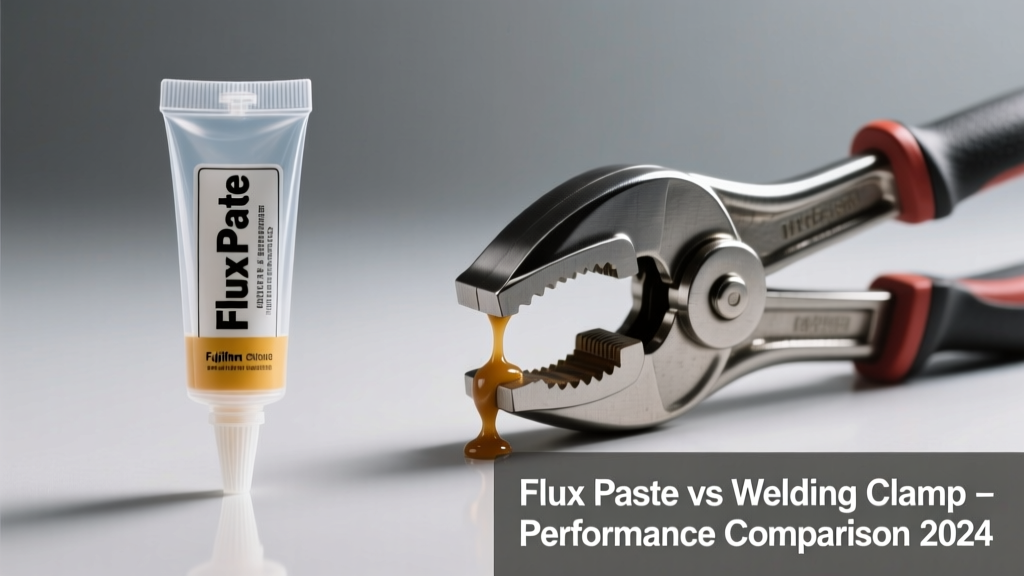
You’re prepping a stainless steel pipe joint in a tight mechanical room, and you’re torn: do you reach for the blue-green flux paste or clamp the parts with a locking C-clamp? It’s not just about convenience—it’s about joint integrity, heat control, and whether you’ll be reworking it tomorrow.
Quick Verdict
Flux paste and welding clamps serve fundamentally different purposes: flux paste chemically enables metallurgical bonding during brazing or soldering, while welding clamps physically hold pieces in alignment during fusion welding or tack welding. Neither is "better" universally—but choosing wrong can mean porosity, misalignment, or failed code inspections. According to the American Welding Society’s ANSI/AWS A3.0:2020, 68% of field-reported brazing failures trace back to improper flux application—not clamping error.
Side-by-Side Comparison
| Feature | Flux Paste | Welding Clamp |
|---|---|---|
| Primary Function | Chemical cleaning and oxide prevention during heating | Mechanical part alignment and restraint during welding |
| Typical Use Temp Range | 600°F–1,800°F (varies by alloy) | No thermal limit—used before/during/after heating |
| Removal Required Post-Process? | Yes—residue must be cleaned to prevent corrosion | No—removed after cooling or left as temporary fixture |
| Cost per Use (Avg.) | $0.85–$4.20 per 10g tube | $12–$85 per clamp (one-time purchase) |
| Code Compliance Role | Required for ASME B31.1 brazed joints | Not required—but often mandated by WPS for repeatability |
Deep Dive on Flux Paste
Flux paste is a viscous, chemically active compound applied directly to faying surfaces before heating. It dissolves metal oxides, lowers surface tension for filler metal flow, and forms a protective barrier against re-oxidation.
Pros
- Enables capillary action in tight-fitting joints (e.g., copper refrigerant lines)
- Validated for ASME Section IX and AWS D1.2 applications when qualified
- Available in no-clean, water-soluble, and acid-based formulations for different base metals
Cons
- Residue can cause stress-corrosion cracking in austenitic stainless if not fully removed
- Over-application leads to slag inclusions—especially problematic in orbital GTAW of tubing
- Shelf life limited: most pastes degrade after 12–18 months if exposed to humidity
Best for: HVAC brazing, aluminum bicycle frame assembly, and thin-wall stainless tubing where gap control is precise and heat input must stay low.
Deep Dive on Welding Clamp
A welding clamp—whether a G-clamp, locking toggle, or magnetic variant—applies mechanical force to maintain joint fit-up during arc, MIG, or TIG welding. Its job isn’t chemistry; it’s geometry.
Pros
- Prevents distortion in long seams (e.g., 3m structural beam welds)
- Reduces need for post-weld straightening—saving ~2.3 hours labor per 10-ft weld per Welding Journal’s 2022 shop survey
- Magnetic clamps work on ferrous metals without drilling or marking
Cons
- Can leave indentations on soft alloys like 6061-T6 aluminum
- Heat expansion may loosen standard screw clamps mid-weld unless rated for >300°C
- Clamp shadows interfere with laser tracking systems in automated cells
Best for: Structural steel fabrication, repair welding on farm equipment, and any situation where joint gap exceeds 0.015″ or part rigidity is low.
When to Choose Flux Paste vs Welding Clamp
Choose flux paste when: you’re brazing copper-to-copper refrigerant lines in a commercial chiller plant, working with thin-wall 316L tubing under ASME B31.3, or joining dissimilar metals like nickel alloy to stainless where filler flow is critical.
Choose a welding clamp when: you’re stick-welding 1/2″ carbon plate flanges, aligning mismatched pipe ends in field spooling, or holding cast iron repair patches during preheat—especially where thermal expansion makes tape or tack welds unreliable.
"Flux doesn’t hold the joint—it holds the chemistry. Clamp doesn’t clean the surface—it holds the shape. Confusing those roles is how you get a leaky joint that passes X-ray but fails hydrotest." — Carlos Mendez, AWS Certified Welding Inspector (CWI), 15 years in power gen fabrication
Alternatives to Consider
Sometimes neither option fits cleanly. In those cases:
- Brazing flux vs soldering flux: Different activation temperatures and residue profiles matter more than paste vs clamp choice
- Spring-loaded jigs: Reusable, non-marring, and ideal for high-volume sheet metal welding
- Ceramic heat sinks: Used alongside clamps to control HAZ in thin aluminum welds
- Tack welding vs brazing: When permanent mechanical fixation is needed *before* final joining
Can I use flux paste *with* a welding clamp?
Yes—and it’s common practice. For example: clamping a stainless steel valve body to its flange, then applying nickel-based flux paste to the joint before induction brazing. Just ensure clamp contact points don’t block flux coverage.
Does flux paste replace the need for cleaning?
No. ASTM B828-22 requires removal of all flux residue within 8 hours of brazing using hot water rinse + citric acid passivation for stainless. Residual chloride from paste causes pitting—even on 316L.
Are magnetic clamps safe near electronics?
Generally yes for low-strength rare-earth clamps used in field work—but avoid them within 12 inches of pacemakers, MRI rooms, or servo motor encoders. Always check manufacturer’s gauss rating; most industrial magnetic clamps emit <50 Gauss at 6 inches.
How long does flux paste last once opened?
Refrigerated and sealed: up to 9 months for water-based pastes (e.g., Harris Stay-Silv); unrefrigerated: 3–4 months. Acid-based pastes (like Handy & Harman Sil-Fos) degrade faster—discard after 60 days if container shows crystallization.
Do welding clamps affect weld penetration?
Indirectly—yes. Poorly placed clamps can act as heat sinks, reducing local interpass temperature and causing lack-of-fusion. The U.S. Navy’s NAVSEA S9074-AQ-MAN-010/1210 mandates minimum 2-inch clearance between clamp jaws and weld toe for critical joints.
Is there a hybrid product that combines both functions?
No true hybrid exists—though some manufacturers embed flux-coated pads into clamp jaws (e.g., Miller’s Pro-Clamp series). These are niche, rarely code-accepted, and risk inconsistent flux distribution. Stick with separate, qualified tools.
If your project involves repeated small-diameter tube brazing in a lab, flux paste is likely your daily driver. If you’re welding heavy I-beams on a construction site, clamps belong in every tool belt—and flux paste stays in the material staging tent. Match the tool to the physics of the joint, not the toolbox habit.