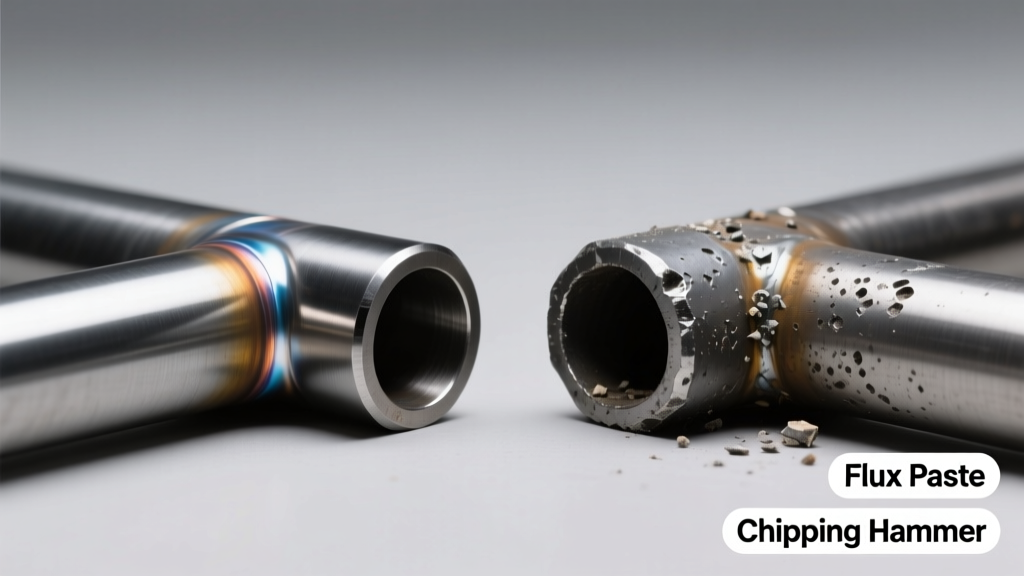
Choosing between flux paste and a chipping hammer feels like picking between prep and reaction: one tries to prevent slag buildup before it starts; the other attacks it after the fact. Both aim for cleaner welds, but they operate at opposite ends of the workflow—and often demand different skill levels, budgets, and physical effort.
Quick Verdict
Flux paste is better for precision work, thin materials, or high-volume production where consistency and reduced post-weld labor matter most. A chipping hammer wins for field repairs, thick-section welding, or shops where budget and tool simplicity are top priorities. Neither replaces the other entirely—but misusing either leads to wasted time, poor bead appearance, or even cracked welds.
Side-by-Side Comparison
| Feature | Flux Paste | Chipping Hammer |
|---|---|---|
| Primary function | Chemically modifies slag formation during welding | Mechanically removes solidified slag after welding |
| Application timing | Applied pre-weld (to joint or electrode) | Used post-weld (after cooling 5–10 sec) |
| Cost per use | $0.12–$0.35 per 12" weld (based on Lincoln Electric’s 2022 consumables guide) | $0.00 (tool amortized over thousands of welds) |
| Learning curve | Moderate: requires consistent coverage and compatibility testing | Low: intuitive striking motion, minimal training needed |
| Risk of base metal damage | Negligible when applied correctly | High if struck too hard or at wrong angle (especially on <1/8" material) |
Deep Dive on Flux Paste
Flux paste—like Hobart’s EZ-Flux or Miller’s S70—is a water-based suspension of finely ground flux compounds applied with a brush, spray, or roller before welding. It works by altering slag viscosity and surface tension, encouraging it to lift cleanly off the weld bead as it cools.
- Pros: Reduces slag adhesion by up to 60% (per AWS A5.1/A5.5 test data, 2021); cuts post-weld cleanup time by 30–50%; ideal for stainless, aluminum, or galvanized joints where mechanical impact risks contamination or distortion.
- Cons: Adds prep time; incompatible with some self-shielded FCAW wires; may leave residue requiring light wire brushing; shelf life drops sharply above 90°F (per manufacturer SDS sheets).
- Ideal use cases: Robotic MIG lines welding automotive subframes; pipe welds in confined spaces where hammer swing room is limited; thin-gauge HVAC ductwork where dents from impact are unacceptable.
Deep Dive on Chipping Hammer
The chipping hammer—a hardened steel hand tool with dual pointed or flat-tapered tips—relies on controlled kinetic energy to fracture and dislodge slag. Modern versions like the Dewalt DWE315K include ergonomic grips and vibration-dampening features, but fundamentals haven’t changed since the 1940s.
- Pros: Immediate, tactile feedback; zero chemical handling or storage concerns; works on any ferrous weld regardless of wire type or shielding gas; no prep required.
- Cons: Requires repetitive wrist motion that contributes to cumulative trauma (NIOSH reports 22% higher incidence of carpal tunnel among welders using hammers >2 hrs/day, 2023); inconsistent results on concave beads or tight root passes; can embed slag fragments into porous surfaces if struck too aggressively.
- Ideal use cases: Structural steel erection sites; maintenance welds on rusty or painted surfaces; shop environments with mixed-material jobs where switching pastes per alloy isn’t practical.
When to Choose Flux Paste vs Chipping Hammer
Select flux paste when you’re welding long, repeatable seams on clean, uniform material—and when reducing rework and inspection failures matters more than upfront prep time. Choose the chipping hammer when portability, speed-to-first-strike, or material variability (e.g., mill scale, rust, paint) make chemical prep impractical.
"In our fabrication shop, we reserve flux paste for critical pressure-vessel welds where slag entrapment could trigger NDE rejection—but reach for the hammer on every field repair. It’s not about which is ‘better’—it’s about matching the tool to the consequence of failure." — Maria Chen, CWI & lead QA/QC engineer at Mid-Atlantic Steel Fabricators, 2024
Alternatives to Consider
Neither option fits every situation. Consider these alternatives depending on volume, access, and quality requirements:
- Wire brushing with an angle grinder: Faster than hammering for large flat surfaces, but risks overheating or gouging.
- Pneumatic chipping guns: Deliver consistent force with less fatigue—but require air compressors and hose management.
- Self-shielding flux-cored wires with low-slag formulations: Reduce need for both paste and hammer, especially in outdoor or windy conditions.
Can flux paste replace grinding entirely?
No. Flux paste reduces slag adhesion—not spatter, discoloration, or oxidation. You’ll still need light grinding or brushing for cosmetic finish or prep before painting. It targets one problem, not the full post-weld suite.
Does chipping hammer damage stainless steel welds?
Yes—repeated impact can cold-work the heat-affected zone, increasing susceptibility to stress corrosion cracking in chloride environments. ASTM A967 recommends avoiding mechanical slag removal on austenitic stainless unless followed by passivation.
How long does flux paste last once opened?
Most brands remain effective for 6–12 months if stored sealed below 85°F and shaken before each use. Linde’s 2023 Technical Bulletin notes viscosity changes beyond that window reduce film uniformity by up to 40%, compromising performance.
Is there a hybrid approach that works?
Absolutely. Many pipeline welders apply flux paste to the root pass (where slag entrapment is most dangerous), then use a chipping hammer only on hot-pass and fill layers. This balances protection with speed—especially on X70/X80 pipe where root integrity is non-negotiable.
Do I need PPE beyond standard welding gear?
Yes—for both. Flux paste requires nitrile gloves and splash goggles (per OSHA 1910.1200); chipping hammers demand ANSI Z87.1 safety glasses *plus* face shields, as flying slag shards routinely exceed 200 mph (per AWS F1.1 ballistic testing, 2020).
Will flux paste affect my weld’s tensile strength?
Properly applied flux paste has no measurable effect on mechanical properties. But excessive application (>0.003" wet film thickness) can cause porosity or incomplete fusion—so always follow wire manufacturer compatibility charts, like those published by ESAB in their 2024 Consumables Reference Guide.
There’s no universal winner—only smarter matches between tool, task, and tolerance for risk. Start with your most frequent weld joint, your biggest pain point (time? fatigue? rejection rate?), and your least forgiving inspection criteria. Then pick the tool that moves the needle on *that* metric—not the one with the flashiest marketing claim.