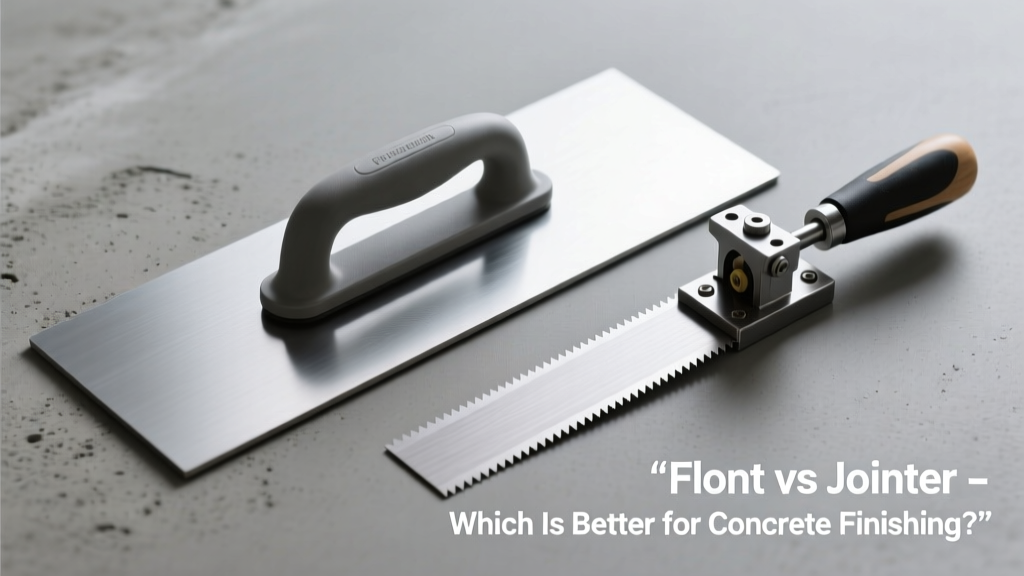
Choosing between a float and a jointer isn’t just about tool names—it’s about understanding how each shapes the surface, controls cracking, and fits into your workflow. Contractors often grab the wrong one mid-pour and pay for it in repairs or callbacks.
Quick Verdict
A float smooths and densifies; a jointer creates controlled contraction joints. You need both—but at different stages. Using a jointer instead of a float on fresh concrete will gouge the surface; using a float instead of a jointer where control joints are required invites random cracking. According to the American Concrete Institute’s ACI 302.1R-22, proper jointing must occur before final set—typically within 1–3 hours after placement—while floating happens earlier, during initial finishing.
Side-by-Side Comparison
| Feature | Concrete Float | Concrete Jointer |
|---|---|---|
| Primary function | Densifies surface, removes trowel marks, closes pores | Cuts straight, shallow grooves to guide crack location |
| Timing in pour cycle | After bull floating, before final troweling (when thumbprint leaves 1/4" indentation) | After float, before surface stiffens (thumbprint leaves no impression but resists fingernail pressure) |
| Typical depth | N/A — surface contact only | 1/4" to 1/3 the slab thickness (e.g., 1" deep in 4" slab) |
| Common materials | Magnesium, aluminum, wood, or foam-faced | Steel or carbide-tipped wheels or blades |
| Power options | Hand-held, walk-behind, or ride-on (for large areas) | Mostly hand-held or walk-behind; few ride-on models exist |
Deep Dive on Concrete Floats
Floats come in multiple forms—hand floats, darby floats, and powered versions—and serve one core purpose: refining the surface while enhancing durability and wear resistance.
Pros of Using a Float
- Improves surface density by pushing aggregate down and bringing paste to the top
- Reduces dusting and scaling risk—critical for interior slabs exposed to foot traffic
- Enables smoother transitions into troweling; skipping float often leads to tearing during steel troweling
- Wood and magnesium floats offer tactile feedback that helps gauge stiffness
Cons of Using a Float
- Over-floating can trap water and air, causing delamination or blistering
- Using too aggressive a float too early pulls aggregate to the surface (a condition called “rock popping”)
- Does nothing to manage shrinkage stress—so it cannot replace jointing
Floats excel on garage floors, warehouse slabs, and residential patios where aesthetics and abrasion resistance matter more than precise crack control. For guidance on timing, concrete float timing is critical—too early and you sink; too late and you tear.
Deep Dive on Concrete Jointers
Jointers aren’t finish tools—they’re structural insurance. They create intentional weak points so cracks form where you want them, not where they’ll compromise safety or appearance.
Pros of Using a Jointer
- Prevents random, unsightly cracks by directing shrinkage along clean, straight lines
- Meets code requirements for most commercial and municipal projects (e.g., ACI 302.1R-22, IBC Section 1908)
- Wheel-type jointers cut consistent depth and spacing without operator fatigue
- Can be used with laser-guided systems for tight tolerances on large industrial floors
Cons of Using a Jointer
- Use too late and the blade drags, smearing paste and weakening the joint
- Use too early and the joint walls collapse, reducing effectiveness
- Manual jointers require steady hands—poor alignment leads to jagged, non-functional joints
Jointers are non-negotiable on driveways over 10' wide, sidewalks longer than 15', and any slab over 4" thick. For slab-on-grade foundations, jointing also supports moisture barrier integrity. See our control joint spacing guide for exact layout rules based on slab thickness and exposure.
When to Choose a Float vs a Jointer
It’s rarely an either/or decision—it’s a sequence. But if forced to prioritize due to budget or crew size, here’s how to decide:
- Choose a float first if you’re finishing a small residential patio or interior slab with minimal shrinkage risk and no strict jointing specs.
- Choose a jointer first if you’re pouring a 20'×30' warehouse floor—even if you’ll rent a float later—because unjointed slabs almost always crack unpredictably.
- Never skip float before jointing: a rough, bumpy surface makes joint alignment inaccurate and increases blade drag.
- Never use a jointer before floating: it will catch on high spots and rip out chunks of still-plastic concrete.
The U.S. Department of Transportation estimates that improper jointing accounts for nearly 37% of premature concrete pavement failures reported in state DOT maintenance logs (FHWA Report No. FHWA-HRT-21-067, 2021).
"If you're only going to use one finishing tool, make it a float—but if you're only going to use one jointing tool, make it a jointer. One affects quality; the other affects longevity." — Maria Chen, Field Engineer, Portland Cement Association (2023)
Alternatives to Consider
While floats and jointers dominate manual finishing, newer options fill specific gaps:
- Walking power trowels combine floating and light troweling in one pass—ideal for large interior slabs but less precise for jointing
- Laser screeds eliminate the need for bull floats and improve flatness (FF/FL), but don’t replace hand floats for edge work
- Early-entry saws cut joints after initial set (6–12 hours) when hand jointers aren’t feasible—but increase labor cost and risk raveling if timed poorly
- Formed joints (pre-placed plastic or metal strips) work well for elevated slabs but add material cost and complicate formwork
For hybrid solutions, many crews now use float-and-trowel combo tools on smaller jobs—but none replicate the precision of a dedicated jointer.
Can I use a trowel instead of a float?
No. A steel trowel is too aggressive for early-stage finishing and will pull paste, cause delamination, or close the surface prematurely—blocking bleed water escape. Always float before troweling.
Do I need both magnesium and wood floats?
Not necessarily. Magnesium floats provide faster, smoother results on medium-stiff concrete; wood floats are gentler and preferred for decorative overlays or when minimizing surface sheen matters. Most pros carry one magnesium and one wood for flexibility.
Can I rent a jointer instead of buying?
Yes—and often advisable. Rental rates average $85–$140/day for walk-behind models (Home Depot & United Rentals, 2024). Given their infrequent use per project, renting avoids $1,200–$2,500 upfront cost for quality units.
What happens if I skip jointing entirely?
You’ll get random cracks—usually within 3–6 weeks—as the slab shrinks. These cracks rarely follow aesthetic lines and often widen under load or freeze-thaw cycles. Repairing them later costs 3–5× more than proper jointing upfront (Concrete Repair Association, 2022).
Is there a tool that does both floating and jointing?
No single tool performs both functions effectively. Some multi-head power trowels have optional jointer attachments, but they lack the downward force and depth control of dedicated jointers—and compromise float performance. Stick with specialized tools.
How do weather conditions affect timing?
Hot, dry, or windy conditions accelerate evaporation and shorten the window for both floating and jointing. In 90°F+ temps, the jointing window may shrink from 2 hours to under 45 minutes. Use evaporation retardants and monitor surface stiffness—not the clock—to time both operations.
Ultimately, floats and jointers answer different questions: ‘How smooth and durable should this surface be?’ and ‘Where will it crack, and how controlled will that failure be?’ Mastering both—and knowing when to deploy each—is what separates acceptable slabs from professional-grade ones. If you’re prepping for a pour, cross-check your plan against our finishing timeline cheat sheet to avoid timing traps.