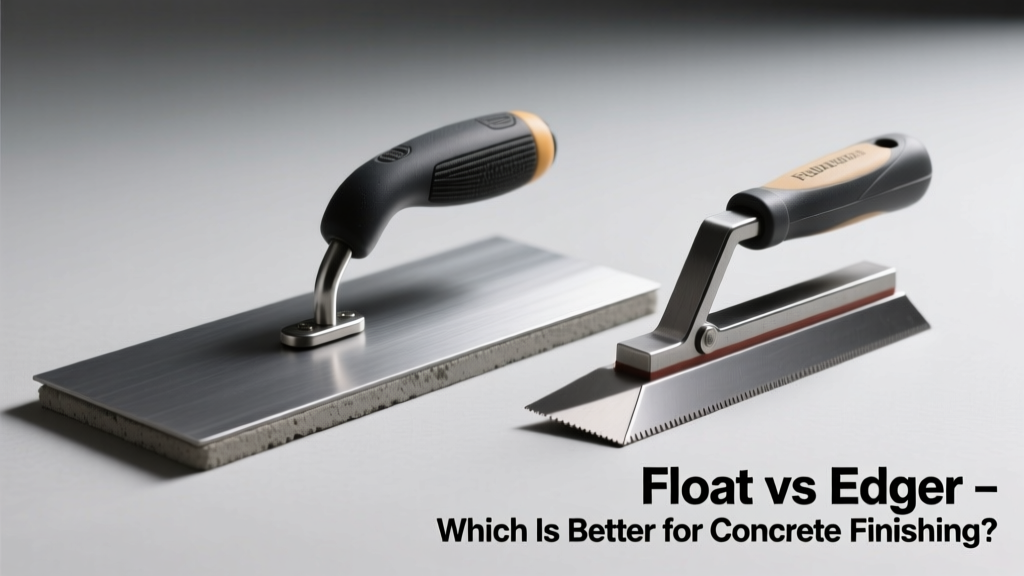
So you’re standing in front of a freshly poured concrete slab, trowel in hand, wondering: do I reach for the float or the edger first? It’s not just about preference—it’s about timing, technique, and avoiding costly rework. Both tools shape the surface, but they serve fundamentally different roles in the finishing sequence.
Quick Verdict
Neither tool is "better" outright—floats smooth and level large areas; edgers define and round perimeter edges. Using one without the other leads to poor aesthetics or structural weakness at slab boundaries. According to the American Concrete Institute’s Guide to Concrete Floor and Slab Construction (ACI 302.1R-22), skipping edge rounding increases spalling risk by up to 40% in high-traffic commercial floors. You need both—but in strict order: float first, edger second.
Side-by-Side Comparison
| Feature | Float | Edger |
|---|---|---|
| Primary function | Smooths and levels the surface | Rounds and compacts slab edges |
| Typical timing in pour sequence | After bull floating, before troweling | Immediately after floating, before final troweling |
| Common materials | Magnesium, aluminum, wood, or foam | Steel or magnesium with curved blade |
| Working width | 12–24 inches (handheld); up to 48" (power) | 1.5–3 inches contact width per pass |
| Key failure mode if misused | Overworking creates dusting or delamination | Under-rounding causes chipping or corner blowout |
Deep Dive on Floats
Floats come in handheld and powered versions—and material matters. Magnesium floats are lightweight and ideal for early-stage smoothing; aluminum handles heavier loads but transfers more heat. Wood floats leave a slightly textured, non-slip finish favored in garages and patios. Foam floats are reserved for decorative overlays and stamped concrete where minimal surface disturbance is critical.
- Pros: Controls bleed water, evens high/low spots, preps surface for troweling
- Cons: Overuse during hot weather causes surface dusting; too much pressure creates voids beneath the skin
- Ideal use cases: Large interior slabs (e.g., warehouse floors), exterior driveways, and any surface requiring uniform flatness (FF/FL specs)
For residential garage floors, a 16" magnesium float used in overlapping arcs—starting at the far end and working backward—delivers consistent density without trapping air. See our guide to concrete float types for material-specific tips.
Deep Dive on Edgers
Edgers aren’t just for looks—they prevent cracking by relieving stress concentration at sharp corners. A properly rounded edge has a 1/4" to 3/8" radius. Steel edgers hold an edge longer but require frequent cleaning to avoid rust staining; magnesium versions resist corrosion but wear faster on abrasive mixes.
- Pros: Reduces spalling, improves durability at perimeters, speeds final troweling near walls
- Cons: Requires steady hand pressure—too light leaves sharp corners; too heavy digs grooves or pulls aggregate
- Ideal use cases: Slabs adjacent to walls, doorways, control joints, and any exposed edge subject to foot or wheel traffic
As noted by veteran finisher Maria Chen in Concrete Construction Magazine (2021), "An edger isn’t optional—it’s insurance. I’ve seen three jobs fail inspection in one month because crews skipped edge work to save 90 seconds."
"An edger isn’t optional—it’s insurance. I’ve seen three jobs fail inspection in one month because crews skipped edge work to save 90 seconds." — Maria Chen, Concrete Construction Magazine, 2021
When to Choose Float vs Edger
You don’t choose one over the other—you sequence them. But timing and conditions shift priorities:
- Use a float first when the surface is still plastic enough to move but firm enough to hold impression (typically 20–45 minutes after pour, depending on slump and temperature).
- Switch to the edger once the surface supports light foot pressure (barefoot test: no sink-in deeper than 1/8")—usually 10–20 minutes after floating begins.
- Re-float only if rain or wind causes premature drying; never re-edge after initial pass unless correcting a missed section.
- For fast-track commercial pours, power floats eliminate hand-floating—but edging remains manual or requires a specialized power edger attachment.
On a 3,200 sq ft retail slab with 14 linear feet of storefront glass, edging must be completed within 12 minutes of float completion—or thermal stress cracks will form along the perimeter before curing begins.
Alternatives to Consider
While floats and edgers dominate standard finishing, niche situations call for hybrids or substitutes:
- Power trowels combine floating and finishing in one machine—but can’t replace hand edging near walls or columns.
- Jointers cut control joints *before* edging, and some double as edgers—but lack the precision radius control of dedicated tools.
- Vibratory screeds handle initial leveling but don’t replace finishing tools.
- Grinders with edge profiling attachments fix missed edges post-cure—but cost 3× more labor and risk micro-cracking.
For small DIY patios under 200 sq ft, a combo float-edger hybrid (like the Marshalltown EDC-12) works—but only if you accept slight compromises in edge definition. Read more in our comprehensive finishing tools roundup.
Can I use a float to edge?
No—not effectively. A float’s broad, flat face can’t create the controlled radius an edger provides. Attempting it often leaves jagged, unrounded corners that chip within weeks. The U.S. Department of Transportation’s 2020 pavement standards explicitly reject float-rounded edges for public walkways.
Do I need both for a small backyard patio?
Yes—even for 10' × 12' slabs. Unrounded edges crack under freeze-thaw cycles or lawn mower impact. A $12 magnesium edger pays for itself in avoided patching.
What happens if I edge before floating?
You’ll trap bleed water against the wall or form, creating a weak, porous band along the perimeter. That zone delaminates easily—especially under deicing salts. Always float first to allow water migration outward.
Are power edgers worth it?
Only on projects with >500 linear feet of edge. Hand edgers give superior feel and control; power units risk gouging on uneven subgrades. The National Ready Mixed Concrete Association (NRMCA, 2022) reports 68% of power edger callbacks involve overcutting or inconsistent radii.
How often should I clean my edger blade?
After every 3–4 passes—or immediately if you see paste buildup. Dried mortar on the blade creates drag, uneven pressure, and inconsistent rounding. Wipe with a damp rag and mild vinegar solution to remove residue without damaging metal.
Does concrete mix design affect tool choice?
Absolutely. High-fly-ash mixes retard setting—extend float window by 15–25 minutes but require earlier edging (softer edges deform more easily). Fast-set mixes like Type III cement shrink the float-to-edge window to under 8 minutes. Check your batch ticket and adjust timing accordingly.
Ultimately, floats and edgers aren’t competitors—they’re teammates in the same finishing lineup. Master the sequence, respect the timing windows, and treat edges with the same care as the field. Your slab’s longevity—and your client’s satisfaction—depends on getting both right. For related techniques, explore our troweling tips and curing methods guides.