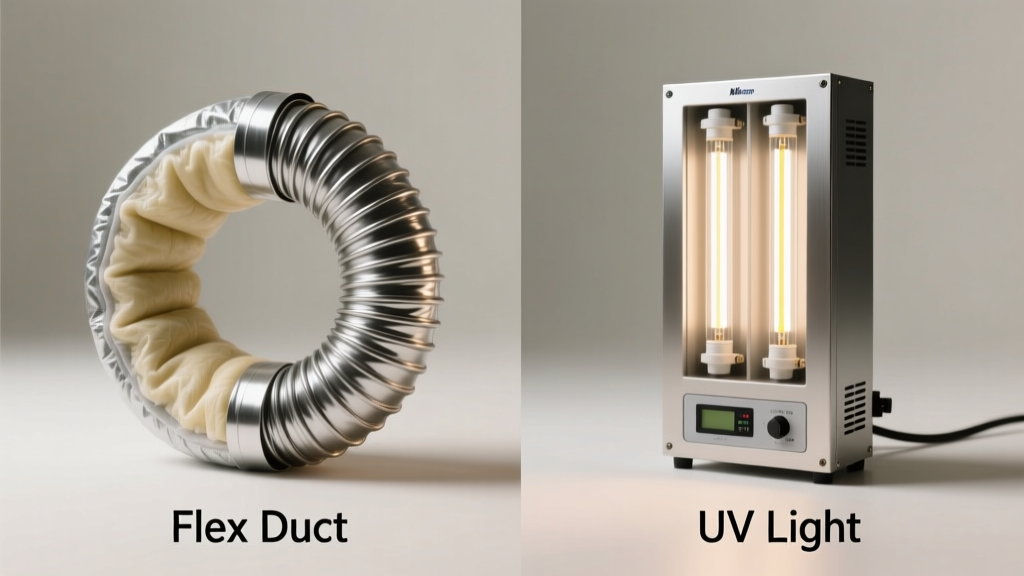
You’re troubleshooting an HVAC issue—maybe musty odors, weak airflow, or persistent mold—and you’ve landed on two very different fixes: replacing aging flex duct or installing a UV light system. They sound like solutions to the same problem, but they aren’t even in the same category. One moves air; the other kills microbes. Confusing them is common—but costly.
Quick Verdict
Flex duct and UV light serve fundamentally different purposes: flex duct is a passive air delivery component, while UV light is an active air treatment device. Neither is ‘better’ overall—but choosing wrong means wasting money or missing the root cause. If airflow is uneven or ducts are collapsed, UV light won’t help. If mold is growing inside your air handler, new flex duct won’t stop spores from circulating.
Side-by-Side Comparison
| Feature | Flex Duct | UV Light System |
|---|---|---|
| Purpose | Transfers conditioned air from HVAC unit to rooms | Inactivates bacteria, viruses, and mold spores on coils or in airstream |
| Installation Location | Between registers and main trunk lines (often in attics, crawlspaces) | Inside air handler (coil irradiation) or ductwork (air-stream irradiation) |
| Lifespan | 10–15 years (degrades with UV exposure, moisture, compression) | 9–14 months for bulbs; fixture lasts 5+ years with maintenance |
| Energy Use | None (passive) | 15–60 watts per lamp, depending on type and coverage |
| Code Compliance | Must meet UL 181B-FX or ASTM E2237 standards; improper installation violates IRC M1601.4 | No universal code mandate; ASHRAE Standard 180 recommends placement but doesn’t require it |
Deep Dive on Flex Duct
Flexible ducting—typically insulated, helical-wire reinforced, and wrapped in vapor-barrier foil—is engineered for ease of installation in tight or irregular spaces. It’s widely used in residential retrofits and attic runs because it bends around joists and pipes without custom sheet metal fabrication.
Pros
- Lower upfront cost than rigid ductwork—$1.50–$3.50/ft installed vs. $8–$15/ft for sheet metal
- Reduces labor time by up to 40% compared to rigid duct assembly (2022 NAHB Remodeling Impact Report)
- Available in standard diameters (4″–12″) and R-values (R-4 to R-8), supporting most residential load calculations
Cons
- Higher static pressure drop than smooth-walled rigid duct—up to 35% more resistance at equivalent length and velocity (ASHRAE Fundamentals Handbook, 2023)
- Prone to kinking, compression, and insulation separation if improperly supported (minimum 12″ spacing per ACCA Manual D)
- Not rated for UV exposure: sunlight degrades outer jacket within 6–12 months, increasing leakage risk
Flex duct shines when retrofitting older homes with limited access—or when budget and timeline constrain options. But it’s not a fix for microbial growth or stale air.
Deep Dive on UV Light
UV-C germicidal lamps (254 nm wavelength) disrupt DNA/RNA in microorganisms. Installed near evaporator coils or in return ducts, they reduce surface biofilm and airborne pathogen load. Effectiveness depends heavily on dwell time, lamp intensity, and lamp-to-target distance.
Pros
- Proven coil sanitation: A 2021 study in Indoor Air found UV-C reduced coil microbial load by 87% over 90 days
- Low maintenance—bulb replacement every 9–12 months, no filters to replace
- Zero impact on airflow or static pressure when properly sized and mounted
Cons
- No effect on dust, VOCs, or particulate matter—only biological contaminants
- Ozone-generating models (185 nm) violate California Air Resources Board (CARB) limits and pose health risks
- Improper placement creates shadow zones where mold thrives unchecked—e.g., behind drain pans or under coil fins
UV light works best as a supplement—not a substitute—for regular coil cleaning and filter changes. According to the U.S. EPA, UV systems alone do not replace the need for MERV 13 filtration in homes with allergy sufferers.
When to Choose Flex Duct vs UV Light
Choose flex duct if:
- You’re replacing deteriorated, leaking, or crushed ducts causing uneven heating/cooling
- Your home has inaccessible ceiling cavities or irregular framing that makes rigid duct impractical
- A duct blaster test shows >15% total system leakage (typical threshold for remediation)
Choose UV light if:
- You’ve confirmed mold growth on the evaporator coil or in the drain pan via inspection camera
- Your household includes immunocompromised individuals and you already use MERV 13+ filtration
- You’ve ruled out humidity control issues (e.g., oversized AC, poor drainage) that feed microbial growth
Alternatives to Consider
Neither option solves every HVAC problem. Before committing, evaluate these alternatives:
- Rigid metal ductwork for long-term efficiency and lower pressure drop
- In-duct HEPA filtration for particulate removal (dust, pollen, dander)
- Whole-house dehumidification to address root-cause moisture driving mold
- Duct sealing + insulation upgrades—especially for unconditioned spaces like attics
Can UV light damage flex duct?
Yes—direct UV-C exposure degrades the outer polyethylene or foil jacket of most flex duct within weeks. That’s why UV lamps should never be mounted inside or adjacent to flex duct runs. Always maintain ≥12″ clearance or use UV-reflective shielding. As HVAC engineer Maria Chen notes in her 2023 ASHRAE seminar: “UV isn’t magic—it’s physics. Place it wrong, and you’ll trade mold for leaks.”
Does flex duct improve indoor air quality?
Only indirectly—if old, leaky flex duct is pulling in attic dust or insulation fibers. New, properly sealed flex duct reduces infiltration, but it adds zero filtration or disinfection. For IAQ gains, pair it with in-duct air purifiers or upgraded filters.
How often should UV bulbs be replaced?
Every 9–12 months—even if still glowing. UV-C output degrades ~30% after 9,000 hours (typical bulb life). Use a UV radiometer to verify intensity, or follow manufacturer specs. Skipping replacement renders the system ineffective.
Is flex duct allowed in commercial buildings?
Rarely. Most commercial codes (IMC Section 603.4, IBC 2021) restrict flex duct to short connections (<6 ft) and prohibit it in plenums or concealed spaces unless listed for those uses. Rigid duct dominates for fire safety and pressure integrity.
Do UV lights work against COVID-19 or flu viruses?
Lab studies confirm UV-C inactivates SARS-CoV-2 and influenza A at appropriate doses (≥25 mJ/cm²), but real-world duct-mounted systems rarely achieve full inactivation due to short dwell time. ASHRAE states UV is a supplemental layer—not a standalone mitigation.
What’s the ROI on UV light vs duct replacement?
Flex duct replacement typically pays back in 2–4 years via energy savings (reduced fan runtime, lower static pressure). UV systems rarely show energy ROI—but may reduce service calls for mold-related complaints. A 2020 NATE survey found UV installations correlated with 22% fewer coil-cleaning callbacks over 2 years.
If your concern is airflow, reach for the duct tape (and a duct blaster). If it’s mold, mildew, or recurring odors from the air handler—UV light belongs on your list. Just remember: one moves air, the other mutates microbes. They don’t compete—they complement. And sometimes, what you really need is neither: just a better filter, tighter seals, or a dehumidifier working quietly in the background.