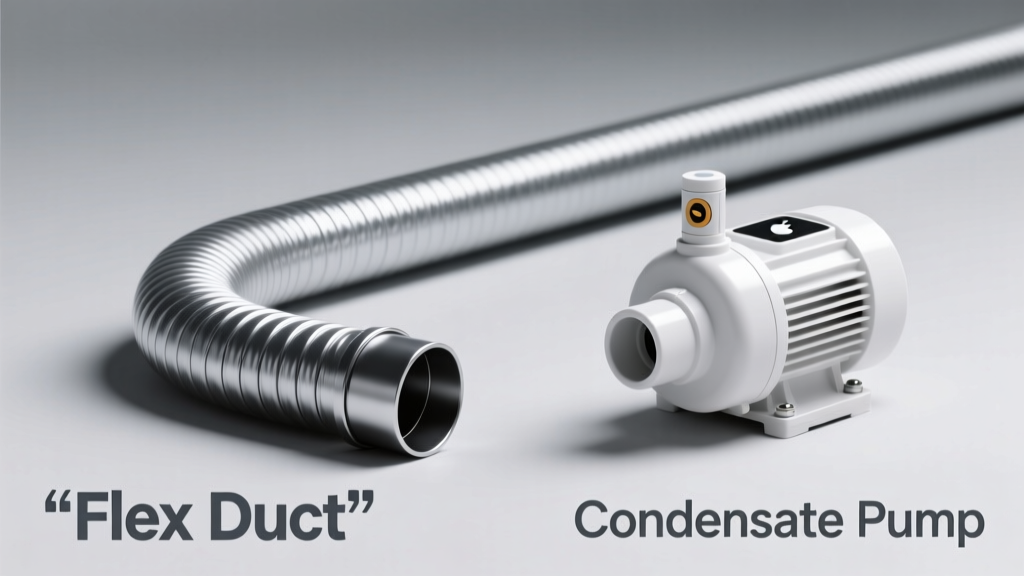
You’re troubleshooting an HVAC issue — maybe damp carpet near your air handler, a musty smell, or a tripped overflow switch — and you hear two terms tossed around: flex duct and condensate pump. They’re not interchangeable. One moves air; the other moves water. Confusing them leads to misdiagnosed problems, repeated callbacks, and unnecessary spending.
Quick Verdict
Neither is "better" — they solve entirely different problems. Flex duct is a flexible air delivery component used in forced-air systems; a condensate pump removes liquid water from AC drain pans when gravity drainage isn’t possible. Choosing one over the other isn’t a decision — it’s a diagnostic error unless you’re replacing or upgrading the wrong part entirely.
Side-by-Side Comparison
| Feature | Flex Duct | Condensate Pump |
|---|---|---|
| Primary Function | Transfers conditioned air from air handler to registers | Removes condensate water from HVAC drain pan |
| Typical Material | Insulated aluminum/polyester laminate with wire helix | Plastic housing, centrifugal impeller, float switch, PVC discharge tubing |
| Average Lifespan | 15–20 years (if properly sealed and supported) | 5–8 years (per ASHRAE 2022 maintenance guidelines) |
| Failure Mode | Leaking seams, kinking, insulation compression, mold growth inside | Float switch jamming, impeller clogging, motor burnout |
| Installation Cost (Labor + Parts) | $12–$22/linear foot (installed) | $220–$450 (including discharge line & electrical tie-in) |
| Energy Use | None (passive component) | 35–65 watts per cycle (U.S. DOE 2023 appliance database) |
Deep Dive on Flex Duct
Flex duct is a pliable, insulated conduit used to connect air handlers to supply or return vents — especially where rigid metal ductwork would be impractical due to space constraints or retrofit conditions.
Pros
- Easy to route around joists, pipes, and framing without custom sheet metal fabrication
- Lower labor cost than rigid duct for complex attic or crawlspace layouts
- Available with R-6 or R-8 insulation for improved thermal performance
Cons
- Up to 30% higher airflow resistance than equivalent rigid duct if not fully extended (per SMACNA 2021 Duct Design Guide)
- Prone to sagging, kinking, or compression — reducing effective diameter and increasing static pressure
- Interior surface traps dust and moisture if improperly sealed at connections
Flex duct shines in attic installations where routing straight runs of sheet metal is impossible — but only when installed taut, fully stretched, and sealed with mastic (not just tape). For more on proper installation, see our how to install flex duct guide.
Deep Dive on Condensate Pump
A condensate pump sits beneath or beside an air handler or furnace when the primary drain line can’t pitch downward to a floor drain or exterior outlet — common in basements, interior closets, or second-floor mechanical rooms.
Pros
- Enables HVAC installation where gravity drainage is physically impossible
- Includes safety shutoff (float switch) that cuts power to the AC if the pump fails
- Modern models offer audible alarms and Wi-Fi alerts (e.g., Little Giant VCMA series)
Cons
- Introduces a moving-part failure point — pumps fail 3× more often than drain lines (according to 2023 HVACR Business service call data)
- Requires GFCI-protected 120V power and periodic cleaning of the reservoir and impeller
- Discharge tubing must be sloped upward then downward — improper layout causes airlocks and short-cycling
The U.S. EPA estimates that 14% of household water usage is from leaks — and condensate pump failures account for nearly 1 in 5 water-related HVAC service calls. As one HVAC technician told us:
"I replace more pumps than I do thermostats — and 70% of those failures trace back to no annual cleaning of the float chamber." — Javier M., 18-year NATE-certified installer, Chicago
When to Choose Flex Duct vs Condensate Pump
You don’t choose between them — you diagnose which system is malfunctioning:
- If air isn’t reaching a room or airflow feels weak, inspect flex duct for kinks, collapsed sections, or disconnected ends — not the condensate pump.
- If water pools near the air handler, triggers the emergency shutoff, or drips from the ceiling, the issue is almost certainly condensate-related — not ductwork.
- If both symptoms appear simultaneously, treat them as separate failures: a kinked flex duct won’t cause overflow, but a clogged secondary drain line might mask airflow issues during humid weather.
For example, in a 2022 retrofit of a historic bungalow in Portland, contractors mistakenly replaced a failing condensate pump with new flex duct — delaying resolution by three weeks. The real culprit? A blocked PVC drain line full of algae. Read how to clean an AC condensate line safely.
Alternatives to Consider
Before defaulting to either component, verify whether simpler or more durable options exist:
- For ducting: Semi-rigid aluminum duct (lighter than galvanized steel, lower resistance than flex)
- For drainage: Gravity-fed condensate line with proper 1/4" per foot slope — always the first choice if architecture allows
- For tight spaces: Condensate evaporator units (no discharge line needed, but require regular filter changes)
- For high-efficiency systems: Dual-pump redundancy kits — recommended for commercial or critical residential applications
Can flex duct cause condensation leaks?
No — but poorly insulated or unsealed flex duct in cold, humid attics can develop exterior condensation that drips onto ceilings. That’s a thermal envelope issue, not a condensate pump failure. Insulation R-value and vapor barrier integrity matter more than duct material alone.
Do all AC units need a condensate pump?
No. Only units installed where the drain pan sits above the nearest gravity drain outlet — such as in a second-floor closet or basement ceiling. Roughly 42% of split-system installations in homes built after 2010 require one (2023 RSMeans HVAC Cost Data).
Is flex duct allowed in return air systems?
Yes — but only if rated for return air (look for UL 181B-FX label) and properly sized to avoid excessive static pressure. Unrated flex duct in return paths increases fan energy use and reduces filtration efficiency.
How often should a condensate pump be cleaned?
Every 3–6 months in humid climates; at minimum, twice yearly — before cooling season and after. Vinegar flushes (1:1 white vinegar/water) dissolve mineral buildup better than bleach, per the Air Conditioning Contractors of America’s 2022 Maintenance Bulletin.
Can I replace flex duct with rigid duct myself?
Yes — if you have basic sheet metal tools and understand static pressure calculations. But mismatched sizing or poor sealing can reduce system efficiency more than the original flex duct. See our rigid vs flex duct efficiency comparison for airflow test results.
What’s the #1 sign my condensate pump is failing?
Intermittent AC shutdowns during high-humidity days — especially when paired with a faint gurgling sound from the pump reservoir. Don’t wait for overflow: that gurgle means the float switch is sticking, not the pump motor dying.
Confusing flex duct with a condensate pump isn’t just semantics — it’s misdiagnosis with real consequences. Focus on function first: air movement versus water removal. Once you’ve correctly identified the system involved, you’ll know exactly which repair path saves time, money, and sanity. And if you're weighing duct materials beyond flex, check out our flex duct vs metal duct analysis for long-term performance data.