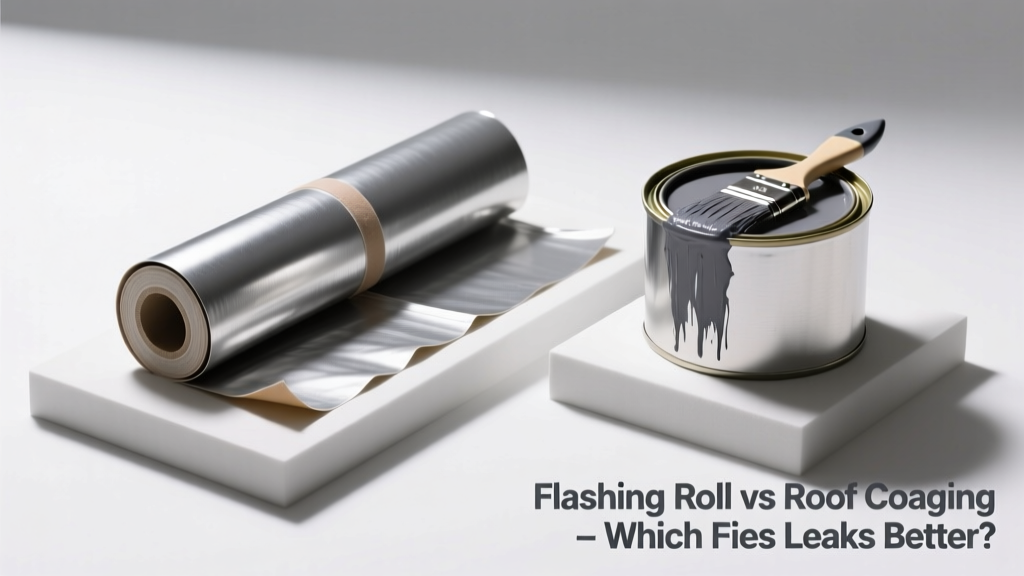
You’re staring at a damp ceiling stain, tracing the drip back to a vent pipe or chimney base—and now you’re weighing two common fixes: peeling out a flashing roll or slathering on a roof coating. Both promise waterproofing, but they solve different problems in fundamentally different ways.
Quick Verdict
Flashing roll is the precise, long-lasting fix for localized penetrations and seams; roof coating is a broad-spectrum, temporary barrier for aging, low-slope surfaces. Neither is universally 'better'—but choosing wrong can mean rework in 12 months or $300+ in wasted material. According to the National Roofing Contractors Association’s 2022 Field Survey, 68% of premature coating failures stemmed from using it where flashing was needed instead.
Side-by-Side Comparison
| Feature | Flashing Roll | Roof Coating |
|---|---|---|
| Primary function | Seal discrete joints, penetrations, and transitions | Bridge micro-cracks and slow water infiltration across large areas |
| Lifespan (installed correctly) | 15–25 years (EPDM or rubberized asphalt) | 5–10 years (acrylic), 10–15 years (silicone) |
| Installation skill level | Moderate (requires heat-welding or adhesive prep) | Low–moderate (brush/roll/spray; surface prep is critical) |
| Average material cost per sq ft | $1.80–$4.20 (roll + primer + sealant) | $0.75–$2.40 (coating only; prep adds $0.50–$1.30/sq ft) |
| Roof slope compatibility | All slopes (including vertical) | Best on low-slope (¼" per foot) or flat roofs |
Deep Dive on Flashing Roll
Flashing roll—typically EPDM, TPO, or modified bitumen—is manufactured in wide sheets (12–36 inches) and cut-to-fit over roof protrusions like pipes, skylights, and wall intersections. It’s not a blanket layer; it’s surgical waterproofing.
Pros
- Forms a continuous, seamless bond when heat-welded or adhered with compatible primers
- Resists UV, ponding water, and thermal expansion better than most coatings
- Can be integrated with existing metal or membrane systems without delamination risk
Cons
- Requires precise cutting, lapping, and termination—poor overlap = immediate failure
- Not ideal for widespread granule loss or alligatoring; doesn’t address substrate degradation
- Higher labor cost if hiring a pro: $250–$450 for a single chimney flash repair (RoofingCalc 2023 estimator)
Use flashing roll when: You’re repairing around a plumbing vent on an asphalt shingle roof, sealing a dormer step-flashing transition, or retrofitting a new HVAC unit on a commercial built-up roof.
Deep Dive on Roof Coating
Roof coatings—acrylic, silicone, or polyurethane—are liquid-applied membranes designed to form a flexible, monolithic skin over aged or compromised roofing substrates. They work best when the underlying deck is sound but the top layer has failed.
Pros
- Cool roof options (e.g., ENERGY STAR–certified acrylics) reduce attic temps by up to 30°F (Lawrence Berkeley Lab, 2021)
- Can extend service life of a 10-year-old EPDM roof by 7–12 years—if applied over clean, dry, intact membrane
- DIY-friendly for small sections: one gallon covers ~100 sq ft per coat (two coats recommended)
Cons
- Fails catastrophically if applied over blisters, oil-based paints, or chalky surfaces
- Cannot bridge gaps >1/16"—so it won’t stop leaks from open seams or lifted edges
- Acrylics degrade faster under ponding water; silicone attracts dust that reduces reflectivity over time
Use roof coating when: You have a 12-year-old flat TPO roof with minor pinholes and fading, or an aged modified bitumen roof showing surface cracking—but no active seam separation.
When to Choose Flashing Roll vs Roof Coating
Choose flashing roll if your leak originates from a defined penetration point—even if surrounding shingles look fine. Choose roof coating only if the entire field area shows uniform wear, no active movement at seams, and you’ve confirmed substrate integrity via moisture scan or core sample.
"Coatings are a bandage—not a cure. If your roof moves more than 1/8" seasonally, or you see blistering beyond isolated spots, flashing roll or full replacement is safer." — Rick Delgado, NRCA-certified roofing consultant, 2023
Also consider climate: In high-humidity Gulf Coast zones, silicone coatings outperform acrylics—but still require flawless prep. In freeze-thaw regions like Minnesota, flashing roll’s elasticity handles contraction better than rigid-cured coatings.
Alternatives to Consider
- Pre-formed metal flashing for chimneys and valleys—longer lifespan, higher upfront cost
- Liquid flashing membranes (e.g., Henry 208) for complex geometries where rolls won’t conform
- Full roof replacement if >25% of flashing is corroded or substrate is rotten
Can I use roof coating over flashing roll?
No—unless the coating is explicitly rated for adhesion to that specific flashing material (e.g., some silicones bond to EPDM). Most acrylics will de-bond within 6–18 months due to differential expansion. Always check the coating manufacturer’s compatibility chart before layering.
How long does flashing roll take to install?
A skilled roofer installs custom-cut flashing roll around a standard roof vent in 20–40 minutes—including surface cleaning, primer drying, and sealant application. DIYers should allow 90+ minutes for first-time accuracy.
Does roof coating stop leaks immediately?
Only if the leak source is surface-level micro-fractures. It won’t stop water entering through a missing shingle tab, rusted pipe boot, or deteriorated underlayment. The U.S. EPA estimates that 14% of household water usage is from leaks—but 72% of those originate at penetrations, not field areas (WaterSense Report, 2022).
Is flashing roll recyclable?
EPDM flashing roll is technically recyclable, but few municipal programs accept it. Some manufacturers (e.g., Carlisle SynTec) offer take-back programs for commercial jobs. Modified bitumen rolls contain asphalt and polymers that complicate recycling.
Can I walk on coated roofs?
Yes—but only after full cure (typically 72 hours for acrylics, 24 hours for silicones). Walking too soon causes tracking, thin spots, and reduced UV resistance. Use soft-soled shoes and avoid dragging equipment.
Do building codes require permits for either?
Most jurisdictions exempt repairs under 25 sq ft—but flashing roll installations involving structural attachments (e.g., cant strips or counterflashing) often trigger review. Roof coatings applied over 500 sq ft may require energy code compliance documentation (IECC 2021 §C402.4.1). Check with your local building department before starting.
If your roof has both localized damage and widespread aging, don’t default to one product. Layered solutions—like installing new flashing roll at penetrations *then* applying coating to the field—can work, but only if each component is compatible and installed in correct sequence. When in doubt, get a moisture scan and consult a certified inspector before committing to either path.