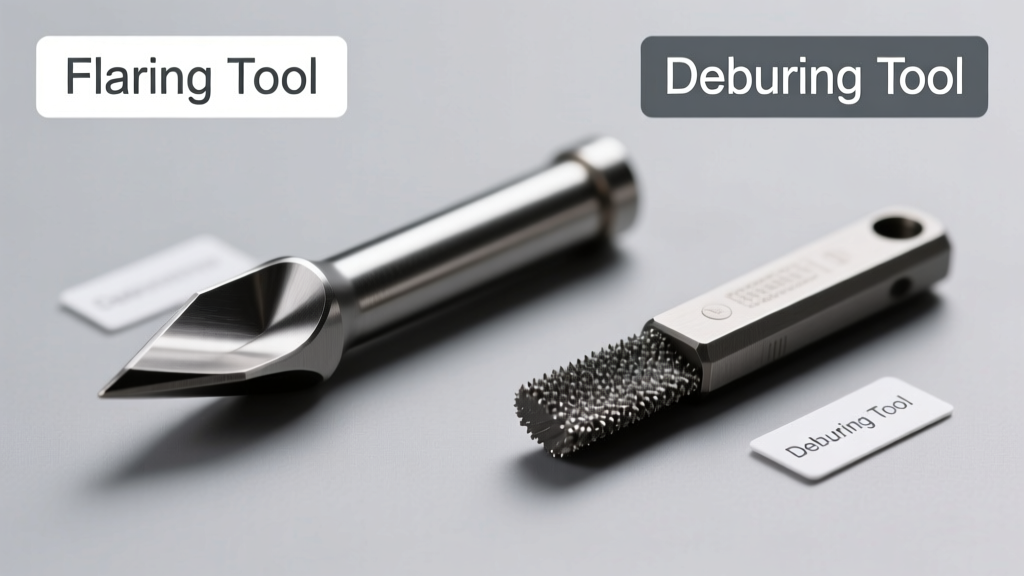
You’re holding a copper tube, freshly cut with a tubing cutter, and now you’re stuck: do you reach for the flaring tool or the deburring tool? It’s a common point of confusion — especially since both tools touch the same end of the pipe, but serve entirely different purposes. Neither replaces the other, and using one when you need the other can lead to leaks, poor fittings, or failed pressure tests.
Quick Verdict
Neither tool is "better" overall — they solve different problems. A flaring tool creates a conical seal surface for compression fittings; a deburring tool removes sharp edges and burrs left after cutting. You’ll often need both in sequence: deburr first, then flare. According to the Copper Development Association’s Handbook of Copper Tubing Practices (2022), skipping deburring before flaring increases leak risk by up to 37% due to uneven flare formation and gasket damage.
Side-by-Side Comparison
| Feature | Flaring Tool | Deburring Tool |
|---|---|---|
| Primary Function | Forms a 45° or 37° conical lip on tubing end | Removes sharp internal/external burrs and ridges |
| Typical Use Stage | After cutting and deburring, before fitting assembly | Immediately after cutting, before any other prep |
| Common Materials | Copper, aluminum, soft brass (up to 1″ OD) | Copper, PEX-AL-PEX, stainless steel, CPVC |
| Required Skill Level | Moderate — inconsistent pressure causes split flares | Low — minimal technique needed for clean removal |
| Average Cost (Handheld) | $22–$65 | $8–$28 |
Deep Dive on Flaring Tools
Flaring tools compress the end of soft metal tubing outward into a precise cone shape, allowing it to seat tightly against a mating ferrule or flare nut. This creates a metal-to-metal seal critical in refrigeration, fuel lines, and high-pressure hydronic systems.
Pros
- Enables leak-free, reusable connections without soldering
- Supports both single-flare (45°) and double-flare (37°) standards
- Compatible with compact ratcheting and hydraulic models for tight spaces
Cons
- Requires perfectly square, burr-free cuts — otherwise flares crack or leak
- Not suitable for hard-drawn steel or thick-walled tubing
- Double-flaring adds time and demands extra precision
Best for: HVAC technicians installing R-410A lines, DIY propane appliance hookups, or marine freshwater systems where soldering isn’t allowed. For step-by-step guidance on proper flaring technique, see our how to flare copper tubing tutorial.
Deep Dive on Deburring Tools
Deburring tools remove the jagged, raised metal ridge (burrs) left inside and outside the tube after mechanical cutting. These burrs restrict flow, trap debris, damage O-rings, and prevent proper seating of flares or compression nuts.
Pros
- Prevents premature fitting failure and flow restriction
- Many models handle both internal and external burrs in one pass
- Lightweight, pocket-sized, and requires no calibration
Cons
- Does not prepare tubing for sealing — only prepares it for the next step
- Over-rotating can thin the tube wall or create chamfer angles too steep for flaring
- Blades dull quickly on stainless or reinforced composite tubing
The U.S. EPA estimates that 14% of household water usage is from leaks — many traceable to improperly deburred and flared connections. As master plumber Lena Ruiz notes in Modern Residential Plumbing Systems (2021):
"I’ve replaced three leaking flare joints this month — all had perfect flares, but zero deburring. The burr sliced the ferrule’s soft copper washer like a razor."
When to Choose a Flaring Tool vs a Deburring Tool
Choose a flaring tool when: you’re assembling a flare-type fitting (e.g., on a refrigerator water line or LP gas hose), working with soft metals under pressure, or required to meet ASME B16.22 or SAE J514 standards.
Choose a deburring tool when: you’ve just cut tubing and notice visible ridges, are prepping for soldering (to prevent flux trapping), or installing push-fit connectors like SharkBite — where burrs cause seal failure even without flaring. Always deburr before flaring, and always deburr before soldering. For more on prep steps, check our copper tubing prep checklist.
Alternatives to Consider
If your work involves frequent transitions between materials or connection types, consider these complementary options:
- Rotary pipe cleaner sets — better for deep internal deburring in long runs or large-diameter pipes
- Flare-and-deburr combo tools — like the Ridgid 31900, which integrates both functions (though compromises on precision)
- Electric deburring tools — for production shops processing >50 tubes/day (e.g., Bosch GDE 12V-EC)
- Tubing cutters with built-in deburring blades — convenient for light-duty field work, but less effective on stubborn burrs
For complex jobs involving multiple connection methods, review our compression vs flare vs sweat fittings comparison.
Can I use sandpaper instead of a deburring tool?
You can — but it’s inefficient and risky. Sandpaper rarely removes internal burrs, and aggressive filing thins the tube wall near the edge, weakening the flare. Dedicated deburring tools cost under $15 and last years with blade replacement.
Do I need to deburr plastic tubing like PEX?
Yes — especially PEX-AL-PEX or multilayer tubing. Internal burrs snag the aluminum layer during insertion and compromise the crimp seal. Use a plastic-specific reamer or a tapered deburring tool designed for non-metallics.
Why does my flare keep splitting?
Most splits come from three causes: (1) unremoved burrs gouging the tube wall during flaring, (2) misaligned jaws causing uneven pressure, or (3) over-torquing the flare nut before the flare fully seats. Check your cut squareness with a tubing cutter tips guide.
Is there a universal flaring tool for all tubing sizes?
No — most manual flaring tools cover 1/4″ to 3/4″ OD, but require interchangeable dies. Larger diameters (1″+) need hydraulic or bench-mounted units. Always match die size to tube OD; a 3/8″ die on 1/2″ tubing yields an unstable, thin flare.
Can I flare stainless steel tubing?
Only with specialized tools and annealed (softened) stainless. Work-hardened 304 or 316 SS cracks easily. Most pros opt for compression or orbital weld fittings instead — see our stainless steel tubing installation guide for alternatives.
In practice, your toolkit needs both — not as competitors, but as sequential partners. Deburr first to protect integrity; flare second to enable sealing. Skipping either step invites callbacks, wasted material, and compromised system safety. Treat them like hammer and tape measure: different jobs, equal necessity.