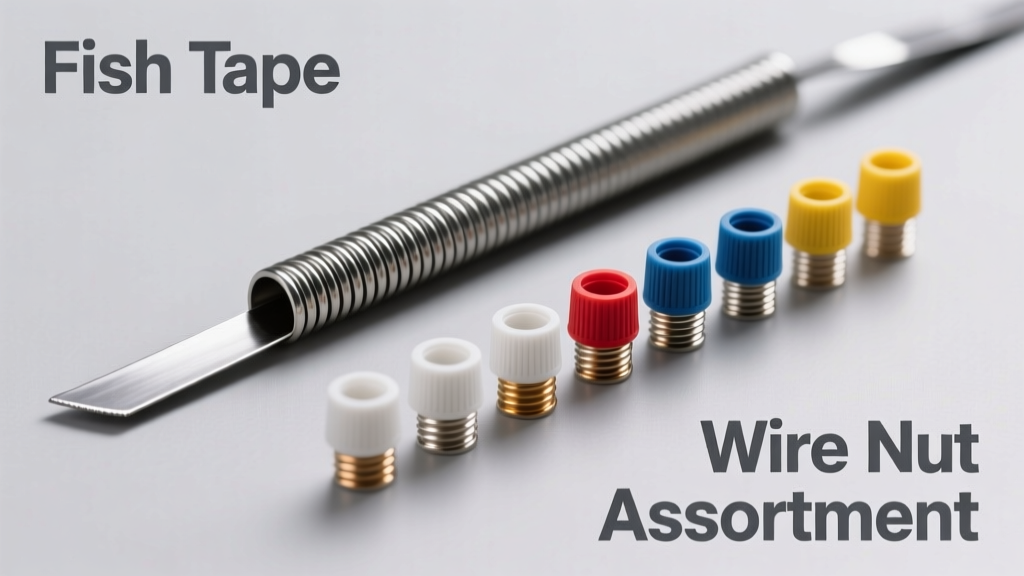
You’re standing in your garage or basement, holding a bundle of Romex and wondering: do I need fish tape to pull wires through walls, or should I grab that wire nut assortment I bought last year? It’s not a silly question — these tools serve fundamentally different jobs, yet both appear in nearly every electrician’s toolkit and DIYer’s drawer.
Quick Verdict
Fish tape is for routing wires — guiding them through conduits, walls, and ceilings. A wire nut assortment is for connecting wires — joining conductors safely and securely. Neither replaces the other. Choosing one over the other isn’t about superiority; it’s about matching the tool to the task. Using fish tape to splice wires violates NEC Article 110.14(B) and creates an immediate safety hazard.
Side-by-Side Comparison
| Feature | Fish Tape | Wire Nut Assortment |
|---|---|---|
| Primary Function | Routing wires through concealed spaces | Electrically joining insulated conductors |
| Typical Materials | Spring steel, fiberglass, or nylon | Thermoplastic (nylon/polypropylene) with internal metal spring |
| UL Listing Requirement | Not UL-listed (tool, not component) | UL 486A-B certified (required for permanent installations) |
| Average Lifespan | 5–10 years with proper care (steel degrades if kinked) | Indefinite shelf life; performance drops after ~10 years of UV exposure or extreme heat |
| NEC Compliance Role | No direct NEC reference (used as installer aid) | Mandatory per NEC 110.14(B) for splices in accessible locations |
Deep Dive on Fish Tape
Fish tape is a flexible, retractable guide used to feed new cable behind drywall, through EMT conduit, or across attic joists. Standard 25- to 100-foot lengths come in steel (stiff, high-torque), fiberglass (non-conductive, bend-resistant), and nylon (lightweight, low-friction).
Pros
- Enables single-person wire pulls in tight or inaccessible cavities
- Steel variants handle up to 150 lbs of pull force (per Klein Tools’ 2022 spec sheet)
- Fiberglass models are OSHA-compliant for use near live circuits up to 1,000 V
Cons
- Steel tapes kink easily — once bent beyond 90°, they jam or break mid-run
- Cannot be used as a conductor, jumper, or grounding path (per NFPA 70E Section 130.5)
- Useless without a secure anchor point (e.g., existing cable, screw eye, or magnet)
Best for: Retrofitting outlets in finished walls, adding circuits to older homes, pulling THHN through ½" EMT, or feeding low-voltage cable behind baseboards. Avoid using fish tape where sharp bends exceed 360° — you’ll spend more time retrieving it than pulling wire.
Deep Dive on Wire Nut Assortment
A wire nut assortment contains multiple sizes (e.g., red, yellow, orange, tan) designed for specific conductor combinations — from 2×14 AWG to 6×22 AWG — and rated for voltage (typically 600V) and temperature (usually 105°C). The internal spring compresses conductors while the thermoplastic shell insulates the splice.
Pros
- UL-certified for permanent residential wiring when installed per manufacturer torque specs
- Color-coding reduces misapplication (e.g., Ideal’s 2023 catalog confirms red = 3–4×14 AWG)
- Reusable only if undamaged — but never reuse after overheating or visible melting
Cons
- Improper sizing causes arcing: Under-torqued nuts allow vibration-induced loosening; oversized nuts won’t grip smaller wires
- Not approved for aluminum-to-copper splices unless specifically labeled (e.g., AlumiConn or Copalum)
- Cannot be buried in plaster or concrete without a junction box — NEC 300.15 requires accessibility
According to the U.S. Electrical Safety Foundation International’s 2022 incident report, 12% of residential electrical fires involved improperly installed wire connectors — most commonly undersized or overtightened wire nuts.
“If the wire nut spins freely after hand-tightening, it’s too big. If insulation is cut or stripped back less than ¾ inch, it’s too small.” — Mike Hiltz, Master Electrician & NEC Code Trainer, 2023
When to Choose Fish Tape vs Wire Nut Assortment
Choose fish tape when:
- You’re installing new NM-B cable into a stud bay with no existing wires
- You need to route coax or Cat-6 from a basement panel to a second-floor office
- You’re fishing wires around HVAC ductwork or past fire blocking
Choose a wire nut assortment when:
- You’re splicing 12/2 NM-B in a ceiling box to connect a light fixture
- You’re extending a circuit by joining two runs of THHN inside a junction box
- You’re repairing a damaged section of branch-circuit wiring (with proper box access)
Never substitute one for the other — and never use a wire nut to pull wire, or fish tape to make a splice. Both violate code and compromise safety.
Alternatives to Consider
If your project demands something beyond basic fish tape or wire nuts, consider these code-compliant options:
- Push-in wire connectors — faster installation for 14–12 AWG, UL-listed, but higher failure rate in high-vibration environments (per IEEE Transactions on Industry Applications, 2021)
- Conduit fishing tools — specialized magnets, glow rods, and vacuum systems for long or complex conduit runs
- Wago lever-nut connectors — reusable, tool-free, and rated for stranded and solid copper — ideal for panels and control cabinets
Can I use a wire nut to pull wire?
No. Wire nuts are not rated for tensile load. Applying pull force risks stripping the internal spring, exposing bare conductors, and creating a shock or fire hazard. Always use a proper fish tape or pulling rope — never improvise with connectors.
Do I need different fish tapes for metal vs PVC conduit?
Yes. Steel fish tape works well in rigid metal conduit (RMC) and EMT, but can scratch or bind in PVC. For PVC, use fiberglass or nylon tape — smoother surface, lower friction, and non-marring. Klein Tools’ 2023 Conduit Compatibility Guide recommends fiberglass for Schedule 40 PVC runs longer than 20 feet.
Are all wire nut colors standardized?
Mostly — but not universally. Ideal, Gardner Bender, and Thomas & Betts follow similar color codes (yellow = 2–3×14 AWG), but always verify the packaging’s listed capacity. Some budget brands deviate: a “red” nut from a no-name brand may only handle 2×12 AWG, not the standard 3–4×14 AWG.
Can I reuse a wire nut after removing it?
Only if it’s undamaged, shows no discoloration, and retains full spring tension. Twist it onto bare wires by hand — if it spins freely or doesn’t bite within 1–2 turns, discard it. Reuse increases risk of cold joints, especially with aluminum wire.
Is there a fish tape alternative for tight spaces?
Yes — flexible glow rods (like the Greenlee 524G) work in narrow gaps and offer visual confirmation via LED tip. They’re less durable than steel tape but excel in shallow wall cavities or behind cabinets where torque matters less than visibility.
What’s the minimum wire strip length for wire nuts?
Per UL 486A-B and manufacturer instructions, strip ¾ inch for 14–12 AWG, 7⁄8 inch for 10 AWG, and 1 inch for 8 AWG. Too short = poor contact; too long = exposed copper beyond the shell. Always twist conductors together *before* applying the nut — don’t rely on the nut to do the twisting.
Bottom line: fish tape moves wires. Wire nuts join them. Confusing the two invites code violations, callbacks, or worse. Keep both in your kit — but use each exactly as intended. For more on safe splicing methods, see our guide on how to splice electrical wires, and for conduit-specific routing tips, check out best conduit fishing tools.