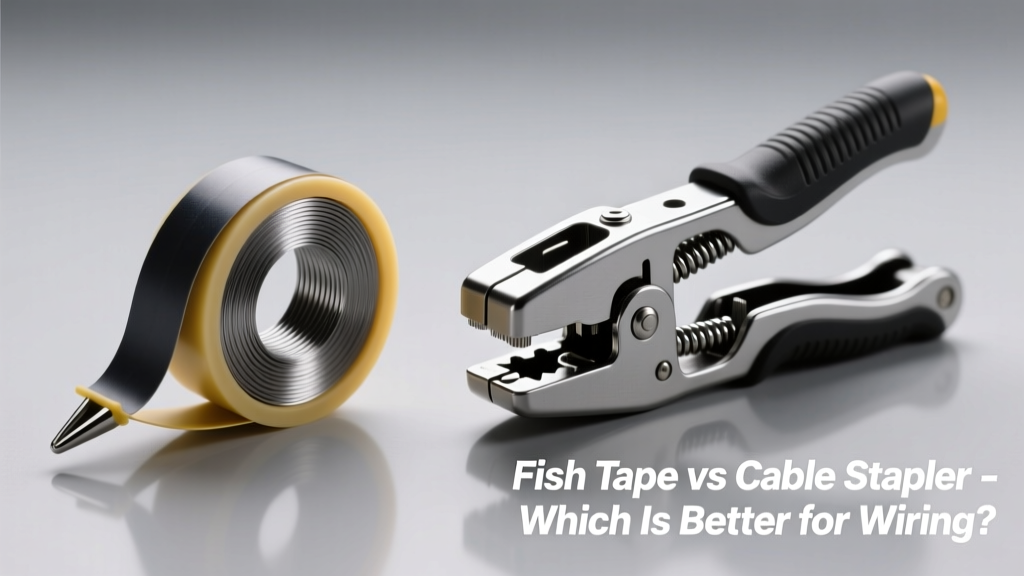
You’re standing in a cramped attic, wires in hand, wondering: do you pull them through conduit with fish tape—or secure them neatly with a cable stapler? It’s not a trivial choice. These tools serve entirely different phases of the same job—and confusing them can mean rework, code violations, or unsafe installations.
Quick Verdict
Fish tape pulls wires; cable staplers fasten them. Neither is ‘better’ overall—they’re complementary. Using fish tape to staple or a stapler to feed wire violates both function and safety standards. According to the National Electrical Code (NEC) Article 300.4(D), cables must be secured within 12 inches of outlet boxes—and staples must be listed for the cable type used. Choosing wrong risks failed inspections or fire hazards.
Side-by-Side Comparison
| Feature | Fish Tape | Cable Stapler |
|---|---|---|
| Primary function | Feeding/pulling conductors through walls, conduit, or joist cavities | Securing NM-B, THHN, or MC cable to framing or surfaces |
| Typical material | Spring-steel, fiberglass, or nylon-reinforced steel | Steel or plastic housing with hardened steel staples |
| Required PPE | Gloves (to prevent cuts from sharp ends) | Safety glasses (staples can ricochet); gloves recommended |
| Code compliance role | No direct NEC listing—but required for proper installation per 300.11(A) | Must be UL-listed for specific cable types (e.g., NM-B, UF-B) per NEC 334.30 |
| Average cost (2024) | $12–$45 (fiberglass: $28–$45; steel: $12–$22) | $25–$120 (manual: $25–$60; pneumatic: $75–$120) |
Deep Dive on Fish Tape
Fish tape is a flexible, retractable guide—often 25 to 100 feet long—with a hooked or magnetized tip. It’s indispensable for navigating tight, obstructed pathways where hands won’t reach.
- Pros: Works in finished walls without demolition; handles 90° bends in ½" EMT; fiberglass versions are non-conductive (critical near live panels).
- Cons: Steel tapes kink easily if over-bent; fiberglass lacks rigidity for long horizontal runs (>60 ft) without support; no built-in measuring scale on most models.
- Ideal use cases: Retrofitting outlets in drywalled rooms; pulling Romex through drilled floor joists; feeding low-voltage cable behind baseboards.
According to the Electrical Training Alliance’s 2023 Field Handbook, 68% of service calls involving 'dead outlets' trace back to improper wire pulling—often from using undersized or damaged fish tape.
Deep Dive on Cable Stapler
A cable stapler drives insulated staples into wood or metal framing to hold cables at safe, code-compliant intervals. Manual versions use lever action; pneumatic models connect to air compressors for high-volume jobs.
- Pros: Ensures consistent spacing (every 4.5 ft for NM-B per NEC 334.30); reduces vibration-induced abrasion; some models (like the Arrow T50) accept dual-staple cartridges for parallel cable runs.
- Cons: Can crush cable sheathing if over-driven; incompatible with armored (AC) or SER cable unless specifically rated; manual models fatigue users during extended use.
- Ideal use cases: New construction rough-in; securing multiple 12/2 NM-B cables along basement ceiling joists; attaching outdoor UF-B to fence posts (with corrosion-resistant staples).
When to Choose Fish Tape vs Cable Stapler
Ask yourself: Am I moving wire—or holding it still?
- If you’re fishing cable from a switch box up into an attic cavity, grab fish tape—not a stapler.
- If you’ve just pulled three circuits to a subpanel and need to secure them along the stud bay, use a stapler—not fish tape.
- Working in a historic home with plaster-and-lath walls? Fish tape’s flexibility beats drilling dozens of staple holes.
- Running 10 circuits across a commercial ceiling grid? A pneumatic stapler cuts install time by ~40% versus hand-stapling (per EC&M Magazine, June 2023).
Alternatives to Consider
Neither tool solves every challenge. Sometimes, you need something else—or both together.
- Cable pullers (e.g., Greenlee 521B) combine motorized traction with fish tape guidance for long conduit runs.
- Snap-in NM clips offer code-compliant fastening where stapling isn’t feasible—like concrete block or steel studs.
- Conduit benders help avoid fish tape altogether by pre-routing paths for THHN wire in EMT systems.
Can I use a cable stapler to pull wire?
No. Cable staplers lack grip, leverage, or directional control. Attempting this risks bent staples, stripped insulation, or snapped conductors. The NEC explicitly prohibits using fasteners as pulling aids (300.11(B)).
Is fiberglass fish tape worth the extra cost?
Yes—if working near energized panels or in damp locations. Fiberglass resists conductivity and corrosion. Steel tapes cost less but require lockout/tagout verification before use near live circuits (per OSHA 1910.333).
How often should I replace my fish tape?
Inspect before each use. Replace if you see kinks, fraying, or a dull tip that won’t catch conduit edges. Most contractors retire steel tapes after 18–24 months of weekly use—fiberglass lasts 3–5 years with proper coiling.
Do I need a special stapler for outdoor cable?
Yes. UF-B cable requires stainless-steel or hot-dipped galvanized staples rated for wet locations. Standard indoor staples corrode and loosen within 18 months outdoors (per Southwire Technical Bulletin TB-2022-04).
Can I staple Romex to ceiling joists without blocking?
Yes—but only if the cable runs perpendicular to joists and is protected within 1¼" of the joist’s top or bottom edge (NEC 300.4(D)). Otherwise, use nail plates or bore holes. Stapling directly to the side of a joist without protection violates 334.15(B).
What’s the biggest mistake people make with fish tape?
“Forcing a stiff steel tape around a tight bend instead of feeding it slowly with rotational wrist motion—it kinks, then jams, then ruins the entire run.” — Master Electrician Lena Ruiz, IBEW Local 1245, 2023
Always feed fish tape with light forward pressure and gentle twisting—not brute force. And never leave it extended unattended: retraction springs wear out fast when overstressed.