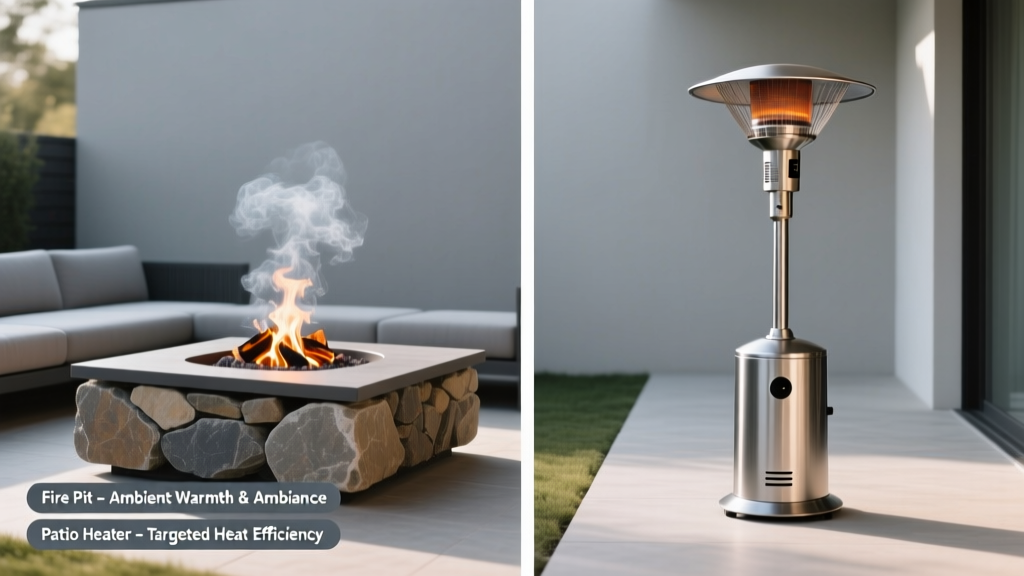
It’s late afternoon in early October—your guests are arriving soon, but the air has that crisp bite that makes bare arms shiver. You’ve got two go-to options to warm your deck or backyard: a crackling fire pit or a sleek patio heater. But which one actually delivers consistent comfort without headaches?
Quick Verdict
A fire pit wins for ambiance, social appeal, and multi-use flexibility (roasting marshmallows, extending summer evenings), while a patio heater excels at targeted, wind-resistant warmth in cooler or windier climates—especially for covered patios or urban balconies. Neither is universally better; your yard layout, local ordinances, and how you use outdoor space tip the scale.
Side-by-Side Comparison
| Feature | Fire Pit | Patio Heater |
|---|---|---|
| Heat Output Range | 15,000–90,000 BTU (wood or propane) | 30,000–50,000 BTU (propane or electric) |
| Effective Coverage Area | 10–20 ft radius (radiant + convective) | 12–15 ft radius (directional, downward-focused) |
| Setup & Portability | Heavy (30–150+ lbs); permanent or semi-permanent | Lightweight (25–45 lbs); most models roll or fold |
| Fuel Type Options | Wood, propane, natural gas, ethanol | Propane (most common), electric, natural gas |
| Indoor Use Allowed? | No—strictly outdoor only | Electric models only (UL-certified); propane prohibited indoors |
| Average Upfront Cost | $199–$2,800 (stone inserts, built-ins) | $149–$1,200 (freestanding, wall-mounted, tabletop) |
Deep Dive on Fire Pits
Pros
- Creates strong visual and auditory ambiance—flame movement, crackle, and glow boost mood and conversation
- Multi-functional: cook food, toast marshmallows, serve as a focal point for seating arrangements
- Longer usable season in mild climates—heat radiates outward, warming people *and* nearby surfaces
- Lower long-term fuel cost if using seasoned hardwood (vs. propane tanks)
Cons
- Smoke and ash require cleanup—and can trigger allergies or violate HOA rules (e.g., no open flames in some California communities)
- Poor performance in wind: flames flicker or die, reducing effective heat by up to 60% (per UL testing standards, 2022)
- Not ideal for small spaces: requires 3+ ft clearance from structures, overhangs, or combustibles
- Permitting may be required for built-in or natural gas models in cities like Seattle or Austin
Fire pits shine in detached backyards with open sightlines and low wind exposure—think suburban patios with stone pavers and lounge seating. They’re also preferred for weekend gatherings where atmosphere matters as much as temperature.
Deep Dive on Patio Heaters
Pros
- Consistent, directional heat—even at 15 mph winds, infrared models retain ~75% efficiency (Gas Appliance Manufacturers Association, 2023)
- Compact footprint: tabletop versions fit on 2-ft-wide balconies; freestanding units clear overhead beams easily
- Instant on/off control: no lighting time, no smoke, no tending flames
- Easier compliance: many municipalities allow electric patio heaters where open flames are banned (e.g., NYC apartment rooftops)
Cons
- Limited social utility: no flame-gazing, no cooking, no shared ritual around the heat source
- Higher ongoing cost with propane: a standard 20-lb tank lasts ~10 hours at medium output ($3.50–$5 per tank)
- Electric models draw 1,500W+—may overload older outdoor circuits without GFCI protection
- Less effective in open, unsheltered areas: heat rises and dissipates quickly without a ceiling or pergola to reflect it
Patio heaters excel in controlled environments—covered porches, rooftop decks, restaurant patios, or narrow urban yards where safety and predictability trump charm. They’re especially practical for weekday evening use when you want warmth fast and hassle-free.
When to Choose Fire Pit vs Patio Heater
If your space has:
- A pergola or low roofline → patio heater (reflected infrared works best under cover)
- Open lawn + gravel surround + no HOA restrictions → fire pit (maximizes radiant spread and ambiance)
- Two-story condo balcony with wind tunnels → electric patio heater (no fumes, no permits, safe mounting)
- Family with young kids or pets → propane fire pit with safety screen *or* a low-profile, tip-resistant patio heater—never an open wood-burning pit
According to the Insurance Institute for Business & Home Safety's 2023 report, 68% of outdoor heating-related injuries involved unsupervised children near uncovered fire pits—making barrier design non-negotiable in family settings.
"A fire pit warms people through radiation—but only those directly in line of sight. A patio heater, especially infrared, heats objects and skin more efficiently in still air, but loses ground fast outdoors without shelter." — Dr. Lena Cho, outdoor thermal engineer, ASHRAE Journal, 2022
Alternatives to Consider
Before committing to either, weigh these middle-ground options:
- Infrared heaters with adjustable tilt: More precise than standard patio heaters, less ambient than fire pits
- Heated patio furniture: Built-in seat warmers (e.g., Sunjoy’s heated sectional) add comfort without changing layout
- Propane fire pit tables: Blend both categories—surface for drinks, flame below, lower profile than traditional pits
Do fire pits work well in rainy weather?
No—most wood and propane fire pits aren’t rated for active rain exposure. Water can extinguish flames, corrode burners, or cause propane buildup if moisture blocks venting. Some stainless steel models (e.g., Solo Stove Mesa) have rain covers, but operation during steady rain isn’t advised.
Can I use a patio heater under a gazebo?
Yes—if the gazebo has at least 7 ft of vertical clearance and open sides (no full walls). Propane heaters require airflow to prevent CO buildup; enclosed or screened gazebos need electric or properly vented natural gas models. Always check the manufacturer’s clearance specs before installing.
How much does it cost to run each option monthly?
For 4 hours/night, 3x/week: wood fire pit ≈ $12–$25/month (seasoned oak); propane fire pit ≈ $30–$45/month (two 20-lb tanks); electric patio heater ≈ $18–$28/month (at $0.14/kWh); propane patio heater ≈ $35–$50/month. These estimates assume average regional utility rates and moderate usage (U.S. EIA Residential Energy Consumption Survey, 2023).
Are there eco-friendly options for either?
Yes—ethanol fire pits produce zero smoke or particulate matter (though CO₂ emissions remain), and ENERGY STAR–certified electric patio heaters use 30% less power than standard models. Avoid greenwashing: “bio-ethanol” doesn’t mean carbon neutral—the feedstock (often corn or sugarcane) carries upstream land and water costs.
What’s the lifespan difference?
Well-maintained stainless steel fire pits last 10–15 years; cast iron or painted steel models often show rust by year 5. Freestanding propane patio heaters average 5–8 years; commercial-grade infrared units (e.g., Bromic) exceed 12 years with annual burner cleaning. Both require seasonal maintenance—cleaning ash trays, checking hose integrity, and inspecting ceramic elements.
Can I convert a fire pit to use propane instead of wood?
Only if it’s designed for dual fuel or comes with a certified conversion kit (e.g., Fire Sense or Outland Living kits). Never retrofit a wood-burning pit yourself—improper gas pressure or venting risks explosion or carbon monoxide poisoning. The National Fire Protection Association (NFPA 58, 2022 edition) prohibits field conversions without third-party certification.
Ultimately, your choice hinges less on ‘which is better’ and more on ‘what kind of outdoor life you live.’ If your evenings revolve around storytelling and slow sips, lean into fire. If your priority is reliable, hands-off warmth during quick post-work decompression, go electric or propane heater. And remember: the best setup might be both—a compact patio heater for weeknights, and a fire pit reserved for weekends with friends.