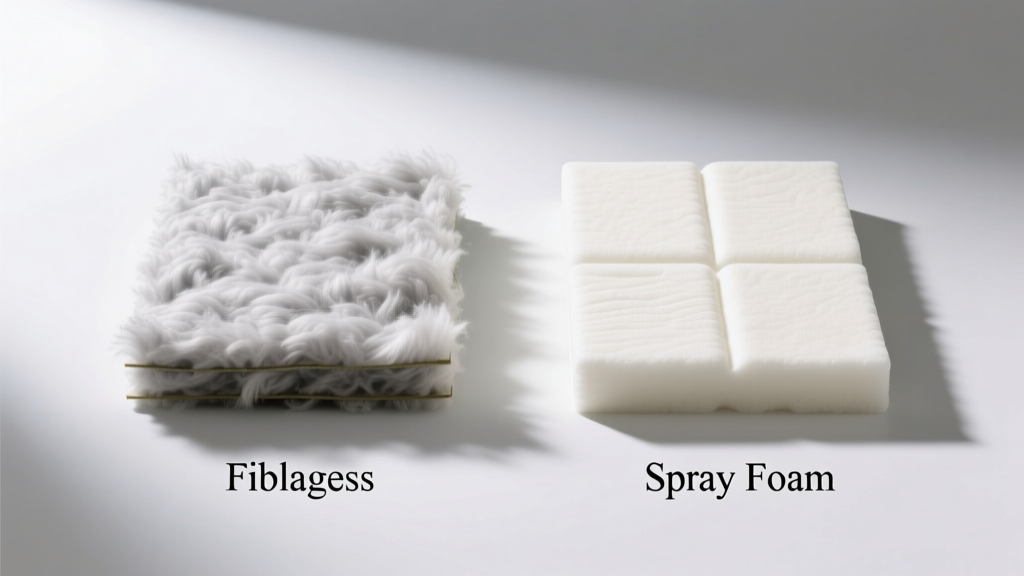
Choosing between fiberglass and spray foam insulation feels like picking between a reliable sedan and a high-performance SUV—both get you where you need to go, but they serve different needs, budgets, and building conditions. It’s not just about R-value; it’s about air leakage, moisture control, retrofit feasibility, and long-term energy savings.
Quick Verdict
Fiberglass is the pragmatic choice for budget-conscious retrofits and standard wall cavities where air sealing isn’t critical. Spray foam excels where air infiltration matters most—like rim joists, cathedral ceilings, or leaky older homes—but costs 2–3× more and requires professional installation. Neither is universally 'better'; the right pick depends on your climate zone, assembly type, and renovation scope.
Side-by-Side Comparison
| Feature | Fiberglass Insulation | Spray Foam Insulation |
|---|---|---|
| R-value per inch | 2.2–4.3 (batt vs loose-fill) | 3.5–7.0 (open-cell vs closed-cell) |
| Air sealing capability | None (requires separate air barrier) | Yes—fills gaps, seals cracks, stops infiltration |
| Material cost (per sq ft, R-13 wall) | $0.50–$1.20 | $2.50–$4.80 |
| Installed labor cost | Low (DIY-friendly) | High (certified installers only) |
| Moisture resistance | Porous—absorbs water, loses R-value when wet | Closed-cell: vapor-impermeable; open-cell: semi-permeable |
| Lifespan | 50+ years if undisturbed and dry | 50+ years; no settling or degradation if properly applied |
Deep Dive on Fiberglass Insulation
Fiberglass comes in batts, rolls, and blown-in forms—and remains the most widely installed insulation in U.S. homes. Its affordability and familiarity make it a go-to for new construction and attic floor upgrades.
Pros
- Low upfront cost—especially for DIY attic installations
- Non-combustible (glass fibers won’t ignite; facing may require thermal barrier)
- Easy to cut, handle, and retrofit into existing stud cavities with minimal disruption
- Recycled content up to 40% (Owens Corning EcoTouch, for example)
Cons
- No inherent air sealing—gaps around outlets, top plates, and corners drastically reduce real-world performance
- Settles over time (especially loose-fill), lowering effective R-value by up to 15% after 10 years (Building Science Corporation, 2021)
- Can irritate skin and lungs during installation—requires gloves, mask, and eye protection
- Performance plummets if compressed or exposed to moisture
Ideal for: Standard 2×4 or 2×6 framed walls in new builds, unfinished attic floors, and budget-driven garage ceiling upgrades. Avoid in unvented cathedral ceilings or leaky basements without an added air barrier.
Deep Dive on Spray Foam Insulation
Spray foam expands on contact, bonding tightly to framing and sheathing. Closed-cell foam (R-6–7/inch) acts as both insulation and vapor retarder; open-cell (R-3.5–3.7/inch) offers sound-dampening and lower cost but requires a separate vapor barrier in cold climates.
Pros
- Superior air sealing—reduces infiltration by up to 50% compared to fiberglass (U.S. Department of Energy, 2022)
- Structural reinforcement: closed-cell foam adds racking strength to walls
- No settling or sagging—maintains full R-value for decades
- Effective in irregular cavities: rim joists, knee walls, and around plumbing penetrations
Cons
- Higher embodied carbon—especially closed-cell, due to hydrofluorocarbon (HFC) blowing agents (though newer HFO-based foams cut GWP by 99.9%, per Chemours 2023 data)
- Requires certified installers—poor mixing or application causes off-gassing, shrinkage, or voids
- Not easily modified post-installation—removing it damages drywall or sheathing
- May trap moisture in wall assemblies if used incorrectly in mixed-climate zones
Ideal for: Retrofitting leaky older homes, insulating unvented roof decks, sealing crawl space walls, and meeting stringent IECC 2021 air-tightness targets (< 3 ACH50).
When to Choose Fiberglass vs Spray Foam
Choose fiberglass when you’re adding insulation to an open attic floor in a dry climate, replacing batts in accessible walls during a remodel, or working within tight budget constraints. Choose spray foam when your home fails blower door tests (>5 ACH50), has persistent condensation in rim joists, or you’re insulating a conditioned crawlspace or basement foundation wall.
According to the Insurance Institute for Business & Home Safety's 2023 report, homes insulated with spray foam in hurricane-prone zones showed 30% fewer moisture-related insurance claims over 5 years—largely due to reduced air-driven rain intrusion.
"Spray foam isn’t about R-value alone—it’s about turning a leaky thermal envelope into a continuous, pressure-balanced system. That’s where real energy and durability gains happen." — Dr. Joseph Lstiburek, Building Science Corporation, 2022
Alternatives to Consider
Don’t overlook other options that bridge the gap:
- Cellulose insulation: Dense-packed into walls (R-3.2–3.8/inch), made from recycled paper, treated for fire resistance, and offers better air sealing than fiberglass—often at half the cost of spray foam.
- Mineral wool: Non-combustible, moisture-resistant, and handles compression better than fiberglass—ideal behind siding or in fire-rated assemblies.
- Rigid foam board: Used as continuous exterior insulation (e.g., polyisocyanurate, R-5.6/inch) to break thermal bridging—commonly paired with cavity insulation in high-performance builds.
Can I combine fiberglass and spray foam?
Yes—and it’s often smart. Use 1–2 inches of closed-cell spray foam against sheathing to seal and control moisture, then fill the rest of the cavity with fiberglass or cellulose. This hybrid approach balances cost, performance, and drying potential.
Does spray foam off-gas after installation?
Properly cured, closed-cell foam emits negligible VOCs after 24–72 hours. But incomplete curing (due to temperature/humidity issues or poor mixing) can release amines and aldehydes. Always verify installer certification through the SPFA’s ProCert program and insist on post-install air quality testing if occupants include infants or those with respiratory sensitivities.
Is fiberglass safe long-term?
Once installed and covered, fiberglass poses no health risk. The concern is strictly during handling. Modern low-itch formulations (e.g., Johns Manville Formaldehyde-Free) eliminate formaldehyde binders entirely—meeting California’s strict CARB Phase 2 standards since 2019.
Will spray foam increase my home’s resale value?
Not directly—but ENERGY STAR-certified homes with verified air sealing (often using spray foam) sell 3.5% faster and for 2.1% more on average, according to the National Association of Home Builders’ 2023 Residential Energy Survey.
Can I add spray foam over existing fiberglass?
Only in vented attics—never in enclosed wall cavities. Trapped moisture between layers can cause mold. In attics, closed-cell foam over old batts is viable if the roof deck is vented and the foam layer is thick enough (≥2 inches) to keep the dew point outside the assembly.
There’s no universal winner—just the right tool for your specific assembly, climate, and goals. If you’re sealing a drafty 1940s bungalow, spray foam likely delivers measurable comfort and efficiency gains. If you’re topping off a new-build attic with R-60, fiberglass or dense-packed cellulose will get you there reliably and affordably. Match the material to the job—not the hype.