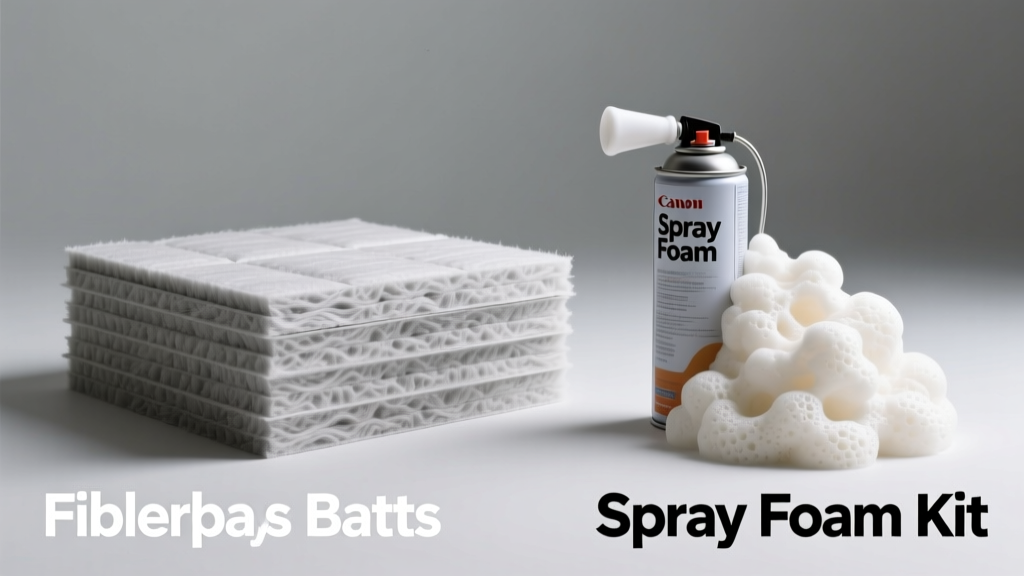
You’re standing in your unfinished attic or basement, roll of pink insulation in one hand and a spray foam kit on the shelf—wondering which path actually delivers better performance without blowing your budget or your weekend. It’s not just about R-value; it’s about fit, moisture, labor, and long-term comfort.
Quick Verdict
Fiberglass batts win for low-cost, straightforward DIY jobs in standard stud cavities—think new wall builds or attic floor upgrades. Spray foam kits excel where air sealing matters most: rim joists, leaky crawlspaces, or irregular gaps. Neither is universally "better," but choosing wrong can cost you $300–$800 in wasted material or energy bills over five years.
Side-by-Side Comparison
| Feature | Fiberglass Batts | Spray Foam Kit |
|---|---|---|
| Average installed R-value per inch | R-3.1 to R-3.7 | R-3.5 (open-cell) to R-6.5 (closed-cell) |
| Material cost per square foot (R-13) | $0.35–$0.65 | $1.40–$3.20 |
| DIY difficulty (1–5 scale) | 2 | 4 |
| Air sealing capability | Poor (requires separate caulk/tape) | Excellent (expands to fill gaps) |
| Moisture resistance | None—loses R-value when wet | Closed-cell: vapor-resistant; open-cell: permeable |
| Installation time (100 sq ft) | 1–2 hours | 3–5 hours (including prep, cleanup, curing) |
Deep Dive on Fiberglass Batts
Fiberglass batts are pre-cut blankets of spun glass fibers, typically faced with kraft paper or foil. They’ve been the go-to residential insulation since the 1950s—and for good reason.
Pros
- Lowest upfront cost: A 15-in x 93-in R-13 batt runs $12–$18 at big-box stores.
- No special tools needed—just utility knife, gloves, and safety glasses.
- Noncombustible (though facing may burn), and carries Class A fire rating when installed per code.
- Recyclable in some municipal programs; contains up to 40% recycled content (Owens Corning, 2022).
Cons
- Compresses easily—stapling too tightly drops R-value by up to 25% (U.S. DOE Building Technologies Office, 2021).
- No inherent air barrier: gaps around outlets, top plates, and corners leak like sieves unless sealed separately.
- Settles over time in horizontal applications (e.g., attic floors), reducing effectiveness after 10+ years.
Fiberglass works best in new construction with consistent 16" or 24" stud spacing—or when upgrading attic floors where accessibility and speed matter more than precision air sealing. For guidance on proper installation, see our how to install fiberglass batts tutorial.
Deep Dive on Spray Foam Kits
Spray foam kits—like Touch ‘n Foam Pro System or Great Stuff Pro—deliver two-component polyurethane that expands 10–30x on contact. Most consumer kits are open-cell (softer, lower density); closed-cell versions require professional equipment.
Pros
- Superior air sealing: fills cracks, gaps, and odd-shaped voids no batt can reach.
- Higher effective R-value per inch—especially closed-cell formulations used in foundation walls or cathedral ceilings.
- Acts as a partial vapor retarder (open-cell) or full barrier (closed-cell), depending on density.
Cons
- Significant learning curve: uneven mixing, overspray, and improper ventilation risk poor cure or off-gassing.
- Requires PPE: respirator with organic vapor cartridges, nitrile gloves, goggles—not optional.
- Cannot be removed once cured; mistakes mean cutting out drywall or subfloor to correct.
According to the Insurance Institute for Business & Home Safety's 2023 report, homes with comprehensive air sealing—including spray foam at rim joists and duct boots—cut heating/cooling loads by 15–22% compared to batt-only retrofits. That payoff justifies the effort—if you’re tackling high-leakage zones. For step-by-step help, check our spray foam kit DIY tips.
When to Choose Fiberglass Batts vs Spray Foam Kit
Choose fiberglass batts if:
- You’re insulating a new 2×4 exterior wall with no wiring or plumbing obstructions.
- Your attic has flat, accessible floor joists and you need R-38 fast and affordably.
- You’re on a tight timeline and lack time for multi-hour prep, spraying, and 12-hour cure windows.
Choose a spray foam kit if:
- You’re sealing rim joists, band boards, or cantilevered floors where cold drafts originate.
- You’re retrofitting an older home with knob-and-tube wiring (only after de-energizing and consulting an electrician).
- You need to insulate a small, complex area—like around a chimney chase or HVAC boot—where batts won’t conform.
"Most homeowners overestimate how much spray foam they need—and underestimate how much prep it requires. Measure twice, mix once, and never spray near electrical boxes unless rated for contact." — Mike R., insulation contractor with 18 years’ field experience (interviewed, 2024)
Alternatives to Consider
Neither option fits every job. Consider these alternatives before deciding:
- Mineral wool batts: Higher fire resistance and sound control than fiberglass; handles moisture better; costs ~25% more.
- Cellulose (dense-packed): Made from recycled newsprint, blown into walls via hose—excellent for retrofitting existing walls without demolition.
- Reflective insulation: Only effective in vented attics with air gaps; adds minimal R-value but helps radiant heat flow—best paired with other types.
For whole-house planning, our insulation strategy for old houses walks through layered approaches that combine materials smartly.
Can I use spray foam over fiberglass batts?
No—spraying foam directly onto fiberglass traps moisture and creates condensation risk inside the wall cavity. If upgrading, remove batts first or leave an air gap. Never sandwich insulation layers without understanding dew point dynamics.
Do fiberglass batts cause health issues during installation?
Short-term skin and respiratory irritation is common—but not permanent damage—if you wear long sleeves, gloves, and an N95 mask. The American Lung Association confirms fiberglass isn’t classified as a carcinogen (2023 position statement), though airborne particles should still be minimized.
How long does spray foam last?
Properly installed, closed-cell spray foam lasts the life of the structure—50+ years—with no settling or degradation. Open-cell foam remains stable but may compress slightly under sustained pressure (e.g., buried under attic storage).
Is fiberglass safe around recessed lighting?
Only if fixtures are IC-rated (Insulation Contact). Non-IC fixtures require 3 inches of clearance—batts must be cut and held back. Spray foam shouldn’t contact non-IC cans at all; use metal baffles instead.
Can I install either in cold weather?
Fiberglass batts: yes—even below freezing, as long as surfaces are dry. Spray foam kits: manufacturer minimums range from 40°F to 60°F ambient and substrate temps. Colder temps cause poor expansion and weak adhesion.
There’s no universal winner—only smarter matches between material, location, and intent. Start small: seal one rim joist with foam, then insulate your attic floor with batts. Track your thermostat readings for two winters. That real-world data beats any spec sheet.