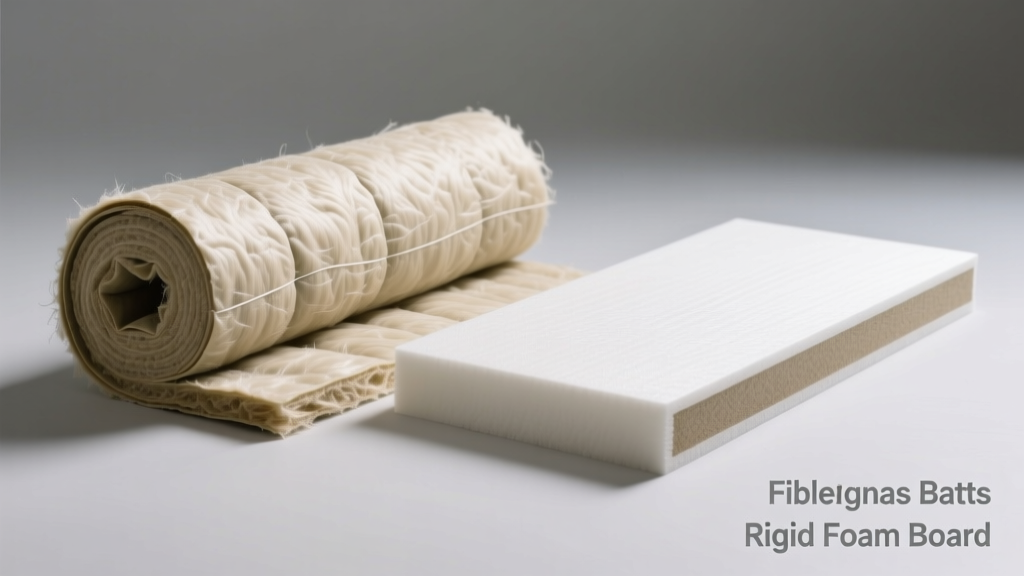
Choosing between fiberglass batts and rigid foam board feels like picking between a reliable sedan and a high-performance SUV — both get you where you need to go, but their strengths, trade-offs, and ideal conditions differ sharply. Your budget, climate zone, assembly type, and whether you’re retrofitting or building new all tilt the scale.
Quick Verdict
Fiberglass batts win for affordability and ease of DIY installation in standard stud cavities (e.g., 2×4 or 2×6 walls, attics). Rigid foam board excels where space is tight, moisture control matters (like basements or cathedral ceilings), or you need higher R-value per inch — especially in cold climates. Neither is universally "better"; the right choice depends on your specific assembly and goals.
Side-by-Side Comparison
| Feature | Fiberglass Batts | Rigid Foam Board |
|---|---|---|
| R-value per inch | R-3.1 to R-4.3 | R-3.6 (EPS) to R-6.5 (polyiso) |
| Average cost per square foot (installed) | $0.50–$1.20 | $1.30–$3.80 |
| Moisture resistance | Poor — absorbs water, loses R-value when wet | High — closed-cell types resist vapor and bulk water |
| Fire rating (typical) | Class A with facing; requires thermal barrier in living spaces | Varies: polyiso often Class A; XPS/EPS usually Class C unless treated |
| Installation complexity | Low — cut with utility knife, friction-fit into cavities | Moderate — requires adhesive, mechanical fasteners, and careful seam sealing |
| Best for air sealing? | No — gaps around edges reduce real-world performance | Yes — when seams are taped and joints sealed properly |
Deep Dive on Fiberglass Batts
Fiberglass batts are the most common insulation in North American homes — especially in wood-framed walls and attic floors. They’re made from fine glass fibers spun into flexible blankets, often with kraft paper or foil facings.
Pros
- Lowest upfront cost per R-value in standard framing
- Easy to cut and fit between studs, joists, or rafters using basic tools
- Noncombustible (glass fibers won’t burn), though facings may require ignition barriers
- Widely available at home centers and lumberyards
Cons
- Loses up to 50% of rated R-value if compressed, misfit, or exposed to moisture
- Poor air-sealing ability — thermal bypasses through gaps are common
- Can irritate skin and lungs during handling; requires gloves, mask, and eye protection
- Not suitable for below-grade or exterior-sheathing applications without additional protection
According to the U.S. Department of Energy’s 2023 Residential Energy Consumption Survey, over 62% of single-family homes built before 2010 used fiberglass batts as primary wall insulation — a testament to its accessibility, not necessarily its long-term performance.
Deep Dive on Rigid Foam Board
Rigid foam board includes three main types: expanded polystyrene (EPS), extruded polystyrene (XPS), and polyisocyanurate (polyiso). Each differs in density, moisture resistance, and thermal drift behavior — especially polyiso, whose R-value drops slightly after initial off-gassing.
Pros
- Higher R-value per inch — critical where wall thickness is constrained (e.g., retrofitting brick veneer or adding exterior insulation)
- Acts as a vapor retarder (especially XPS and foil-faced polyiso), reducing condensation risk in cold climates
- Provides structural bracing when installed over sheathing — improves racking resistance by up to 30%, per APA Engineered Wood Association testing (2022)
- Can be used continuously — over studs, under siding, or beneath slabs — minimizing thermal bridging
Cons
- Higher material and labor cost — especially when taping seams and installing furring strips for cladding
- Requires precise cutting and sealing; poor joint treatment leads to significant thermal leakage
- Most types are petroleum-based and not biodegradable; XPS contains HFC blowing agents phased out under EPA SNAP rules starting in 2024
- Flame spread ratings vary — EPS and XPS typically require ignition or thermal barriers behind drywall
"Rigid foam isn’t just about R-value — it’s about controlling heat, air, and moisture in one layer. But if you skip the seam tape or use the wrong fastener, you’ve just paid premium prices for average performance." — Dr. Antonia Serrano, Building Science Advisor, Building Science Corporation (2023)
When to Choose Fiberglass Batts vs Rigid Foam Board
Go with fiberglass batts if you’re insulating an open attic floor on joists, upgrading interior walls in a mild climate, or working on a tight budget with standard 2×6 framing. Choose rigid foam board when you need continuous insulation (e.g., exterior sheathing over OSB), are finishing a basement with concrete walls, or building to Passive House or Net Zero standards where thermal bridging must be minimized.
For cathedral ceilings without vent channels, rigid foam applied above roof sheathing avoids condensation risks that plague batt-only assemblies — a key recommendation in the 2021 International Residential Code (IRC) Appendix R. In contrast, fiberglass batts remain code-compliant only when paired with proper ventilation and vapor control layers.
Alternatives to Consider
Neither option suits every situation. Blown-in cellulose offers higher density and better air sealing than batts — especially in existing walls — and is made from recycled newsprint. Spray foam (open- or closed-cell) delivers superior air sealing and R-value but costs 2–4× more and requires certified installers. For eco-conscious builders, mineral wool batts (e.g., Rockwool) offer non-combustibility, moisture tolerance, and sound-dampening benefits — see our mineral wool vs fiberglass comparison.
Can I combine fiberglass batts and rigid foam board?
Yes — and it’s often smart. Installing 1–2 inches of rigid foam over sheathing *plus* fiberglass in the cavity (a “double-stud” or “flash-and-batt” hybrid) meets IECC 2021 energy code requirements in Climate Zones 5–7 while limiting thermal bridging. Just ensure the foam is thick enough to keep the sheathing above the dew point — typically ≥1.5" XPS in Zone 6 (per ASHRAE Fundamentals Handbook, 2022).
Which is greener: fiberglass or rigid foam?
Fiberglass has lower embodied energy (~25 MJ/kg) than XPS (~100 MJ/kg) or polyiso (~75 MJ/kg), per the National Institute of Standards and Technology’s BEES 4.0 database (2023). However, fiberglass production uses large amounts of natural gas, and disposal is problematic. Some rigid foams now use bio-based polyols or low-GWP blowing agents — check manufacturer EPDs for transparency.
Do I need a vapor barrier with either material?
Not necessarily — and adding one incorrectly can cause more harm than good. Kraft-faced batts act as a Class II vapor retarder (perm rating ~0.4–1.0), appropriate for mixed-humid climates. Foil-faced polyiso is Class I (<0.1 perm) and may trap moisture if installed on the wrong side of the assembly. Always consult your local building code and climate-specific guidance — like the vapor barrier placement guide.
How do they perform in fire scenarios?
Fiberglass itself doesn’t burn, but paper facings ignite easily. Most rigid foams are combustible and produce toxic smoke when flaming — requiring thermal barriers (½" gypsum) in occupied spaces per IRC R316. Polyiso tends to char rather than drip; XPS melts and pools. Fire performance should drive assembly design, not just material selection.
Can I install rigid foam over existing fiberglass batts?
Only if the existing batts are dry, undamaged, and not compressed. Adding foam *over* batts in a wall cavity creates a sandwich that traps moisture — especially if the foam is vapor-closed and the batts are damp. It’s safer to remove old batts first or apply rigid foam *exterior* to the sheathing, where it serves as continuous insulation without trapping moisture inside framing.
If your project involves a crawlspace, basement rim joist, or unvented attic, neither fiberglass nor rigid foam alone tells the whole story — air sealing, drainage, and drying potential matter just as much. For help matching insulation to your specific assembly, see our insulation by application guide.