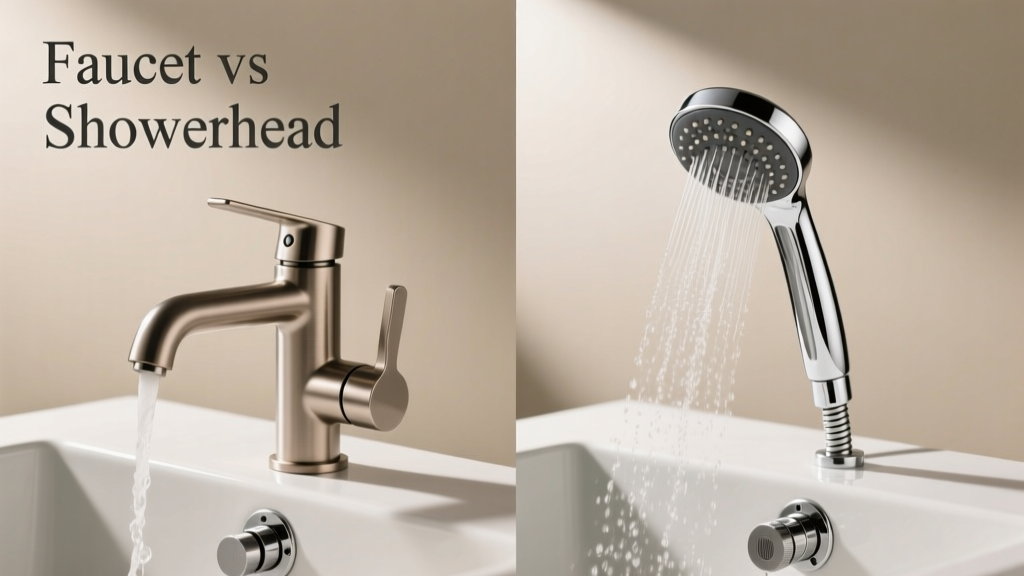
You’re renovating a bathroom—or maybe just tired of low pressure and leaky handles—and suddenly it hits you: are you really comparing apples to oranges when weighing faucet versus showerhead upgrades? They serve different jobs, but confusion sets in when both affect water flow, efficiency, and daily comfort.
Quick Verdict
Neither is universally "better"—it depends on your goal. A faucet upgrade improves sink usability, kitchen or bathroom prep, and style at the basin; a showerhead upgrade directly impacts bathing comfort, water savings, and pressure perception. According to the U.S. EPA’s WaterSense program (2023), replacing an old showerhead with a certified model saves the average household 2,700 gallons annually—more than most faucet aerators save in a year.
Side-by-Side Comparison
| Feature | Faucet | Showerhead |
|---|---|---|
| Primary function | Delivers controlled water flow at sinks (kitchen, bathroom, laundry) | Disperses water over body surface during showering |
| Average lifespan | 15–20 years (with cartridge replacement every 5–7) | 8–12 years (nozzles clog; internal valves wear faster) |
| Water efficiency gain potential | Up to 30% reduction via aerators (e.g., 1.0 GPM models) | Up to 40% reduction (WaterSense-certified: ≤1.8 GPM) |
| Installation complexity | Moderate (shut-off valves, supply lines, deck or wall mount) | Low (most thread onto existing arm; no tools needed) |
| Typical cost range (mid-tier) | $120–$450 (includes pop-up drain, escutcheon) | $45–$220 (handheld, rain, or dual-function models) |
Deep Dive on Faucets
Faucets anchor functional zones—think brushing teeth, washing hands, filling pots, or rinsing makeup. Their design balances ergonomics, finish durability, and internal mechanics like ceramic disc cartridges that prevent drips.
Pros
- Direct impact on hygiene and task efficiency—especially in powder rooms or guest baths where sink use outweighs shower use
- Wide aesthetic range: from minimalist single-handle wall-mounts to vintage two-handle widespreads
- Smart options available: touchless activation, temperature memory, voice control (e.g., Moen Smart Faucet line, 2022)
Cons
- Higher labor cost if reconfiguring rough-ins or switching from centerset to widespread
- Hard water buildup affects internal valves more than shower nozzles—cartridge replacements average $25–$65 every 5–7 years
- Less dramatic water savings than showerheads unless upgrading older 2.2+ GPM models
Deep Dive on Showerheads
A showerhead is your daily wellness interface—where water pressure, spray pattern, and temperature stability shape stress relief or morning alertness. Modern units offer targeted massage jets, magnetic docking for handhelds, and even Bluetooth speakers—but performance hinges on home water pressure and pipe diameter.
Pros
- Fastest ROI for water conservation: a 1.5 GPM showerhead cuts usage by ~35% vs. pre-1994 5.0 GPM units (USGS Water Science School, 2021)
- Minimal installation: most require only a wrench and Teflon tape; no shut-off valve access needed
- Versatile types—rainfall, waterfall, high-pressure, filtered—let you tailor experience without remodeling
Cons
- Limited utility outside the shower stall—no multitasking like faucet-mounted soap dispensers or pull-down sprayers
- Plastic nozzles degrade faster in chlorinated or hard water; rubber-tipped jets resist mineral buildup but wear after ~3 years
- Low-flow models sometimes sacrifice coverage—not all 1.8 GPM units feel equally satisfying (Consumer Reports testing, 2023)
When to Choose Faucet vs Showerhead
Pick a faucet upgrade if:
- You’re updating a half-bath with no shower—sink performance is your only water point of contact
- Your current faucet leaks at the base, wobbles, or has inconsistent hot/cold mixing
- You need ADA-compliant lever handles or touchless operation for accessibility
Pick a showerhead upgrade if:
- Your shower feels weak or inconsistent—even with good home pressure (often due to clogged nozzles or outdated flow restrictors)
- You’re renting or under budget constraints: $65 gets you a WaterSense-certified unit with lifetime warranty (e.g., High Sierra Classic)
- You want measurable water savings fast—no permit or plumber required
Alternatives to Consider
Before choosing one or the other, ask whether your real need is broader:
- Shower faucet combo sets unify valve, trim, and showerhead for coordinated pressure and finish
- Touchless bathroom faucets add hygiene and convenience without full remodel
- Whole-house filtration improves both faucet and showerhead longevity—and skin/hair health—by reducing sediment and chlorine
Can I replace just the showerhead without changing the valve?
Yes—99% of standard shower arms accept any ½-inch NPT threaded showerhead. Just unscrew the old one, wrap the threads with Teflon tape (2–3 wraps clockwise), and hand-tighten. Over-tightening cracks plastic housings.
Do high-end faucets last longer than budget ones?
Not necessarily—but they use thicker brass bodies, tighter-tolerance cartridges, and better plating. A $180 Delta faucet typically outlasts a $75 imported unit because its ceramic disc lasts 1M+ cycles vs. 500K (Delta Engineering Report, 2022). Finish wear (e.g., brushed nickel fading) is more about cleaning habits than price.
Will a new showerhead fix low water pressure?
Sometimes—but only if the issue is nozzle clogging or an outdated restrictor. If pressure is low *everywhere*, check main shutoff valve position, galvanized pipe corrosion, or pressure regulator function. A plumber’s gauge test costs $75–$120 and prevents wasted upgrades.
Are touchless faucets worth it in bathrooms?
In high-traffic or shared bathrooms—yes. They reduce cross-contamination and cut water waste by ~30% per use (CDC Environmental Health Study, 2020). But battery life varies: some last 2 years, others need replacement every 6 months if used 15+ times daily.
What’s the best faucet/showerhead brand for reliability?
For faucets: Moen and Kohler lead in serviceability and cartridge availability—even 15-year-old models have replacement parts online. For showerheads: Waterpik and High Sierra consistently score highest in Consumer Reports’ spray force and ease-of-cleaning tests (2023–2024).
"Most homeowners overspend on visible finishes while ignoring the valve—the heart of any water fixture. A $300 faucet with a cheap plastic valve will drip within 2 years. Spend 20% more for a brass-bodied unit with a lifetime cartridge warranty." — Sarah Lin, licensed plumbing contractor since 2008, Seattle WA
If your shower leaves you rinsing shampoo for 90 extra seconds—or your bathroom sink sprays sideways when you turn it on—you already know which upgrade matters most right now. Neither faucet nor showerhead is a luxury; both are precision tools for daily living. Match the tool to the task, not the trend.