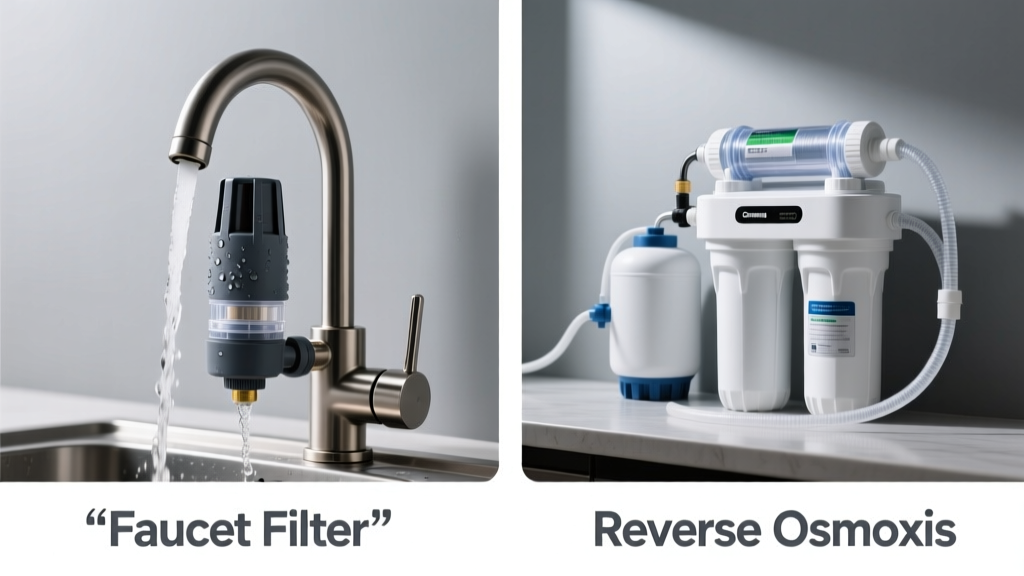
You’re standing in front of two water filtration options at the hardware store—or scrolling through Amazon late at night—wondering whether a $35 faucet filter or a $300+ under-sink RO system is actually worth the investment. Both promise cleaner water, but they tackle contaminants in fundamentally different ways—and serve very different households.
Quick Verdict
A faucet filter is best for renters, small kitchens, or those needing basic chlorine and sediment reduction on a tight budget. Reverse osmosis delivers lab-grade purification—including fluoride, nitrates, and heavy metals—but requires permanent installation, wastes water, and costs more upfront and to maintain. Neither is universally 'better'; the right choice depends on your water test results, plumbing setup, and usage habits.
Side-by-Side Comparison
| Feature | Faucet Filter | Reverse Osmosis |
|---|---|---|
| Installation | No tools; screws onto standard faucet aerator in <2 minutes | Requires drilling, shut-off valve access, and under-sink space; professional install recommended |
| Contaminant Removal | Reduces chlorine (95%), lead (97%), and sediment; ineffective against fluoride, nitrates, or dissolved solids | Removes up to 99% of dissolved solids, including fluoride (94%), arsenic (98%), nitrate (90%), and PFAS (70–90%, per NSF/ANSI 58 testing) |
| Flow Rate | 0.5–1.0 GPM (slight pressure drop noticeable during use) | 0.25–0.5 GPM (noticeably slower; requires storage tank) |
| Filter Replacement | Every 2–3 months (~$15–$25 per cartridge) | Pre-filters every 6–12 months ($25–$45); RO membrane every 2–3 years ($75–$120) |
| Water Waste | None | Wastes 3–5 gallons for every 1 gallon purified (U.S. EPA estimates average 4:1 ratio) |
Deep Dive on Faucet Filters
Faucet-mounted filters attach directly to your kitchen spout and use activated carbon block or granular carbon combined with ion exchange resin. They’re certified to NSF/ANSI Standard 42 (aesthetic contaminants) and often Standard 53 (health-related contaminants like lead and mercury).
Pros
- No permanent modification to plumbing—ideal for apartments or leased spaces
- Lowest entry cost: $25–$50 for initial unit + cartridges
- Instant access to filtered water without waiting or tank refills
- Easy to swap between sinks or take when moving
Cons
- Cannot remove dissolved minerals (e.g., sodium, calcium), fluoride, or nitrate
- Limited capacity: most cartridges process only 100–200 gallons before performance drops
- May interfere with pull-down or spray-function faucets unless adapter included
- Does not reduce TDS (total dissolved solids)—so no improvement in taste from mineral-heavy water
They shine in homes with municipally treated water that’s safe but has chlorine odor or occasional lead leaching from older pipes. For example, if your home water test shows 0.5 ppm chlorine and 5 ppb lead—but no nitrate or fluoride—you’ll get full value without over-engineering.
Deep Dive on Reverse Osmosis Systems
RO systems force water through a semi-permeable membrane under pressure, stripping away ions, molecules, and larger particles. Most residential units include a 3- to 5-stage process: sediment pre-filter → carbon pre-filter → RO membrane → carbon post-filter → optional remineralization stage.
Pros
- Most thorough residential filtration available—removes bacteria, viruses (when paired with UV), and microplastics
- Proven effectiveness against contaminants common in well water or agricultural runoff (e.g., nitrate, sulfate, chromium-6)
- Long-term cost per gallon drops significantly after year two (as low as $0.02/gal vs. $0.12/gal for faucet filters)
- Many models now include smart monitoring, tankless designs, and high-efficiency membranes that cut waste to 1.5:1
Cons
- Requires dedicated under-sink space and cold-water line access
- Wastes water—older systems discard 4 gallons for every 1 usable gallon
- Removes beneficial minerals like calcium and magnesium (unless using a remineralizing add-on)
- Lower pH output (5.5–6.5) may cause corrosion in copper pipes over time
According to the Water Quality Association’s 2022 Consumer Survey, 68% of RO users reported improved coffee and tea flavor—especially notable in hard-water regions like Arizona or Texas. But
"If your municipal water already meets all EPA standards and your main concern is chlorine taste, RO is overkill—and environmentally costly," says Dr. Elena Ruiz, water treatment engineer at the University of Illinois Urbana-Champaign (2023).
When to Choose Faucet Filter vs Reverse Osmosis
Choose a faucet filter if:
- You rent and can’t modify plumbing
- Your water report shows only chlorine, lead, or particulates—not nitrate, fluoride, or total dissolved solids above 300 ppm
- You need filtered water for cooking and drinking only—not for brewing, aquariums, or CPAP machines
- You want immediate installation and under-$50 startup cost
Choose reverse osmosis if:
- You rely on private well water (and have confirmed nitrate, arsenic, or uranium presence)
- Your local utility adds fluoride, and you prefer its removal
- You brew espresso or make baby formula and demand lowest possible TDS (<10 ppm)
- You’re willing to invest $300–$600 upfront and maintain the system long-term
Alternatives to Consider
Before committing to either option, consider these middle-ground solutions:
- Countertop gravity filters (e.g., Berkey): No installation, removes fluoride and heavy metals, but slower flow and bulkier footprint
- Under-sink carbon systems: More capacity than faucet filters, no water waste, but still can’t remove fluoride or nitrate
- UV + carbon combos: Ideal for well water with biological risk—but won’t reduce chemicals or minerals
- Refrigerator filters: Convenient for icemakers and dispensers, but limited to one outlet and short lifespan
Do faucet filters reduce lead effectively?
Yes—if certified to NSF/ANSI Standard 53 for lead reduction. Look for “lead reduction to 5 ppb or less” on packaging. Not all faucet filters meet this; some only claim ‘lead adsorption’ without third-party verification. Always check the certification number on the NSF website.
Can reverse osmosis remove PFAS?
Standard RO membranes remove 70–90% of PFAS compounds (like PFOA and PFOS), per NSF/ANSI 58 testing in 2021. However, performance varies by molecular weight and membrane age. For maximum PFAS reduction, pair RO with a post-carbon filter specifically rated for PFAS (e.g., coconut-shell carbon with >1,000 mg/g adsorption capacity).
How often should I replace RO pre-filters?
Every 6 months if using municipal water; every 3–4 months with well water or high-sediment supply. Skipping pre-filter changes clogs the RO membrane faster—cutting its life from 3 years to under 18 months. A clogged sediment filter also lets particles damage the carbon stage, reducing chlorine removal efficiency.
Will a faucet filter work with a pull-out sprayer?
Most standard models won’t fit—sprayer heads lack threaded aerators. But adapters like the PUR Advanced Faucet Adapter or Brita On Tap Swivel Connector let you mount inline behind the sprayer base. Just confirm compatibility with your faucet model (e.g., Moen, Delta, Kohler) before buying.
Does reverse osmosis affect water pressure?
It doesn’t reduce household pressure—but it does limit flow *at the RO faucet*. Most systems deliver 0.25–0.5 GPM, meaning filling a 12-oz glass takes ~25 seconds. Tankless RO models improve responsiveness but require higher incoming pressure (60+ PSI) and may cycle on/off audibly during use.
Are there faucet filters that don’t block the sink sprayer?
Yes—models like the Culligan FM-15A or Waterdrop WD-F-1 install *under the sink* but connect to the cold line and feed a dedicated filtered faucet. These are technically “faucet-style” systems (not mounted on the spout) and avoid sprayer interference entirely. They cost more ($120–$200) but bridge the gap between basic faucet filters and full RO.
If your goal is safer, better-tasting water—not perfection—start with a faucet filter and a review of your local water quality report. If test results reveal red flags like nitrate >5 ppm or arsenic >5 ppb, upgrade to reverse osmosis. Either way, never skip verifying certifications—and always retest after installation.