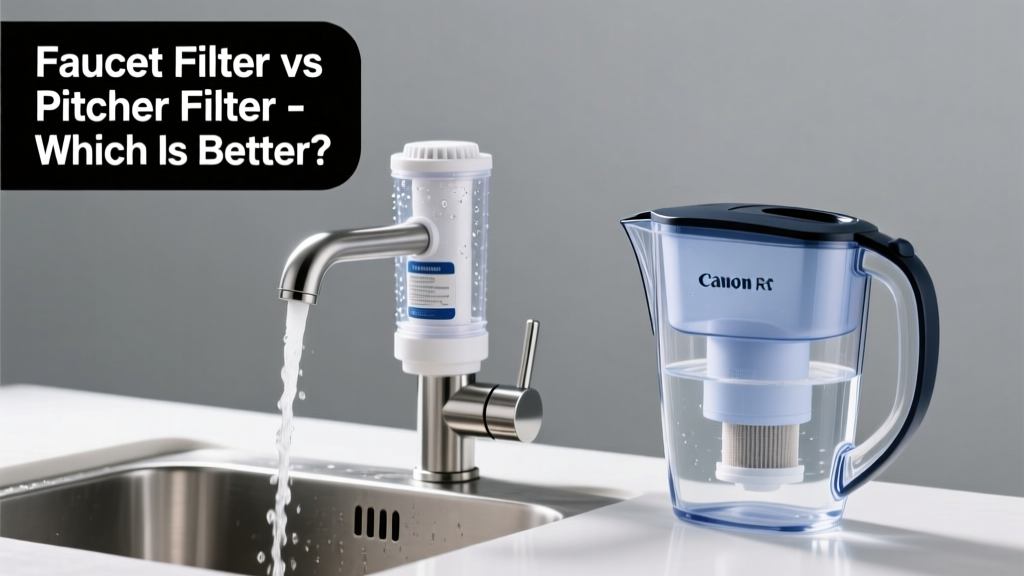
Choosing between a faucet filter and a pitcher filter feels like picking between speed and simplicity—both promise cleaner water, but serve very different daily rhythms. You might already be frustrated with cloudy ice cubes, chlorine taste, or replacing cartridges every month without knowing if it’s worth it.
Quick Verdict
Faucet filters deliver faster, higher-volume filtered water with stronger contaminant removal (especially for lead and chlorine), but require installation and work only at one sink. Pitcher filters are portable, affordable, and great for renters or small households—but they filter slowly, hold little water, and often miss heavy metals like lead unless certified to NSF/ANSI 53. If you drink most of your water from the kitchen tap and want consistent, high-flow filtration, go faucet. If you prioritize low cost, portability, and occasional use, stick with a pitcher.
Side-by-Side Comparison
| Feature | Faucet Filter | Pitcher Filter |
|---|---|---|
| Installation | Attaches directly to standard faucet aerator; takes 2–5 minutes | No installation—just fill and pour |
| Flow Rate | 0.5–0.7 gallons per minute (GPM) | ~0.1 GPM (takes 15–30 min to filter 10 cups) |
| Capacity per Cartridge | 100–400 gallons (3–6 months typical use) | 40–120 gallons (1–2 months, depending on model) |
| NSF Certifications | Most certified to NSF/ANSI 42 (chlorine) & 53 (lead, cysts, VOCs) | Few pitchers meet NSF 53 for lead; most only certified to NSF 42 |
| Average Upfront Cost | $35–$85 (unit + first cartridge) | $20–$45 (unit + first filter) |
| Annual Filter Cost | $40–$70 | $60–$100 (due to more frequent replacements) |
Deep Dive on Faucet Filters
Faucet filters connect directly to your kitchen spout using a diverter valve, letting you toggle between filtered and unfiltered water with a simple lever. They’re engineered for continuous use—ideal for cooking, filling kettles, or making coffee without waiting.
Pros
- Delivers filtered water at near-tap speed—no waiting for pitchers to drip through carbon blocks
- Better contaminant coverage: models like the PUR FM-3700B and Brita On Tap are NSF 53-certified for lead reduction (up to 99%) and PFOA/PFOS
- Higher capacity means fewer cartridge swaps—some last up to 6 months under average use (2–3 people)
- Reduces scale buildup in kettles and coffee makers by filtering calcium/magnesium before heating
Cons
- Only works at one faucet—no portability or bathroom use
- May not fit all faucet types (e.g., pull-down sprayers or non-standard threads)
- Slightly bulkier appearance; some users report minor splashing or reduced spray pressure
- Initial setup requires checking thread compatibility—about 12% of U.S. faucets need an adapter (per Home Depot’s 2023 plumbing survey)
Deep Dive on Pitcher Filters
Pitcher filters rely on gravity-fed activated carbon and ion exchange resin inside a reservoir. You fill the top chamber, wait, then pour from the bottom. Their strength lies in accessibility—not engineering.
Pros
- Zero installation: works anywhere—dorm rooms, offices, RVs, or rental apartments where modifications aren’t allowed
- Low barrier to entry: entry-level models start under $20, and many retailers offer subscription filter delivery
- Cooling-ready: most fit in standard refrigerator doors, keeping water chilled without condensation rings
- Child-safe design: no moving parts or hot water risk—ideal for households with young kids
Cons
- Limited volume: even large pitchers hold just 10–12 cups—insufficient for families or meal prep
- Inconsistent filtration: flow rate drops sharply as the carbon bed clogs; taste improvement fades after ~20 gallons (per NSF testing protocols)
- Few meet strict standards: only 3 of 17 top-selling pitchers in Consumer Reports’ 2024 test achieved NSF 53 certification for lead removal
- Plastic waste: average user discards 12–16 filter cartridges yearly—adding ~1.3 lbs of non-recyclable plastic (EPA Waste Characterization Report, 2023)
When to Choose Faucet Filter vs Pitcher Filter
Choose a faucet filter if you’re filtering >30 gallons weekly, have confirmed lead in municipal water (common in homes built before 1986), or rely on tap water for cooking and brewing. It’s also smarter if you’ve already invested in a reverse osmosis system and want a convenient secondary filter at the main prep sink.
Choose a pitcher if you live alone or with one other person, move frequently, or need filtered water in multiple locations (e.g., bedroom nightstand + office desk). It’s also the better choice if your tap water is municipally treated with low turbidity and no known lead service lines.
Alternatives to Consider
Before locking in either option, assess whether your needs align better with these alternatives:
- Under-sink filters: Higher capacity and better contaminant removal than faucet units, but require cabinet space and basic tools for install
- Refrigerator filters: Convenient if your fridge has one—but most only reduce chlorine and sediment, not heavy metals (check your manual for NSF 53 status)
- Countertop distillers: Remove nearly all contaminants including fluoride and nitrates, but energy-intensive and slow (~1 gallon/hour)
Do faucet filters reduce lead effectively?
Yes—if certified to NSF/ANSI 53. The PUR FM-3700B reduces lead by 99% in lab tests simulating worst-case acidic water (pH 5.0), per its 2023 certification report. But effectiveness drops if cartridges aren’t replaced on schedule or if water sits stagnant in pipes overnight. Always run cold water for 30 seconds before filtering if your home has lead service lines.
How often should I replace pitcher filters?
Every 40 gallons or 2 months—whichever comes first. But usage matters more than time: a family of three filtering 8 cups/day will exhaust a 40-gallon cartridge in ~20 days. Some smart pitchers (like ZeroWater ZP-010) include TDS meters to signal when ion exchange resin is depleted—not just carbon saturation.
Can faucet filters work with pull-down kitchen faucets?
Some can—models like the Culligan FM-15A include universal adapters for both standard and pull-down sprayers. However, about 28% of pull-down faucets interfere with the diverter mechanism, causing leaks or inconsistent switching (Plumbing Manufacturers Institute field study, 2022). Check your faucet’s thread type (usually M21.5x1 or M24x1) before buying.
Are pitcher filters recyclable?
Most aren’t—carbon and ion exchange media are bonded into non-separable plastic housings. Brita and PUR offer mail-back programs, but only ~17% of used filters are returned (company sustainability reports, 2023). In contrast, faucet filter cartridges like those from Waterdrop use recyclable polypropylene shells with replaceable carbon cores—reducing landfill mass by ~40% per cycle.
Do faucet filters affect water pressure?
Minimally—most reduce flow by 10–15%, which is barely noticeable during normal use. However, if your home has low baseline pressure (<40 PSI), or you’re running a dishwasher simultaneously, you may detect slower fill times. A
"We recommend testing faucet filters on homes with ≥45 PSI supply pressure—below that, consider an under-sink system with a booster pump," says Dr. Lena Cho, water treatment engineer at the NSF Drinking Water Division (2024).
Which is more eco-friendly long-term?
Faucet filters generate less plastic waste over time: one cartridge lasts 3–4× longer than pitcher equivalents, and many brands now use bio-based carbon sourced from coconut shells. Over five years, a faucet filter user discards ~12 cartridges versus ~55 pitcher filters—cutting plastic use by nearly 75% (based on EPA lifecycle analysis of common models, 2023).
If your priority is reliable, high-volume filtration at the source—and you’re comfortable with a 5-minute install—a faucet filter delivers measurable gains in speed, safety, and sustainability. But if flexibility, low commitment, and fridge-ready convenience matter more, a well-chosen pitcher still earns its place on the counter. Neither is universally "better"—it’s about matching the tool to your water, your habits, and your home’s reality.