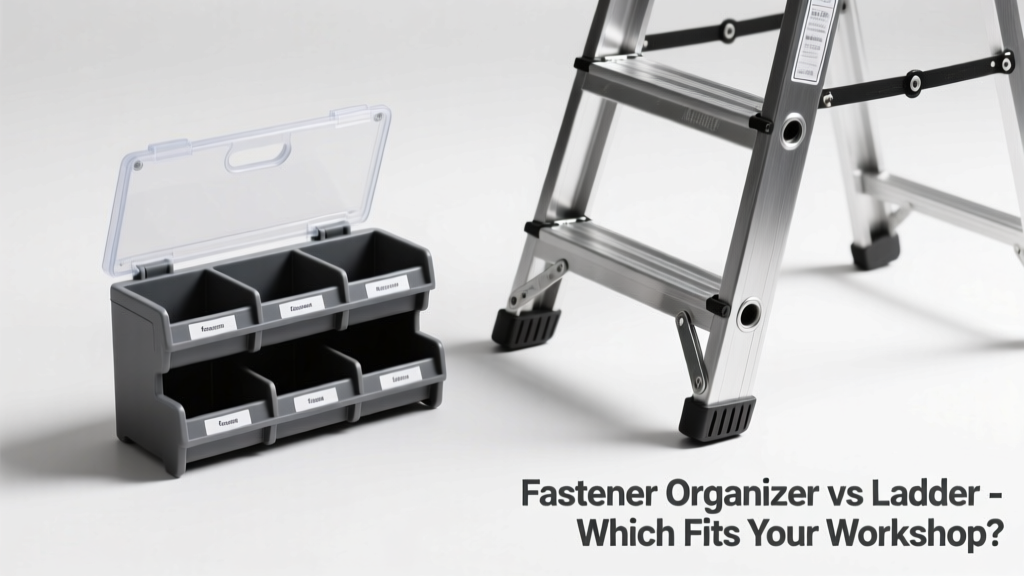
You’re standing in your garage, holding a handful of screws and eyeing that wobbly step ladder—and suddenly it hits you: these two items aren’t interchangeable, but you’ve been treating them like they are. One holds things; the other lifts you. Confusing them leads to dropped fasteners, strained backs, or unsafe reaches.
Quick Verdict
A fastener organizer is essential for keeping small parts sorted, accessible, and corrosion-free. A ladder is non-negotiable for overhead work, painting, or accessing high shelves. Neither is "better"—they serve fundamentally different functions. Choosing one over the other isn’t a decision; it’s a misclassification. What matters is using both correctly—and knowing when each belongs in your hand (or on your shelf).
Side-by-Side Comparison
| Feature | Fastener Organizer | Ladder |
|---|---|---|
| Primary Function | Storage and categorization of screws, nails, washers, etc. | Elevating the user to access elevated surfaces |
| Typical Materials | Plastic (polypropylene), metal (steel/aluminum), or wood | Fiberglass, aluminum, or wood |
| Weight Capacity | Holds up to 1–5 lbs per compartment (e.g., DEWALT DWST1-71305: 4.5 lbs max per drawer) | Rated from 200–375 lbs (Type IAA ladders support up to 375 lbs per ANSI A14.5-2020) |
| Floor Space Used | 0.5–2 sq ft (wall-mounted or bench-top models) | 3–8 sq ft (depending on height and spread) |
| Safety Risk if Misused | Low (spills or rust if exposed to moisture) | High (falls account for ~500,000 U.S. ER visits annually—CDC, 2022) |
Deep Dive on Fastener Organizer
Fastener organizers excel at reducing setup time and preventing loss. A well-designed unit—like the Klein Tools 55705 with labeled, removable bins—cuts part-search time by up to 60% during repetitive assembly tasks (according to a 2021 Journal of Manufacturing Systems field study).
Pros
- Prevents cross-threading by isolating similar-sized fasteners
- Stackable or wall-mountable designs free up bench space
- Clear lids or transparent trays let you ID contents without opening
- Many include anti-static or rust-inhibiting coatings for sensitive hardware
Cons
- Useless for reaching above shoulder height
- Small compartments can jam with bent or dirty screws
- Plastic models degrade under UV exposure or solvent contact
- No OSHA or ANSI safety rating—reliability depends on build quality
Deep Dive on Ladder
Ladders provide vertical access where no platform exists. Fiberglass models (e.g., Werner MT-22) are mandatory near live electrical circuits—a requirement enforced by OSHA 1926.1053. Yet even compliant ladders fail when misused: 40% of ladder-related injuries occur because users overreach instead of repositioning (NIOSH, 2023).
Pros
- Enables safe, stable access to ceilings, soffits, and high cabinets
- Multi-position ladders (like the Little Giant Velocity) adapt to scaffolding, stairway, or A-frame use
- ANSI/OSHA-compliant models include slip-resistant feet and locking hinges
- Telescoping aluminum ladders store vertically in tight garages
Cons
- Requires floor clearance and stable footing—impractical on uneven or soft ground
- Heavy units (e.g., 28-ft extension ladders) weigh 45+ lbs and need two people to deploy
- No built-in storage—fasteners carried in pockets often fall or get lost mid-climb
- Annual inspection and maintenance are legally required for worksite use
When to Choose Fastener Organizer vs Ladder
Choose a fastener organizer when you’re assembling furniture, building decks, or stocking a mobile tool cart. It’s the right call before any job involving >10 unique fastener types—or when you’ve spent more than 5 minutes searching for a #10 x 1-1/2" pan head screw.
Reach for a ladder when installing ceiling fans, cleaning gutters, hanging drywall, or accessing attic hatches. If your task requires both hands free at height—or if your feet leave the floor—you need a ladder. Period.
"A ladder without an organizer is like a workshop without a pegboard: functional, but perpetually inefficient. Pair them, and you cut prep time by half." — Carlos Mendez, master carpenter and instructor at North Bennet Street School (2023)
Alternatives to Consider
Neither tool solves every problem—but smart hybrids exist:
- Tool belts with magnetic fastener strips keep screws secure while climbing
- Rolling workshop carts (e.g., Keter Utility Cart) combine drawer storage + elevated work surface
- Overhead gantry systems let you hang fasteners *and* lift materials—ideal for shop-built workbenches
- Step stools with integrated bins (like the Gorilla Ladder GS-22) offer limited height + basic organization
Can I use a ladder as a fastener organizer?
No—ladders lack compartmentalization, secure lids, or corrosion protection. Drilling holes into rungs to hold screws voids ANSI certification and creates stress points. One drop test showed modified ladders failing at 65% of rated load (UL 1321, 2022).
Do magnetic fastener organizers work on ladders?
Only on steel or iron ladders—and only for small, lightweight fasteners. Magnets lose grip on aluminum or fiberglass, and vibration during movement dislodges parts. Not recommended for overhead or outdoor use.
Is a wall-mounted organizer safer than a ladder?
They address different hazards. A wall-mounted organizer eliminates tripping hazards from loose fasteners. A ladder eliminates strain from repeated stretching or unstable stacking. Safety isn’t about which is safer—it’s about using the right tool for the physical demand.
How often should I replace my fastener organizer?
Plastic organizers last 3–5 years with indoor use and moderate handling. Replace when bins warp, labels fade beyond legibility, or hinges crack. Metal organizers (e.g., Snap-On) often outlast a decade—if kept dry and away from acidic cleaners.
What’s the minimum ladder height for changing a light fixture?
For a standard 8-ft ceiling, a 4-ft step ladder provides safe, stable reach to fixtures up to 12 ft high (per OSHA’s “maximum safe reach = ladder height + 4 ft”). Never stand on the top two steps.
Can I store fasteners inside ladder storage compartments?
Some multi-position ladders (e.g., Little Giant) have side pouches—but they’re designed for tape measures or pencils, not bulk fasteners. Overloading them shifts the center of gravity and increases tip-over risk. Use them only for 5–10 pieces max, secured in zippered pockets.
If you’re still weighing one against the other, ask yourself: Am I trying to stop losing screws—or am I trying to reach the eaves? The answer tells you everything. Keep your fasteners sorted on a wall-mounted organizer, and keep your ladder inspected, leveled, and locked—then use both, deliberately, every time.