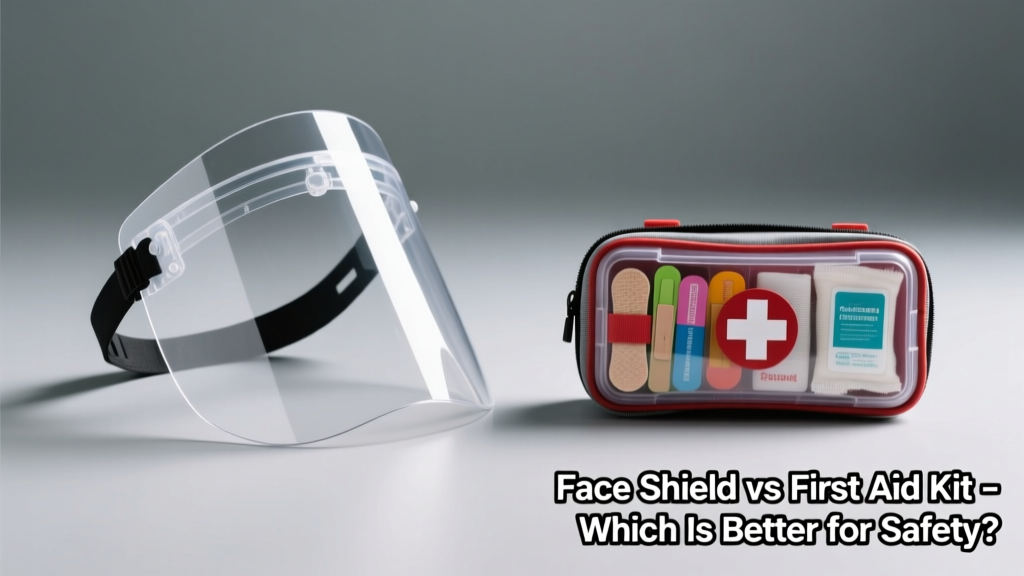
You’re stocking a workshop, prepping a home emergency drawer, or outfitting a school lab—and suddenly wonder: should you prioritize a face shield or a first aid kit? It’s a common mix-up, but these tools serve fundamentally different purposes—one prevents injury, the other treats it.
Quick Verdict
Neither is "better"—they’re complementary, not competitive. A face shield is personal protective equipment (PPE) designed to block splashes, sprays, or debris from reaching your eyes, nose, and mouth. A first aid kit contains supplies to manage injuries *after* they occur—cuts, burns, sprains, or minor trauma. According to OSHA’s 2022 PPE standards, face shields must be used *with* safety goggles in high-risk settings, while ANSI/ISEA Z308.1-2021 requires first aid kits to include specific minimum contents based on workplace hazards.
Side-by-Side Comparison
| Feature | Face Shield | First Aid Kit |
|---|---|---|
| Purpose | Prevent exposure to hazards (e.g., chemical splash, flying particles) | Treat injuries after they happen (e.g., lacerations, burns, allergic reactions) |
| Regulatory Standard | ANSI Z87.1-2020 (impact & optical clarity) | ANSI/ISEA Z308.1-2021 (content categories & quantities) |
| Required Refills/Replacements | After impact, deep scratches, or 2 years of normal use (per manufacturer guidance) | Adhesive bandages expire; antiseptics degrade; replace every 12–24 months |
| Portability | Lightweight, hangs on hooks or folds flat; fits in tool pouches | Range from pocket-sized (10 items) to wall-mounted (150+ items); weight varies widely |
| Training Needed? | Yes—proper fit, cleaning, and compatibility with other PPE (e.g., respirators) | Yes—basic wound care, CPR, and epinephrine auto-injector use improve outcomes |
Deep Dive on Face Shields
Face shields create a physical barrier against liquid splashes, airborne droplets, and moderate-velocity impacts. They’re commonly used in dental offices, labs, construction, and food service.
- Pros: Full-face coverage, reusable, compatible with glasses and respirators, easy to disinfect with 70% isopropyl alcohol
- Cons: No protection against inhalation of fine aerosols alone; fogging can impair vision; doesn’t seal around the face like a respirator
- Ideal use cases: During chemical handling in a garage workshop; assisting someone with active bleeding (CDC recommends face shields *plus* gloves and eye protection); teaching hands-on science labs with volatile reagents
The U.S. EPA estimates that 62% of occupational eye injuries could be prevented with proper face and eye protection—but only if worn *before* the incident occurs.
Deep Dive on First Aid Kits
A well-stocked first aid kit bridges the gap between injury and professional medical care. Contents vary by setting: a car kit needs burn gel and reflective triangles; a warehouse kit must include spine boards and trauma dressings per OSHA guidelines.
- Pros: Addresses immediate physiological needs (bleeding control, pain relief, infection prevention); supports triage in multi-injury events; required by law in many workplaces
- Cons: Useless without training; outdated supplies (e.g., dried antiseptic wipes) reduce efficacy; overstocking irrelevant items wastes space and budget
- Ideal use cases: On a hiking trail (backcountry first aid kit with blister care and snake bite prep); in a school nurse’s office (school first aid kit checklist with epinephrine and child-dose meds); inside a food truck where burns and slips are frequent
When to Choose Face Shield vs First Aid Kit
Choose a face shield when your primary risk is *exposure*—not injury. Think: mixing bleach solutions, sanding fiberglass, or assisting during a seizure. Choose a first aid kit when your environment carries risk of *physical harm*—like using power tools, climbing ladders, or handling hot surfaces.
- If you’re setting up a home woodshop: get both—a face shield for router work *and* a home workshop first aid kit with tourniquet and heavy gauze
- If you’re a teacher doing weekly dissections: face shield is mandatory; first aid kit must be within 30 seconds’ reach
- If you’re packing a bug-out bag: prioritize compact first aid kit first—face shield adds bulk and limited utility off-grid
- If your job involves intermittent chemical handling: face shield + safety goggles is non-negotiable; first aid kit should be mounted nearby with eyewash station access
Alternatives to Consider
Neither tool solves every safety need. Consider layering in these options:
- Safety goggles — superior splash-and-impact protection for eyes alone; lighter than face shields but no mouth/nose coverage
- Emergency trauma kit — focused on life-threatening hemorrhage (tourniquets, chest seals, hemostatic gauze); complements but doesn’t replace standard first aid kits
- Respirator + face shield combo — for environments with both airborne particulates *and* splash hazards (e.g., mold remediation)
- Smart first aid app — like Red Cross First Aid app (2023 update), which guides users through wound care and CPR steps when no trained person is present
Can a face shield replace safety goggles?
No. ANSI Z87.1-2020 explicitly states face shields are secondary protection and must be worn *with* primary eye protection—goggles or safety glasses—unless the shield is rated Z87+ and tested for high-mass impact. Goggles seal around the eyes; face shields don’t.
Do first aid kits expire?
Yes—most components do. Adhesives dry out, antiseptic solutions lose potency, and cold packs degrade. The American Red Cross recommends reviewing kits every 6 months and replacing expired items immediately. Sterile gauze typically lasts 5 years unopened; antibiotic ointment expires 2–3 years after manufacture.
Is a face shield enough for COVID-19 protection?
Not alone. The CDC’s 2022 updated guidance states face shields may reduce exposure to respiratory droplets but offer *no reliable filtration* of aerosols. In indoor, poorly ventilated spaces, N95 respirators remain the gold standard—face shields add splash protection but shouldn’t substitute for source control or air filtration.
Can I build my own first aid kit?
You can—but ANSI/ISEA Z308.1-2021 warns against skipping content categories. A DIY kit missing burn gel, triangular bandages, or a CPR face shield fails compliance checks and reduces clinical effectiveness. Pre-assembled kits certified to Class A or B standards ensure balanced, evidence-based contents.
How often should I clean a face shield?
After every use in healthcare or lab settings. For general use, wipe with 70% isopropyl alcohol or mild soap and water daily—or immediately after visible soiling. Avoid abrasive cloths or ammonia-based cleaners, which degrade anti-fog coatings. As one industrial hygienist told us:
"A scratched, fogged, or improperly fitted face shield gives workers false confidence—it’s worse than wearing nothing at all." — Dr. Lena Torres, Certified Industrial Hygienist, National Safety Council, 2023
What’s the minimum first aid kit for a family of four?
ANSI Class A (minimum 20+ items) covers most home incidents—but for families, upgrade to a Class B kit (minimum 50 items) with pediatric doses, burn gel, and extra adhesive bandages. Include a laminated instruction card—not just an app—since phones fail during power outages or signal loss.
Bottom line: You wouldn’t choose between a seatbelt and an ambulance—and you shouldn’t treat face shields and first aid kits as rivals. They belong in the same safety ecosystem, each activated at different points in the chain of harm. Start with hazard assessment, then match tools to timing: prevention first, response second.