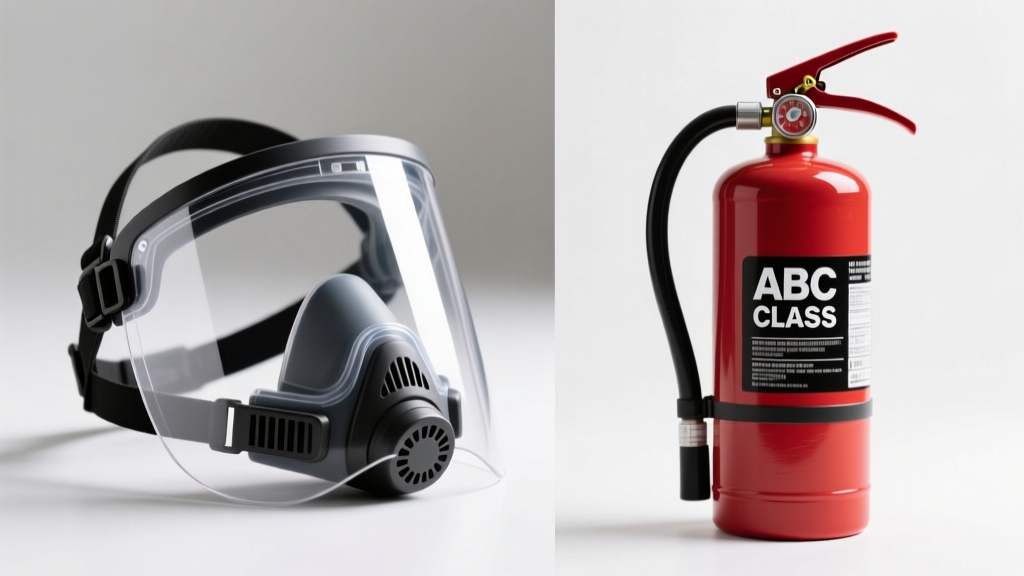
You’re standing in your garage, holding a face shield in one hand and a fire extinguisher in the other—and suddenly realize you’re comparing apples to fire hoses. They both appear in safety checklists, but serve fundamentally different roles. Confusing them could mean missing critical protection—or worse, misallocating resources during an emergency.
Quick Verdict
Neither is "better"—they’re complementary, not competitive. A face shield protects against splashes, sparks, and debris; a fire extinguisher suppresses active flames. According to OSHA’s 2022 Personal Protective Equipment Standard, PPE like face shields must be used in conjunction with engineering controls and emergency response tools—not as substitutes. Choosing one over the other isn’t a trade-off—it’s a misunderstanding of function.
Side-by-Side Comparison
| Feature | Face Shield | Fire Extinguisher |
|---|---|---|
| Primary purpose | Personal protective equipment (PPE) for facial/eye impact and splash resistance | Emergency response device for suppressing Class A–D fires |
| Regulatory standard | ANSI Z87.1-2020 (impact, optical clarity, coverage) | UL 711 (discharge time), NFPA 10 (placement, maintenance) |
| Typical lifespan | 2–5 years (depends on abrasion, chemical exposure, UV degradation) | 10–12 years (if hydrostatically tested every 5–12 years per NFPA 10-2023) |
| Required training | Fit testing and hazard-specific use (e.g., grinding vs. chemical handling) | Hands-on operation training; annual refresher required for workplace compliance (OSHA 1910.157) |
| Failure consequence | Increased risk of eye injury, facial laceration, or chemical burns | Uncontrolled fire spread, structural damage, or life-threatening escalation |
Deep Dive on Face Shield
Face shields are transparent, curved barriers worn over safety goggles or prescription glasses. They’re rated for specific hazards—like molten metal splash (Z87.1+ high-impact), chemical mist (Z87.1+ chemical-resistant coating), or UV radiation (Z87.1+ UV filter).
- Pros: Lightweight, wide field of view, compatible with respirators and hearing protection, easy to clean with isopropyl alcohol
- Cons: No side or chin protection unless extended, doesn’t seal against airborne particles, ineffective against inhalation hazards or radiant heat above 1,000°F
- Ideal use cases: Welding prep (pre-arc), battery acid handling, woodworking with routers, lab chemical transfers, and dental procedures where aerosol generation occurs
According to the National Institute for Occupational Safety and Health (NIOSH), face shields alone reduce eye injury risk by 70–80% when worn with safety goggles—but provide only marginal protection without them (NIOSH Publication No. 2021-129, p. 14).
Deep Dive on Fire Extinguisher
A portable fire extinguisher delivers a suppressant—dry chemical, CO₂, foam, or water mist—to interrupt combustion’s chain reaction. Its effectiveness depends on correct class identification (A = ordinary combustibles, B = flammable liquids, C = energized electrical, D = metals), distance (typically 6–8 ft), and duration (most ABC units discharge in 10–15 seconds).
- Pros: Immediate first-response capability, portable, standardized mounting (wall brackets, cabinets), refillable and rechargeable
- Cons: Requires physical strength and coordination under stress, limited agent capacity, ineffective on deep-seated Class A fires or cooking oil fires (Class K) without proper nozzle design
- Ideal use cases: Server rooms (CO₂), auto shops (ABC dry chem), commercial kitchens (wet chemical), woodshops (ABC or water mist), and electrical panels (CO₂ or clean agent)
When to Choose Face Shield vs Fire Extinguisher
Choose a face shield when preparing for or performing tasks with foreseeable splash, spark, or particle hazards—even if no fire risk exists. Choose a fire extinguisher when active flame suppression capability is needed within 30 seconds of ignition. You need both in scenarios like battery recycling facilities (acid splash + lithium fire risk) or commercial kitchens (grease splatter + Class K fire potential).
- Working near open arc welding? Face shield + safety goggles—not a fire extinguisher.
- Storing gasoline in a shed? Fire extinguisher (Class B) mounted nearby—plus face shield if transferring fuel.
- Running a 3D printing lab with ABS filament? Face shield for fume irritation + CO₂ extinguisher for hot-end fires.
- Refurbishing vintage electronics with lead solder? Face shield for flux spatter + Class C extinguisher for capacitor discharge fires.
Alternatives to Consider
Depending on your hazard profile, neither tool may be sufficient—or may be overkill. Consider these alternatives or supplements:
- Fire blanket for small grease or clothing fires (no discharge, reusable, low training barrier)
- Full-face respirator when vapors or fine particulates are present alongside splash risk
- Heat-resistant gloves paired with face shield for furnace work or foundry applications
- Fixed suppression systems (e.g., kitchen hood suppression) for high-risk zones where portability isn’t viable
Can a face shield stop fire-related injuries?
No. Face shields offer zero flame resistance or thermal insulation. The ANSI Z87.1 standard explicitly excludes radiant heat and flame exposure testing. For flash fire or arc flash, you need NFPA 2112-compliant balaclavas and hoods—not face shields.
Do fire extinguishers require inspection even if unused?
Yes. Per NFPA 10-2023, portable extinguishers must undergo monthly visual inspections (pressure gauge, pin seal, corrosion) and annual maintenance by a certified technician—even if never deployed. Hydrostatic testing is required every 5–12 years depending on type.
Is a face shield enough for chemical handling?
Only if the chemical exposure is brief and low-concentration. For prolonged or high-hazard work (e.g., concentrated sulfuric acid), combine with a chemical-resistant apron, gloves, and ventilation—and consider a full-face respirator with chemical cartridges.
Can I use a fire extinguisher instead of evacuating?
Only if the fire is smaller than a wastebasket, you’re trained, the exit path remains clear, and the extinguisher matches the fire class. The U.S. Fire Administration advises: “If in doubt, get out”—and notes that 73% of fire-related fatalities occur in structure fires where occupants attempted self-extinguishment (USFA Fact Sheet, 2022).
Are there face shields rated for fire departments?
Yes—but they’re part of turnout gear ensembles, not standalone items. NFPA 1971-2022 requires helmet-mounted face shields to withstand 500°F radiant heat for 30 seconds and resist impact from 100 ft-lb energy. These differ significantly from industrial Z87.1 models in thickness, material (polycarbonate + thermal coating), and attachment method.
What’s the most common mistake people make with fire extinguishers?
Pulling the pin too early—before aiming at the base of the fire. As noted in the National Fire Protection Association’s Fire Extinguisher Handbook (2023 ed.): “The PASS technique (Pull, Aim, Squeeze, Sweep) fails if users aim at flames instead of fuel, or panic-squeeze without sweeping across the fire front.”
“A face shield without goggles is like a seatbelt without a lap belt—it looks secure until physics disagrees.” — Dr. Lena Cho, Industrial Hygiene Director, CPWR Center for Construction Research, 2021
If your hazard assessment identifies both impact/spark risks and fire potential, don’t choose between them—layer them. Start with a workplace hazard assessment, then consult your site’s emergency action plan and PPE matrix. Both tools exist because risk rarely fits into a single category—and safety isn’t about picking winners, but building redundancy.