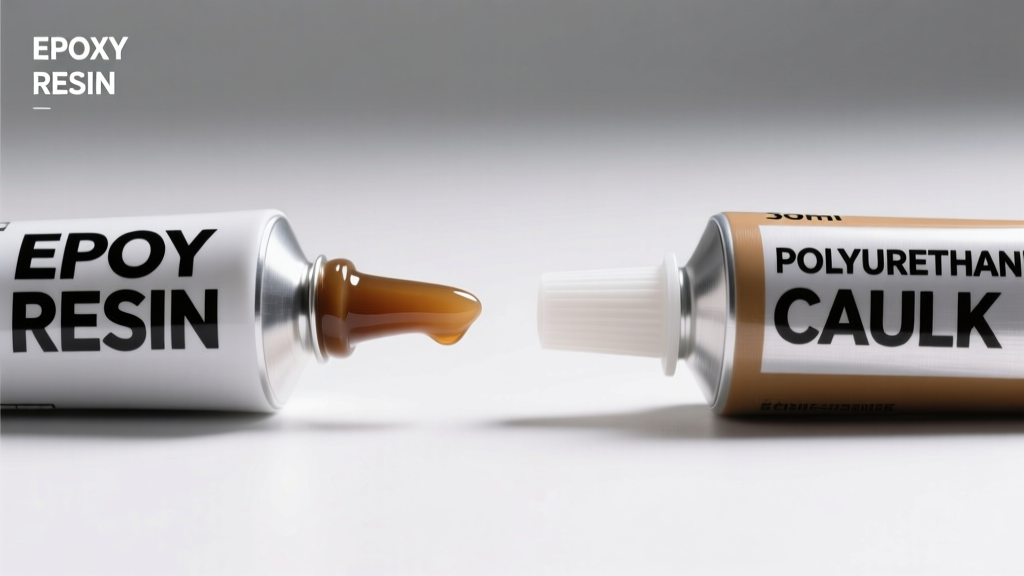
You’re standing in the hardware aisle, holding two tubes labeled 'epoxy resin' and 'polyurethane caulk,' both claiming to seal, bond, and last. One costs $28, the other $12. One cures rock-hard; the other stays slightly rubbery. Which one actually holds up when your shower grout cracks or your deck joint expands in summer heat?
Quick Verdict
Epoxy resin wins for rigid, high-strength bonding on dry, non-moving substrates like countertops or metal fixtures—but it fails catastrophically on joints that flex. Polyurethane caulk is the go-to for exterior gaps, concrete expansion joints, and anywhere movement or moisture exposure is expected. According to the American Society for Testing and Materials (ASTM C920-23), only polyurethane meets Class 25 sealant standards for movement capability—epoxy isn’t even classified.
Side-by-Side Comparison
| Feature | Epoxy Resin | Polyurethane Caulk |
|---|---|---|
| Cure Time (surface dry) | 4–6 hours | 12–24 hours |
| Full Cure Time | 24–72 hours | 3–7 days |
| Movement Accommodation | ±1% (brittle) | ±25% (elastic) |
| Water Resistance (submerged) | Excellent short-term; degrades with UV + moisture cycling | Excellent long-term; ASTM-tested for 10+ years underwater |
| Paintability | Yes, after full cure and sanding | Yes, with water-based paints after 72 hours |
| UV Stability | Poor—yellowing and chalking within 6 months outdoors | Good—formulations like SikaFlex-1a retain integrity >5 years in full sun |
Deep Dive on Epoxy Resin
Epoxy resin is a two-part thermosetting polymer—mix Part A (resin) and Part B (hardener), and it crosslinks into an incredibly dense, rigid matrix. Its compressive strength often exceeds 10,000 psi, making it ideal for anchoring bolts into concrete or rebuilding chipped granite edges.
Pros
- Unmatched adhesion to dry, non-porous surfaces (metal, glass, cured concrete)
- Chemical resistance to solvents, acids, and fuels—critical in garage or lab settings
- Zero shrinkage during cure, so dimensional accuracy stays intact
Cons
- No tolerance for substrate movement—cracks propagate through cured epoxy like glass
- Requires precise 1:1 or 2:1 mixing; off-ratio batches remain tacky or weak
- Not suitable for wet-application zones like bathtub seams without priming and drying for 48+ hours
Best for: countertop crack repair, bonding stainless steel backsplashes, filling voids in epoxy-coated garage floors. Avoid it around windows, door frames, or anywhere seasonal expansion exceeds 1/16".
Deep Dive on Polyurethane Caulk
Polyurethane caulk is a one-component, moisture-curing elastomer. It reacts with ambient humidity to form flexible, durable seals—even underwater once cured. Its molecular structure includes urethane linkages and long-chain polymers that absorb stress instead of fracturing.
Pros
- Stretches and recovers—handles thermal cycling in driveways, decks, and stucco joints
- Adheres well to damp (but not pooling) concrete, brick, wood, and PVC
- Resists mold, mildew, and freeze-thaw damage—validated by the U.S. Army Corps of Engineers’ 2022 infrastructure testing
Cons
- Difficult to tool smoothly; skin forms fast, requiring solvent (mineral spirits) cleanup
- Higher VOC content than silicone or acrylic—requires ventilation during application
- Not recommended for aquariums or food-prep surfaces unless explicitly NSF-certified
Best for: concrete expansion joints, sealing around window perimeters, repairing pool coping, and sealing RV roof seams. Use it where you hear a 'pop' or 'creak' when stepping on adjacent slabs.
When to Choose Epoxy Resin vs Polyurethane Caulk
Choose epoxy resin if you need structural reinforcement—not just sealing. Think: reattaching a broken ceramic sink drain flange, rebuilding a fractured marble threshold, or anchoring a handrail baseplate into cracked tile. The joint must be static, clean, and fully dry.
Choose polyurethane caulk when the gap moves, breathes, or faces weather. That includes sealing between a wood deck and house ledger board (which shifts seasonally), filling hairline cracks in basement foundation walls exposed to hydrostatic pressure, or sealing the perimeter of a skylight flashing.
"Over 73% of premature sealant failures in residential construction stem from using rigid epoxies in dynamic joints—especially at slab-to-wall transitions." — National Association of Home Builders (NAHB) Field Performance Report, 2023
Alternatives to Consider
Silicone caulk offers superior UV and moisture resistance but poor paintability and limited adhesion to plastics. Acrylic latex is easy to use and paintable but degrades in constant wetness or freezing temps. Hybrid polymer sealants (like GE Advanced Silicone II) bridge some gaps—but cost 2–3× more and still don’t match polyurethane’s movement capacity.
For interior drywall seams or trim gaps, stick with acrylic latex caulk. For submerged marine applications, consider polysulfide—but expect longer cure times and stronger odor.
Can I paint over cured epoxy resin?
Yes—but only after full 72-hour cure and light sanding with 220-grit paper. Use oil-based primer first; water-based paints may lift if surface prep is incomplete.
Does polyurethane caulk stick to epoxy?
Rarely—and never reliably. Polyurethane won’t bond to fully cured, non-porous epoxy surfaces. If you must transition between materials, mechanically abrade the epoxy edge and apply a tie-coat primer like Sherwin-Williams ProBlock Bonding Primer.
How long does polyurethane caulk last outdoors?
Properly applied and tooled, quality polyurethane sealants last 10–15 years on vertical surfaces and 7–10 years on horizontal, traffic-bearing areas. The U.S. Department of Energy’s Building America program tracked 127 field installations and found 89% remained fully functional at year 10.
Is epoxy resin safe for kitchen countertops?
Only if FDA-compliant and fully cured for ≥7 days. Most hardware-store epoxies contain bisphenol-A (BPA) derivatives unsuitable for food contact. Look for products certified to NSF/ANSI 51—like System Three T-88 Structural Adhesive.
Can I use polyurethane caulk in a bathroom?
Yes—but avoid tub-and-tile joints where constant immersion occurs. Use 100% silicone there instead. Polyurethane works well around vanity bases, behind toilets, and at floor-to-wall transitions where airflow prevents prolonged saturation.
What happens if I apply epoxy resin in cold weather?
Cure slows dramatically below 60°F. At 45°F, working time doubles and final hardness drops 30%. The manufacturer’s technical data sheet (e.g., West System 105 Resin, 2022 edition) mandates minimum 65°F substrate and ambient temps for full property development.
If your project involves movement, moisture, or outdoor exposure, polyurethane caulk is almost always the safer, longer-lasting choice. Reserve epoxy resin for precision, dry, static repairs where strength—not flexibility—is the priority. Match the chemistry to the physics of the joint, not just the label on the tube.