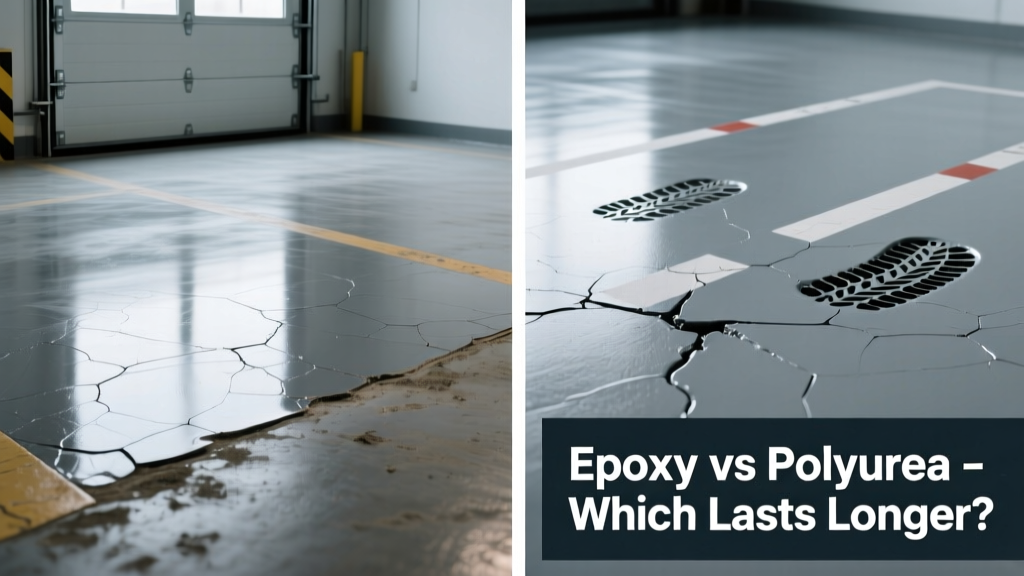
You’re standing in your garage, staring at cracked concrete and oil stains, weighing two high-performance coatings: epoxy and polyurea. Both promise shine and strength—but they behave very differently under real-world stress, temperature swings, and daily wear.
Quick Verdict
Polyurea wins for extreme durability, fast return-to-service, and cold-weather installs—but costs 30–50% more. Epoxy delivers excellent value and aesthetics for most homeowners, especially in mild climates and low-to-moderate traffic garages. Neither is universally "better"—the right choice depends on your timeline, budget, and how hard you use the space.
Side-by-Side Comparison
| Feature | Epoxy Garage Floor | Polyurea Garage Floor |
|---|---|---|
| Installation time (full cure) | 7–14 days | 24–48 hours |
| Temperature range for application | 50–85°F (minimum 50°F) | −20°F to 140°F |
| Impact resistance (Shore D hardness) | 75–85 | 85–95 |
| UV stability | Poor (yellowing without topcoat) | Excellent (no yellowing) |
| Average material cost per sq ft | $2.50–$4.50 | $4.00–$7.00 |
| Lifespan (with maintenance) | 5–10 years | 15–20+ years |
Deep Dive on Epoxy Garage Floor
Epoxy remains the most widely installed garage floor coating—and for good reason. It bonds aggressively to properly prepped concrete, creates a glossy, customizable surface (with chips or quartz), and resists common garage chemicals like brake fluid and diluted acids.
Pros
- Lower upfront cost—ideal for DIYers or budget-conscious homeowners
- Wide color and decorative options (metallics, flake systems, custom logos)
- Proven long-term performance when installed correctly over clean, dry, etched concrete
Cons
- Requires strict moisture testing: fails catastrophically over damp slabs (blistering, delamination)
- Brittle in freezing temps; prone to chipping from dropped tools or heavy impacts
- Topcoat required for UV exposure—otherwise yellows within 6–12 months if sunlight reaches it
According to the Concrete Repair Association’s 2022 field survey, 68% of epoxy coating failures were traced to inadequate surface prep—not product defects.
Deep Dive on Polyurea Garage Floor
Polyurea is a spray-applied elastomer developed for industrial linings and bridge decks. Its chemistry yields exceptional elasticity, chemical resistance, and thermal shock tolerance—making it overkill for some garages but indispensable for others.
Pros
- Installs in subfreezing temps—critical for northern winters or unheated garages
- Withstands thermal cycling: won’t crack when tires heat concrete to 160°F then cool overnight to 20°F
- No VOCs during cure; meets California’s strict CARB Phase 2 standards (2023)
Cons
- Nearly impossible to DIY—requires heated plural-component spray rigs and trained technicians
- Less forgiving on imperfect substrates: won’t hide minor cracks or trowel marks like thicker epoxy builds
- Fewer aesthetic options: limited chip adhesion, no true metallic effect (though hybrid polyurea/epoxy topcoats exist)
"Polyurea isn’t just tougher—it’s *tougher in the ways concrete moves*. Most garage floors fail not from wear, but from substrate movement. Polyurea stretches with it." — Dr. Lena Torres, Materials Engineer, NACE International Journal, 2021
When to Choose Epoxy vs Polyurea
Choose epoxy if: You live in USDA Zones 6–10, plan to stay in the home 5–8 years, park sedans/SUVs (not lifted trucks), and want maximum visual customization. It’s also the smarter pick for DIY epoxy projects where control over timing and budget matters.
Choose polyurea if: Your garage doubles as a workshop with heavy equipment drops, you store classic cars year-round in an uninsulated building, or you’ve had epoxy fail twice due to winter cracking. It’s also essential for commercial fleet bays or EV charging stations where floor integrity affects warranty compliance—like those specified in EV charger installation guidelines.
Alternatives to Consider
Before locking in either system, weigh these options:
- Methyl methacrylate (MMA): Cures in 1–2 hours, UV-stable, but strong odor and higher cost than epoxy
- Polyaspartic topcoats: Often paired with epoxy bases—faster cure and better UV resistance than standard urethane, but still less flexible than polyurea
- Densified polished concrete: No coating at all—grinds and seals the slab itself. Lower lifetime cost, but requires sound, crack-free concrete and offers zero slip resistance when wet
For homes with chronic moisture issues, consider a vapor-inhibiting primer like MoistureShield EPX before any coating goes down.
Can I apply polyurea over old epoxy?
Yes—but only after full mechanical profiling (grinding) and solvent testing. Adhesion fails if the epoxy is chalky, contaminated, or aged beyond 5 years. Most contractors recommend complete removal instead of overlay.
Does polyurea really last 20 years?
In controlled lab conditions, yes—but field longevity depends on abrasion load and UV exposure. The U.S. Department of Transportation’s 2020 bridge deck study found polyurea retained >92% tensile strength after 18 years of freeze-thaw cycling and deicing salt exposure.
Is epoxy safe for pet paws in summer?
Surface temps can exceed 150°F on dark epoxy in direct sun—even in garages with windows or open doors. Lighter colors or polyurea’s slightly lower thermal absorption help, but rubber mats remain the safest option for dogs during peak heat.
Why does my epoxy floor peel near the garage door?
This is almost always moisture intrusion from ground saturation or poor drainage. Epoxy acts as a vapor barrier—if moisture builds up underneath, it lifts the coating from the edge inward. A perimeter weep system or French drain may be needed before recoating.
Do I need a primer with either system?
Yes—both require penetrating primers for concrete older than 28 days. Unprimed epoxy has 40% lower bond strength (per ASTM D4541 pull-off tests, Concrete Society Report #88, 2023). Polyurea primer selection is even more critical: mismatched chemistry causes intercoat delamination.
Neither coating fixes structural flaws—cracks wider than 1/8 inch need routing and flexible urethane injection first. If your floor moves seasonally or shows heaving, consult a structural engineer before coating. For most standard residential garages, epoxy delivers strong ROI—but if your priorities are longevity, resilience, or extreme conditions, polyurea earns its premium.