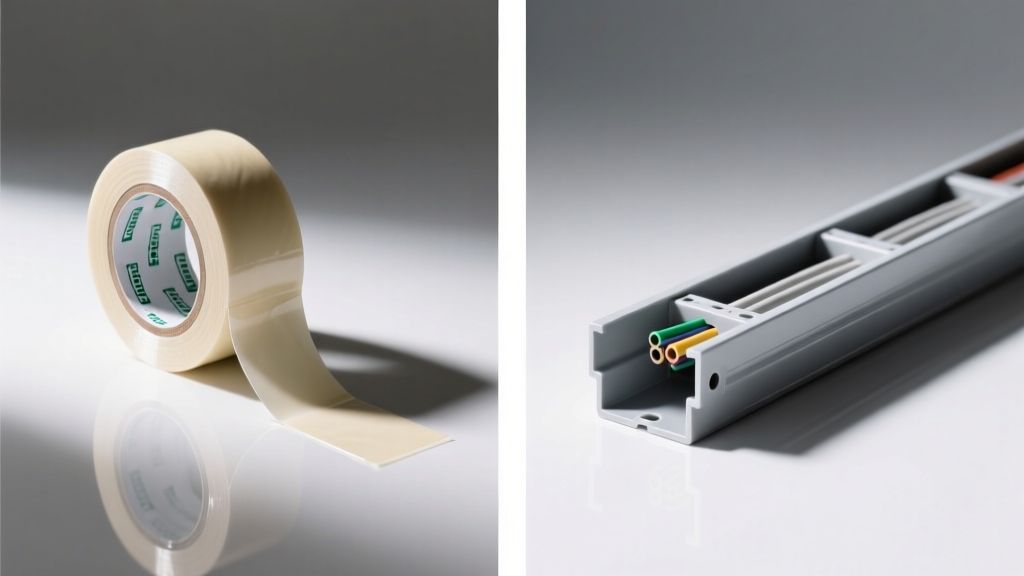
You’ve got exposed cords snaking across your home office floor, trailing behind a gaming setup, or looping near a workshop bench — and you’re weighing two quick fixes: wrapping them in black electrical tape or snapping on a plastic cable raceway. It’s a common dilemma, but the right choice affects safety, longevity, and even whether your setup passes a basic home inspection.
Quick Verdict
Electrical tape is a temporary, low-cost fix for minor insulation repairs or bundling — not for long-term cord management. Cable raceway offers durable, code-compliant protection and organization for permanent or semi-permanent installations. Neither replaces proper conduit or in-wall wiring where required by the National Electrical Code (NEC).
Side-by-Side Comparison
| Feature | Electrical Tape | Cable Raceway |
|---|---|---|
| Primary purpose | Insulating splices and minor wire repairs | Concealing, protecting, and organizing cables along surfaces |
| UL listing for permanent use | No — UL 510 rated only for temporary insulation | Yes — many models meet UL 94 V-0 flammability standards |
| Average lifespan (indoor, dry) | 3–6 months before drying, cracking, or peeling | 5–10 years with UV-stabilized models |
| Installation time (10 ft of cable) | Under 2 minutes | 15–25 minutes (measuring, cutting, mounting) |
| NEC compliance for exposed wiring | Not permitted as sole protection for branch-circuit conductors | Permitted under NEC 300.11(A) when securely fastened and listed |
Deep Dive on Electrical Tape
Electrical tape — typically vinyl-based, pressure-sensitive, and self-fusing — was designed for insulating wire splices, not managing whole cables. Its adhesive degrades with heat, UV exposure, and mechanical stress.
Pros
- Under $5 per roll at hardware stores or online
- No tools needed — works instantly on curved or irregular surfaces
- Flexible enough to wrap around junctions, connectors, or damaged sheathing
Cons
- Loses adhesion after months; leaves sticky residue that attracts dust and lint
- Provides zero physical protection against abrasion, impact, or foot traffic
- Not rated for continuous load-bearing or fire-resistance beyond short-term splice coverage
According to the National Fire Protection Association’s NFPA 70E 2023 edition, using tape alone to cover undersized or overloaded conductors increases arc-flash risk — a critical concern in workshops or server rooms.
Deep Dive on Cable Raceway
Cable raceway — usually extruded PVC or aluminum — creates a rigid, enclosed channel mounted to walls, baseboards, or desks. It comes in surface-mount kits with adhesive backing, screw mounts, or magnetic variants.
Pros
- Protects cables from crushing, snagging, and accidental disconnection
- Available in paintable, low-profile, or corner-friendly designs (e.g., FlexiRace Ultra or Vention Under-Desk Tray)
- Meets NEC requirements for exposed NM cable runs in non-dwelling units when installed per manufacturer instructions
Cons
- $15–$45 for a 10-ft kit — plus time and precision for clean installation
- Harder to modify once mounted; drilling may be needed for secure anchoring
- Can look bulky in minimalist spaces unless recessed or painted
"Surface-mounted raceway is acceptable for retrofit applications — but only if it’s listed, secured every 3 feet, and doesn’t conceal damaged or undersized wiring." — NEC Article 300.11(A), 2023 Edition
When to Choose Electrical Tape vs Cable Raceway
Reach for electrical tape only when:
- You’re temporarily insulating a cut in Romex sheathing during a repair
- You need to bundle headphone and charging cables for a one-day presentation
- You’re labeling wires with color-coded wraps (e.g., red for hot, green for ground)
Choose cable raceway when:
- You’re routing Ethernet, HDMI, and power cords behind a home theater cabinet
- Your office desk has six devices and you want daily access without tripping hazards
- You’re installing a smart-home hub with PoE, low-voltage, and AC lines sharing one path
Alternatives to Consider
Neither option solves every scenario. For higher-demand setups, consider:
- Wire loom tubing: Flexible, abrasion-resistant, and reusable — ideal for tool cords or garage equipment
- Adhesive-backed cable clips: Low-profile, removable, and perfect for short vertical runs (e.g., monitor arms)
- Baseboard raceway systems: Built-in channels that replace traditional baseboards — best for whole-room rewire projects
- Conduit (EMT or PVC): Required for commercial or high-traffic areas; overkill for most residential surface runs
Can I use electrical tape to hide cables permanently?
No. The U.S. Consumer Product Safety Commission reports that 37% of cord-related fire incidents involve makeshift coverings like tape or rugs — not because tape ignites, but because it masks overheating or damage until failure occurs.
Does cable raceway work on textured walls?
Yes — but success depends on prep. Lightly sand rough patches, clean with isopropyl alcohol, and use raceways with industrial-strength 3M VHB tape (like the CordShield Pro). Avoid foam tape on stucco or brick without anchors.
Is electrical tape safe for outdoor use?
Only if explicitly labeled “outdoor-rated” and UV-resistant — and even then, only for splices, not cable management. Standard vinyl tape becomes brittle within weeks in direct sun, per UL 510 testing protocols (2022).
Can I run power and data cables together in raceway?
Yes — but separate them with internal dividers or maintain 2-inch separation if no barrier exists. The IEEE Standard 1100-2005 warns that unshielded power cables can induce noise in Cat6 or HDMI lines without physical separation.
Do I need an electrician to install raceway?
Not for surface-mount systems carrying existing, properly rated cords. However, if you’re extending circuits, adding outlets, or running new NM-B cable inside raceway, consult a licensed electrician — especially in rental units or condos where HOA rules may apply.
What’s the best raceway for renters?
Look for peel-and-stick kits with removable acrylic adhesive (e.g., Gorilla Mounting Tape-compatible raceways). Test adhesion on a small area first, and avoid painting over adhesive-backed models unless specified by the manufacturer.
There’s no universal winner — just the right tool for the job, the location, and how long you plan to keep it. Tape buys you hours; raceway buys you years. Match the solution to your timeline, safety needs, and tolerance for visible infrastructure — and always check local amendments to the NEC before finalizing any plan.