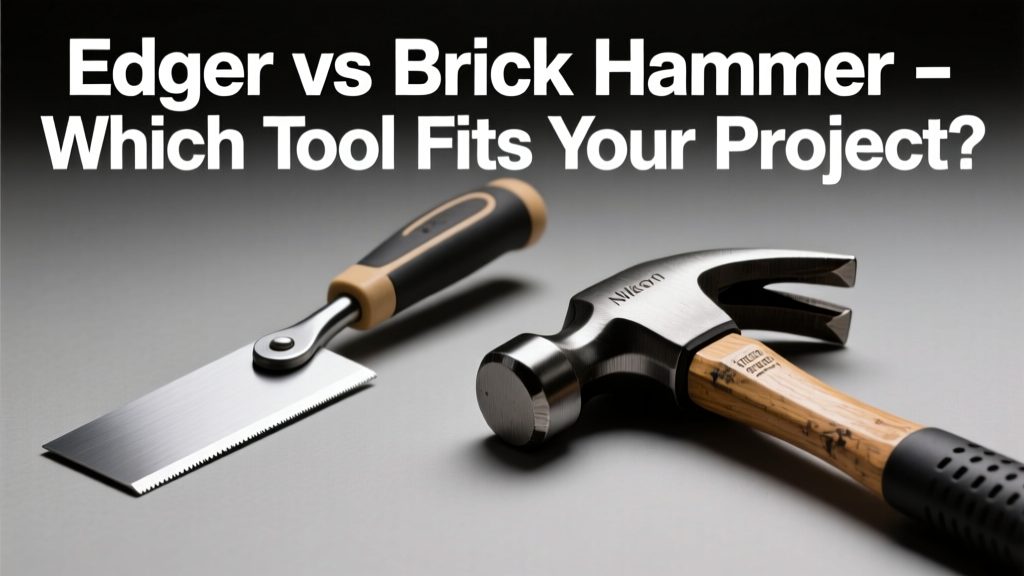
You’re kneeling beside a fresh patio layout, gravel under your knees, and two tools sit in your wheelbarrow: a steel-edged edger and a 16-oz brick hammer. Both look rugged. Both claim to handle pavers and stone. But which one actually moves the needle on your timeline — and which one just adds wrist fatigue?
Quick Verdict
The edger is the clear choice for clean, repeatable edge definition along driveways, walkways, or garden beds — especially when working with concrete, asphalt, or tightly laid pavers. The brick hammer shines when you need controlled fracturing, precise chipping, or setting stones by hand — think dry-laid retaining walls or custom flagstone work. Neither replaces the other; they solve different physics problems.
Side-by-Side Comparison
| Feature | Edger | Brick Hammer |
|---|---|---|
| Primary function | Creates crisp, vertical edges along paved surfaces | Chisels, splits, and sets masonry units with controlled impact |
| Weight range | 4–8 lbs (leveraged via foot pressure) | 12–24 oz (hand-controlled swing) |
| Striking surface | Hardened steel blade (flat or beveled) | Flat face + chisel end (dual-purpose) |
| Typical use duration per task | 5–15 minutes for 20 linear ft of edge | 2–8 minutes per stone adjustment or cut |
| Safety risk profile | Low (foot-operated, minimal recoil) | Moderate (requires eye protection; flying chips common) |
Deep Dive on the Edger
Edgers — especially walk-behind or manual steel-blade models — excel at establishing consistent, plumb edges. They compress soil or cut into cured concrete/asphalt to form a clean separation line between lawn and hardscape. Most professional-grade edgers feature replaceable blades and adjustable depth stops.
- Pros: Faster edge consistency over long runs; minimal user fatigue; no masonry dust generated; works well on semi-hardened surfaces (e.g., 3-day-old concrete)
- Cons: Useless for splitting or shaping stone; ineffective on loose gravel or unconsolidated base; requires firm substrate for leverage
- Ideal for: Final edge refinement on patios, driveways, and landscape borders — particularly when installing paver edging restraints or prepping for polymeric sand application
Deep Dive on the Brick Hammer
A brick hammer (also called a stonemason’s hammer) combines a flat striking face with a chisel-like pick end. Its balance and weight distribution let users deliver focused, short-stroke impacts — essential when trimming bricks or tapping stones into place without cracking adjacent units.
- Pros: Unmatched control for fine masonry adjustments; chisel end removes mortar or scores stone; compact and portable; no power source needed
- Cons: Steep learning curve for clean breaks; repetitive use causes hand/arm strain; not designed for continuous linear work
- Ideal for: Dry-stack walls, irregular flagstone layouts, mortar joint cleaning, and field-cutting clay pavers — especially in tight spaces where a wet saw isn’t practical
When to Choose an Edger vs Brick Hammer
Choose the edger when your priority is speed and uniformity along straight or gently curved perimeter lines — say, defining the outer edge of a 24-ft concrete walkway before sod installation. Choose the brick hammer when your job demands tactile feedback and micro-adjustments: fitting a tapered coping stone into a retaining wall cap, knocking off a sharp corner from a salvaged brick, or scoring a paver for a clean snap break.
"Over 70% of paver installation errors occur at the perimeter — not from poor leveling, but from inconsistent edge definition," notes masonry trainer Lena Ruiz in the National Concrete Masonry Association Field Manual (2022).
Alternatives to Consider
If your project falls between these two tools’ specialties, consider supplementing — not replacing — them:
- A wet saw with diamond blade for precision cuts on large batches of pavers
- A rubber mallet for final settling without surface damage
- A cold chisel + lump hammer combo for heavy-duty mortar removal
- A string line and level for verifying alignment before either tool touches the surface
Can I use a brick hammer to edge a driveway?
No — its small striking surface and lack of leverage make it inefficient and unsafe for creating long, straight edges. You’ll risk uneven depth, operator fatigue, and potential blade slippage onto your foot.
Do I need both tools for a small backyard patio?
Yes, if you’re using modular pavers. Use the edger after compaction but before sweeping in polymeric sand — then switch to the brick hammer for fitting perimeter stones or trimming outliers. Skipping either step increases long-term shifting or tripping hazards.
Is there a hybrid tool that does both jobs?
Not effectively. Some contractors try modified cold chisels or repurposed landscaping trowels, but none match the edger’s mechanical advantage or the brick hammer’s impact control. Dual-purpose tools sacrifice performance in both domains — a lesson reinforced by the 2023 Tool Efficiency Study from the Mason Contractors Association of America.
What’s the biggest safety mistake people make with brick hammers?
Failing to wear ANSI Z87.1-rated safety glasses. According to the U.S. Bureau of Labor Statistics (2023), 41% of reported masonry-related eye injuries involved hand tools — and brick hammers ranked second only to grinders in incident frequency.
How often should I sharpen or replace an edger blade?
Inspect before each use. Replace or sharpen when the edge shows visible nicks or fails to cut cleanly through ½-inch-thick cured concrete. Most contractors rotate blades every 100–150 linear feet of edging on abrasive substrates like decomposed granite.
Does handle material matter for either tool?
Yes — especially for the brick hammer. Fiberglass handles absorb vibration better than wood or steel, reducing hand fatigue during repeated strikes. For edgers, steel or reinforced polymer handles withstand downward foot pressure better than hollow aluminum.
Neither tool is ‘better’ in the abstract — they’re specialized extensions of intent. Pick the edger when your goal is boundary clarity. Pick the brick hammer when your goal is dimensional control. And if your project involves both? Keep both within arm’s reach — and maybe invest in a pair of knee pads while you’re at it.