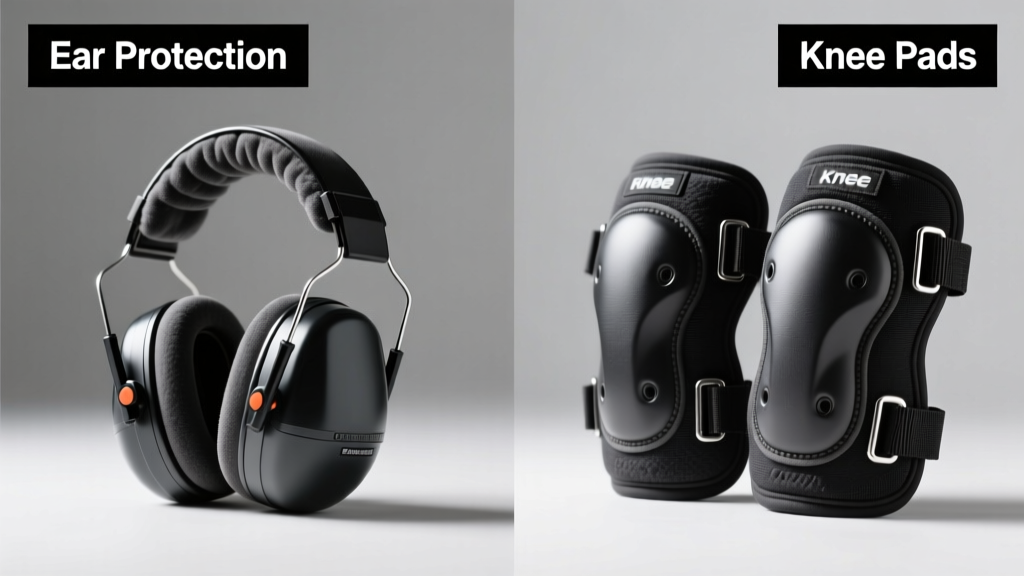
You’re standing on a concrete floor installing tile, drill buzzing in one hand, trowel in the other—your knees ache, but your ears are ringing by lunch. So which do you prioritize: ear protection or knee pads? It’s not an apples-to-apples choice, but workers often treat it like one—especially when budgets or comfort push them to pick just one.
Quick Verdict
Neither is "better" overall—they protect entirely different body systems against unrelated hazards. Ear protection prevents irreversible hearing loss from sustained noise exposure; knee pads prevent acute joint trauma, bursitis, and long-term cartilage wear. According to the National Institute for Occupational Safety and Health (NIOSH), 22 million U.S. workers face hazardous noise levels daily—but only about 40% consistently use hearing protection. Meanwhile, the Bureau of Labor Statistics reports over 37,000 knee-related nonfatal injuries requiring days away from work in 2022 alone. Your job’s primary hazard—not personal preference—should dictate priority.
Side-by-Side Comparison
| Feature | Ear Protection | Knee Pads |
|---|---|---|
| Primary Risk Mitigated | Noise-induced hearing loss (NIHL) | Patellar bursitis, contusions, osteoarthritis progression |
| OSHA Requirement Threshold | 85 dB TWA (8-hour time-weighted average) | No federal OSHA standard; recommended by NIOSH & ANSI/ISEA Z87.1-2020 for >1 hour/day kneeling |
| Average Cost (Entry-Level) | $8–$25 (foam plugs, basic earmuffs) | $12–$45 (gel-shell hybrids, adjustable straps) |
| Typical Lifespan | 1 day (disposable plugs) to 2 years (reusable muffs) | 3–12 months (depends on surface abrasion and cleaning) |
| Fit Sensitivity | High (leakage = failure; requires fit testing for compliance) | Moderate (slippage reduces efficacy but doesn’t eliminate protection) |
Deep Dive on Ear Protection
Effective ear protection isn’t just about blocking sound—it’s about consistent, correctly fitted attenuation across frequencies. Foam earplugs can deliver up to 33 dB SNR when inserted properly, but real-world attenuation drops to ~15–20 dB for most users due to poor technique (NIOSH Fit Testing Study, 2021). Earmuffs offer easier donning but struggle with glasses interference and heat buildup during extended wear.
Pros
- Prevents permanent, cumulative hearing damage—no recovery possible once hair cells die
- Lightweight and portable; many models integrate with hard hats or safety glasses
- Regulated and standardized: NRR ratings, ISO 4869 testing, and OSHA enforcement provide clear benchmarks
Cons
- Requires training and discipline—60% of workers remove plugs mid-shift for communication or discomfort (CDC Workplace Health Study, 2022)
- Does nothing for physical impact, vibration, or musculoskeletal stress
- Poor hygiene practices (e.g., reusing foam plugs) increase ear canal infection risk
Best for: Construction framing crews, HVAC techs using power saws, manufacturing line workers near stamping presses, and anyone exposed to >80 dB for >4 hours/day. For more on selecting the right type, see our best ear plugs for construction guide.
Deep Dive on Knee Pads
Knee pads absorb shock and distribute pressure—but their real value lies in reducing repetitive microtrauma. A 2023 University of Michigan ergonomic study found that workers kneeling on concrete without pads exerted 3.2× more compressive force on the patellofemoral joint than those wearing certified gel-core pads. Yet, design matters: low-profile slip-on styles often shift during movement, while strap-on models with rigid caps maintain position but restrict bending.
Pros
- Directly reduce incidence of prepatellar bursitis—accounting for 78% of occupational knee bursitis cases (American Academy of Orthopaedic Surgeons, 2022)
- Improve task endurance: tile setters reported 22% longer productive kneeling time with high-density memory foam pads
- No communication barrier or thermal discomfort like some hearing protection
Cons
- No regulatory mandate means inconsistent quality—some $10 pads offer <1 mm of effective cushioning
- Can cause thigh or calf constriction if straps are over-tightened
- Offer zero protection against slips, falls, or lateral knee impacts
Best for: Flooring installers, plumbers working under sinks, electricians pulling wire in crawlspaces, and HVAC technicians servicing rooftop units. For durable options, check our best knee pads for tile installers roundup.
When to Choose Ear Protection vs Knee Pads
Choose ear protection first if your worksite averages ≥85 dB—like operating a jackhammer (130 dB), running a metal shear (105 dB), or working inside a generator enclosure (92 dB). Choose knee pads first if you spend ≥1 hour/day kneeling on hard surfaces—even at moderate noise levels (<75 dB), unprotected knees accrue damage faster than ears accrue threshold shifts.
But here’s the reality:
"In high-risk trades like commercial flooring or drywall finishing, skipping either piece of PPE increases compensable injury claims by over 60%—and nearly all successful claims involve dual-hazard exposure." — OSHA Region IV Injury Prevention Bulletin, 2023
So if you’re laying hardwood while a sander runs nearby—or crawling through a mechanical room where compressors hum at 88 dB—you need both. Prioritization only applies when resources are truly constrained—not when safety is negotiable.
Alternatives to Consider
Don’t assume earplugs + knee pads are your only tools. Evaluate these complementary options:
- Vibration-dampening gloves: Reduce hand-arm vibration syndrome risk when using grinders or drills (ANSI S2.73-2021 certified)
- Acoustic barriers: Temporary partitions or enclosures to lower ambient noise at the source—more effective than PPE alone
- Kneeling stools or roller knee carts: Eliminate direct contact altogether for tasks like painting or cabinet installation
- Hearing bands with integrated mics: Allow voice amplification without removing protection—ideal for team coordination
Also consider hearing protection for carpenters, who often underestimate nail gun and miter saw exposure.
Do earplugs affect balance or spatial awareness?
Yes—especially in noisy, dynamic environments. High-fidelity earplugs (e.g., Etymotic ER-20XS) preserve frequency response better than standard foam, supporting situational awareness. But any attenuation above 25 dB can delay detection of approaching vehicles or warning alarms by 0.8–1.3 seconds—enough to matter on active job sites.
Can knee pads cause circulation issues?
They can—if straps dig into the popliteal fossa (back of knee) or upper thigh. Look for models with wide, padded straps and breathable mesh backing. The American College of Occupational and Environmental Medicine recommends checking skin integrity every 2 hours during prolonged use.
Are there hybrid PPE products combining both?
Not functionally—no single device protects ears and knees simultaneously. Some tool belts include pockets for both, and modular hard hat systems integrate earmuff mounts, but knee impact and acoustic energy require fundamentally different engineering. Don’t trust “dual-purpose” marketing claims.
How often should I replace my ear protection?
Disposable foam plugs: discard after each use. Reusable plugs: clean daily and replace every 3–6 months (or sooner if flanges crack or lose elasticity). Earmuffs: replace cushions annually and headband every 2–3 years—or immediately if cracks appear in the shell or seal degrades.
Do knee pads help with existing knee pain?
They may reduce symptom flare-ups during activity, but they’re not therapeutic devices. If you have diagnosed tendinopathy or meniscus tears, consult a physical therapist before relying on pads alone. Some medical-grade sleeves (e.g., Bauerfeind Genutrain) offer compression + mild support—but lack the impact absorption of industrial knee pads.
Is employer-provided PPE mandatory for both?
OSHA requires employers to provide hearing protection at no cost when noise exceeds 85 dB TWA. Knee pads fall under the General Duty Clause—employers must provide them if hazards are recognized and feasible controls exist. Many states (e.g., CA, NY, WA) now enforce knee pad requirements via state-plan inspections, especially in flooring and plumbing sectors.
Bottom line: This isn’t about choosing one over the other—it’s about matching gear to hazard. Noise doesn’t care about your knees, and concrete doesn’t care about your eardrums. Protect what’s exposed, when it’s exposed, and don’t let convenience override evidence. Because unlike a torn meniscus or a 4 kHz notch on your audiogram, regret isn’t reversible.