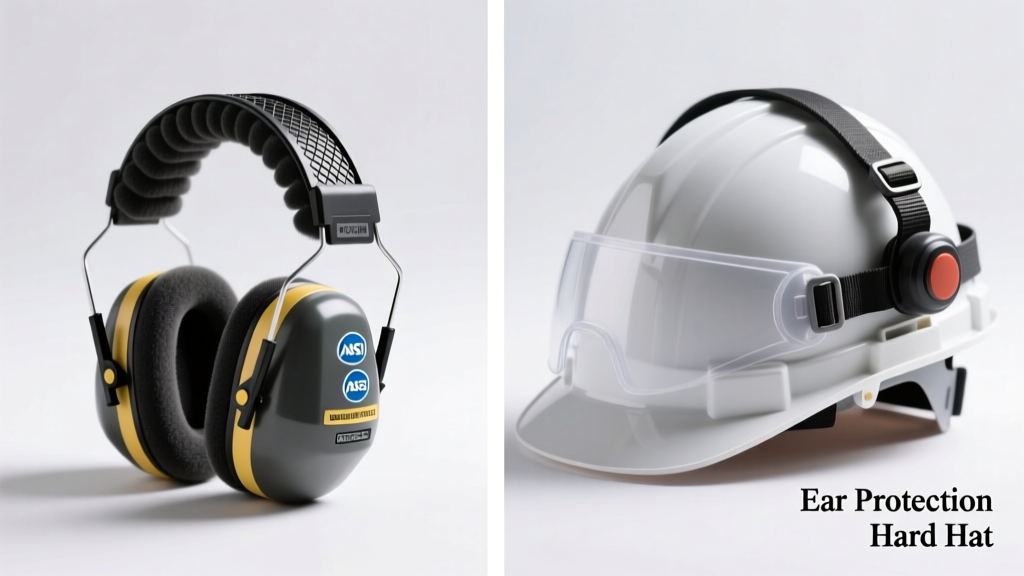
You’re standing on a construction site, drill vibrating in your hand, overhead crane moving steel beams — and you’re wondering: do I grab the foam earplugs or the yellow hard hat first? It’s not an either/or choice — but knowing which safeguard addresses which hazard is critical to staying safe and compliant.
Quick Verdict
Neither ear protection nor a hard hat is "better" overall — they protect against fundamentally different hazards. Ear protection guards against noise-induced hearing loss (NIHL), while hard hats prevent traumatic head injury from impacts, falling objects, or electrical contact. OSHA requires both when hazards coexist — and in many industrial settings, that’s the daily reality.
Side-by-Side Comparison
| Feature | Ear Protection | Hard Hat |
|---|---|---|
| Primary hazard addressed | Sound pressure levels ≥85 dB(A) over an 8-hour shift | Impact, penetration, and electrical hazards to the skull |
| OSHA standard | 29 CFR 1910.95 (Hearing Conservation) | 29 CFR 1910.135 (Head Protection) |
| Typical attenuation | 15–33 dB (varies by type and fit) | Not rated for sound; may slightly reduce high-frequency noise by 2–4 dB |
| Lifespan (with care) | Single-use (foam), or 6–12 months (reusable earmuffs) | Up to 5 years (per manufacturer), but inspect monthly for cracks or UV degradation |
| Required with other PPE? | Yes — often worn with hard hats using suspension-mounted earmuffs | Yes — compatible with face shields, eye protection, and certain hearing devices |
Deep Dive on Ear Protection
Ear protection includes disposable foam plugs, reusable silicone or flanged plugs, and over-the-ear earmuffs. Its sole purpose is reducing decibel exposure — not shielding from physical impact. According to the National Institute for Occupational Safety and Health (NIOSH), 22 million U.S. workers are exposed to hazardous noise annually, and up to 24% of hearing loss in adults is work-related (NIOSH, 2022).
Pros
- Highly effective when properly fitted — well-sealed foam plugs can achieve up to 33 dB reduction
- Lightweight and low-profile, especially custom-molded options
- Compatible with most hard hats via ANSI Z89.1-compliant suspension adapters
Cons
- No protection against falling tools, swinging loads, or overhead hazards
- Effectiveness drops sharply with poor fit — 30% of workers wear earplugs incorrectly (CDC, 2021)
- Can interfere with verbal communication or radio use if not designed for comms integration
Deep Dive on Hard Hats
A hard hat is engineered to absorb and distribute impact energy across its shell and suspension system. Per ANSI/ISEA Z89.1-2023, Type I helmets resist top-impact only, while Type II also guard against lateral and off-center blows. They’re tested at temperatures from −30°C to +50°C and must withstand 440 volts AC for Class G (General) and 2,200 volts for Class E (Electrical).
Pros
- Proven impact resistance — reduces skull fracture risk by up to 85% in tested scenarios (Insurance Institute for Business & Home Safety, 2023)
- Available with built-in visors, chin straps, and accessory rails for mounting lights or cameras
- UV-stabilized shells maintain integrity in outdoor environments for up to 2 years
Cons
- No meaningful hearing protection — some models even amplify mid-frequency noise due to shell resonance
- Bulkier than earplugs; can cause heat stress in hot, humid conditions
- Suspension systems degrade over time — replace every 12 months regardless of visible damage
When to Choose Ear Protection vs Hard Hat
Choose ear protection when your primary risk is sustained noise — like operating jackhammers (130 dB), running generators (105 dB), or working near conveyor systems (88–95 dB). Choose a hard hat where overhead hazards exist — think roofing, scaffolding assembly, or utility pole climbing. But here’s the key: if your job involves both noise and impact risks — which covers over 60% of construction, manufacturing, and infrastructure roles — you need both.
"A hard hat without hearing protection leaves workers vulnerable to irreversible hearing damage — and earplugs alone won’t stop a dropped wrench. Dual protection isn’t optional in high-risk zones; it’s the baseline." — Dr. Lena Torres, Industrial Hygiene Specialist, NIOSH, 2023
Alternatives to Consider
For complex hazard profiles, consider integrated solutions:
- Hard hat–earmuff combos with ANSI-certified suspension mounts
- Electronic earmuffs that amplify speech while suppressing impulse noise (e.g., gunfire or nail guns)
- Custom-molded earplugs with radio-compatible stems for team coordination
- ANSI Type II hard hats with integrated ventilation and sweatband liners for extended wear
Can I wear earplugs under a hard hat?
Yes — and it’s often preferred. Foam or flanged earplugs sit inside the ear canal and don’t interfere with helmet fit. Just ensure the hard hat suspension isn’t overtightened, which can dislodge plugs during movement.
Do hard hats block out noise?
No. While the rigid shell may slightly dampen high-frequency sounds (2–4 dB), it offers no meaningful attenuation for occupational noise. Relying on a hard hat for hearing protection violates OSHA’s hearing conservation standard.
How often should I replace my earplugs?
Disposable foam earplugs should be discarded after each use. Reusable silicone or flanged plugs last 3–6 months with daily cleaning; inspect for cracks, stiffness, or seal loss. Earmuff cushions need replacing every 6 months or sooner if flattened or cracked.
What if my hard hat gets dropped?
Inspect it immediately. Even one drop from waist height can compromise shell integrity. Look for hairline cracks, white stress marks, or deformation. When in doubt, replace it — per MSA’s field guide, 72% of failed helmets showed no visible damage before testing.
Is there a single device that does both jobs?
Not truly — but hard hat–mounted earmuffs certified to both ANSI S3.19 (hearing) and Z89.1 (head) standards come closest. These combine impact resistance with 25–31 dB NRR and are widely used in rail, mining, and wind turbine maintenance.
Does wearing both slow me down or impair awareness?
Modern dual-certified systems improve situational awareness — especially electronic earmuffs with 360° voice amplification and ambient sound pass-through. A 2022 study in the Journal of Safety Research found workers using integrated systems reported 18% faster response times to verbal safety cues than those using separate, non-integrated gear.
Ultimately, asking “which is better” misses the point: hearing loss and head trauma are preventable, but only when protections match the actual hazards present. Start with a site-specific hazard assessment — then equip accordingly. And remember: if your ears ring after a shift or your hard hat has seen two summers of sun exposure, it’s already time for an upgrade.