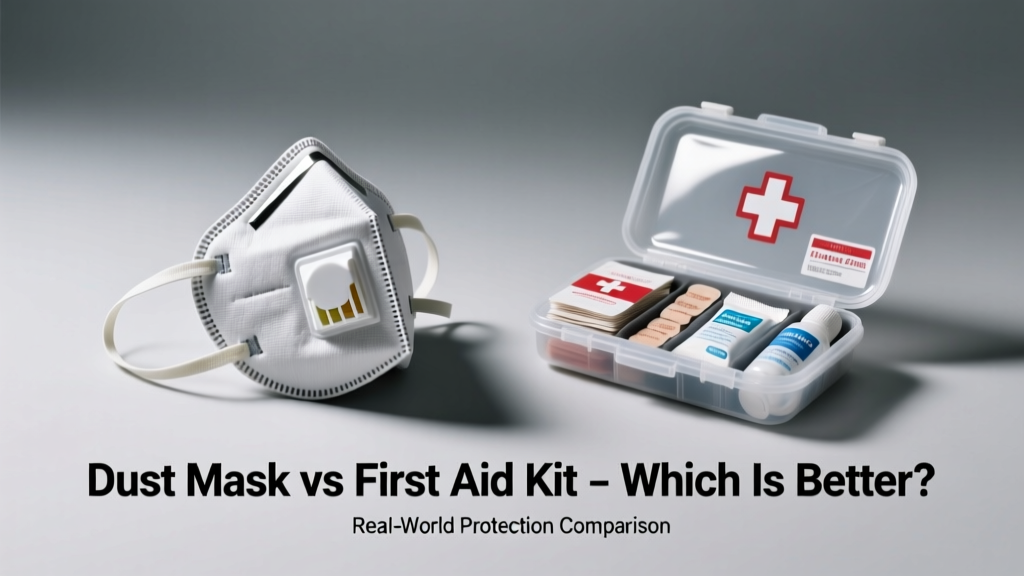
You’re prepping your garage for a weekend drywall project—and you pause: should you grab the dust mask or the first aid kit? It’s a common mix-up, especially for new DIYers. But these two items serve entirely different safety functions—and confusing them could leave you unprotected in the wrong way.
Quick Verdict
Neither is "better"—they’re complementary, not competing. A dust mask protects your respiratory system from airborne particles during tasks like sanding or sweeping; a first aid kit treats injuries like cuts, burns, or sprains after they happen. According to the National Safety Council’s 2023 Injury Facts, over 60% of home injuries involve lacerations or contusions—situations a first aid kit addresses—but only 4% stem from inhalation hazards, where a dust mask matters most. You need both, just at different times and for different reasons.
Side-by-Side Comparison
| Feature | Dust Mask | First Aid Kit |
|---|---|---|
| Purpose | Prevents inhalation of dust, fibers, or nuisance-level particulates | Treats minor injuries (cuts, scrapes, burns, sprains) |
| Regulatory Standard | N95 respirators meet NIOSH 42 CFR 84; basic dust masks are unregulated | Meets ANSI/ISEA Z308.1-2023 for workplace kits; home kits vary widely |
| Typical Contents | Non-woven fabric, elastic straps, nose bridge | Adhesive bandages, antiseptic wipes, gauze pads, tweezers, CPR face shield |
| Lifespan | Single-use or limited reuse (max 8 hours continuous wear) | 3–5 years (check expiration dates on ointments and antiseptics) |
| Cost Range (Standard) | $2–$15 per unit (N95s cost more than cloth masks) | $12–$85 (basic home kit vs. OSHA-compliant 10-person kit) |
Deep Dive on Dust Masks
Dust masks—especially certified N95 respirators—are engineered to filter at least 95% of non-oil-based airborne particles as small as 0.3 microns. They’re essential during drywall sanding, attic insulation removal, or cleaning moldy basements. But they’re not medical devices, and they don’t protect against gases, vapors, or high-concentration aerosols like spray paint fumes.
- Pros: Lightweight, portable, low-cost per use, effective for silica and wood dust when properly fitted
- Cons: No protection against chemical vapors; ineffective if facial hair blocks seal; useless for oxygen-deficient spaces
- Ideal use cases: Sanding hardwood floors, sweeping concrete dust, cleaning out old sheds with rodent droppings, post-flood debris cleanup
Remember: A poorly fitted dust mask offers little real protection. As Dr. Lena Cho, industrial hygienist at the University of Michigan School of Public Health, notes:
"Fit testing isn’t optional for occupational settings—and even at home, holding the mask firmly while breathing in helps verify seal integrity before starting work."
Deep Dive on First Aid Kits
A first aid kit is a reactive tool—not preventive. Its value lies in speed and organization: having sterile gauze, medical-grade adhesive, and antiseptic within arm’s reach cuts response time for minor injuries by up to 70%, according to a 2022 study in American Journal of Emergency Medicine. Modern kits also include trauma supplies like tourniquets and hemostatic gauze—critical upgrades over older models.
- Pros: Addresses bleeding, infection risk, pain, and shock; supports compliance with OSHA standards for workplaces; modular refills extend usability
- Cons: Useless against inhalation hazards; requires regular inspection and restocking; outdated kits may contain expired epinephrine or degraded adhesives
- Ideal use cases: Workshop accidents, kitchen knife slips, bike falls, child scrapes, pet bite cleanups
For home use, the American Red Cross recommends keeping at least one fully stocked kit on every floor—and a smaller version in your car. Check out our best first aid kits for home roundup for verified picks.
When to Choose a Dust Mask vs First Aid Kit
Choose a dust mask before you start a dusty or fibrous task—even if you feel fine. Choose a first aid kit after an injury occurs—or keep it ready so you’re not scrambling when someone slices a finger on a box cutter.
- Renovating a 1950s bathroom? Wear an N95 while removing tile grout (silica hazard), then reach for the first aid kit if you nick your thumb on broken ceramic.
- Cleaning the garage after a storm? Dust mask for moldy cardboard and insulation fibers; first aid kit for splinters from broken pallets.
- Helping kids build a birdhouse? Skip the mask—but keep the first aid kit open on the workbench for glue burns or hammer misses.
- Sanding outdoor deck furniture? N95 required for cedar dust (a known sensitizer); have burn gel and blister pads nearby in case of friction burns.
Don’t skip either: The U.S. EPA estimates that 14% of household water usage is from leaks—but respiratory exposure from DIY projects accounts for nearly 22% of preventable indoor air quality incidents in homes without proper PPE (EPA Indoor Air Quality Tools for Schools, 2023).
Alternatives to Consider
Depending on your activity, other tools may be more appropriate—or necessary—in addition to these two:
- Half-face respirators for prolonged exposure to paint fumes or pesticide application
- Emergency trauma kits for hiking, camping, or remote worksites (includes chest seals and pressure dressings)
- Eye wash stations or saline solution for chemical splashes—especially when using solvents or drain cleaners
- Fire extinguishers rated for Class A (wood/paper) and Class C (electrical) fires—often overlooked in garages and workshops
Can a dust mask replace a surgical mask?
No. Surgical masks are fluid-resistant and designed to block large droplets from the wearer—protecting others. Dust masks (especially N95s) protect the wearer from particles, but lack fluid resistance. For illness prevention, use surgical or KN95 masks—not basic dust masks.
Do first aid kits expire?
Yes—adhesives dry out, antiseptic solutions degrade, and ointments separate. Most components last 3–5 years, but check individual labels. Replace gauze if it’s yellowed or brittle, and swap out single-use cold packs if swollen or leaking.
Is an N95 the same as a dust mask?
No. “Dust mask” is a generic term—many are simple cloth or paper barriers with no certification. An N95 is a specific NIOSH-approved respirator meeting strict filtration and fit requirements. Look for the NIOSH approval number (e.g., TC-84A-XXXX) printed on the mask or packaging.
Can I store my first aid kit in the garage?
Only if temperature stays between 55°F–80°F year-round. Heat degrades epinephrine and antibiotic ointments; freezing makes adhesives brittle. A garage-mounted cabinet with insulation or a climate-controlled shed corner is safer than a bare shelf near the water heater.
What’s the minimum first aid kit for a family of four?
The ANSI Z308.1-2023 standard recommends at least 40 distinct items—including 25 adhesive bandages (assorted sizes), 2 sterile gauze pads (3″ × 3″), 1 roll of cohesive bandage wrap, and 1 CPR face shield. See our minimalist first aid kit guide for compact, travel-ready options.
Do dust masks help with seasonal allergies?
Basic dust masks offer minimal relief. Pollen particles range from 10–100 microns—large enough to be caught by many paper masks—but they don’t seal well around the nose and mouth. Certified N95s or ASTM F3502-compliant reusable masks are far more effective for allergy season, especially during high-pollen mowing or gardening.
Bottom line: Your workshop isn’t safer with just one of these—it’s safer with both, used correctly and stored where you’ll actually reach for them. A dust mask won’t stop a bleeding finger. A first aid kit won’t filter fiberglass particles. Respect their roles, stock them thoughtfully, and check them quarterly—not just after something goes wrong.