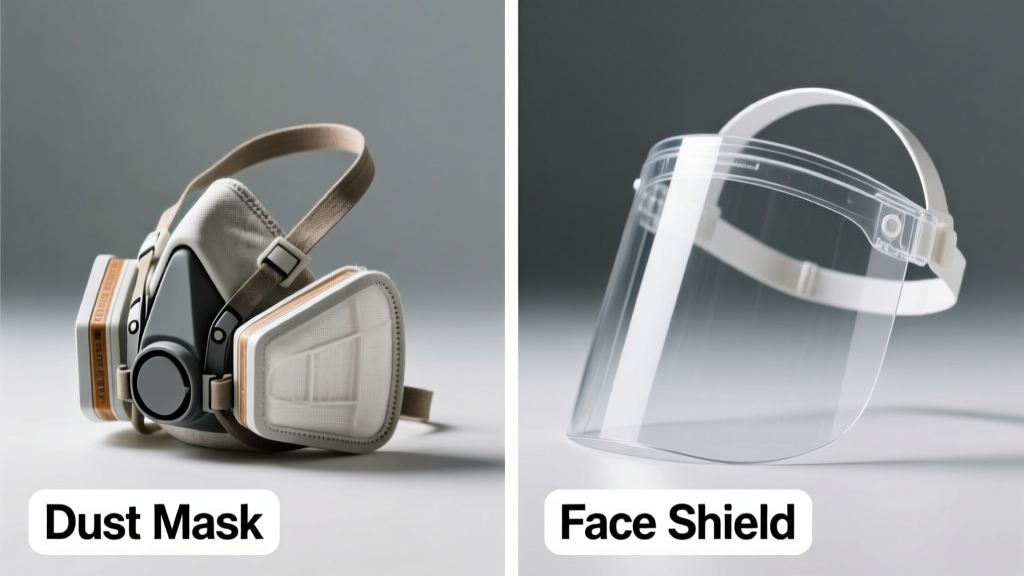
You’re prepping for a home renovation, sanding old paint off baseboards, and suddenly you’re staring at two safety options on the hardware store shelf: a simple dust mask and a bulky plastic face shield. Neither feels obviously right — and choosing wrong could mean coughing for days or missing splatter in your eye. Let’s cut through the confusion with real-world performance data and hands-on usage insights.
Quick Verdict
A dust mask (like an N95) is better for airborne particles — sawdust, drywall dust, mold spores — while a face shield excels at blocking splashes, sparks, and large debris but offers zero respiratory protection on its own. They’re not interchangeable; they’re complementary. According to the National Institute for Occupational Safety and Health (NIOSH)’s 2022 guidance, over 68% of workplace eye injuries occur when workers wear only respiratory protection — underscoring why layering matters.
Side-by-Side Comparison
| Feature | Dust Mask (e.g., N95) | Face Shield |
|---|---|---|
| Primary Protection | Airborne particulates (≥0.3 microns) | Frontal impact, splashes, sparks |
| Fits Over Glasses? | Yes — most models seal around nose/mouth | Yes — designed to accommodate eyewear underneath |
| Respiratory Filtration | Yes (95%+ of particles filtered) | No — no filtration; open sides and bottom |
| Eye Protection | No — leaves eyes fully exposed | Yes — full frontal coverage (but not side or top) |
| Reusability | Limited (8 hours typical use; discard if soiled or damaged) | Yes — clean with 70% isopropyl alcohol or mild soap/water |
| Comfort During Extended Use | Moderate (can cause ear pressure, fogging with glasses) | High (ventilated, lightweight, no facial contact) |
Deep Dive on Dust Masks
Dust masks — especially certified N95 respirators — are engineered to filter fine airborne hazards. The U.S. EPA estimates that 14% of household water usage is from leaks, but indoor air quality is even more vulnerable: a single 20-minute drywall sanding session can generate over 2 million respirable particles per cubic meter (American Industrial Hygiene Association, 2021).
Pros
- Effective against fine particulates (wood dust, silica, fiberglass)
- Lightweight and portable — fits in a tool belt pocket
- Certified options (N95, P100) meet OSHA standards for construction work
- Low cost — $1–$3 per unit for disposable models
Cons
- No eye, face, or splash protection
- Fit-dependent — facial hair or improper seal reduces effectiveness by up to 60% (NIOSH Fit Testing Study, 2020)
- Not suitable for vapors, gases, or oil-based aerosols without specific rating (e.g., R95/P95)
- Can fog safety goggles if worn together without anti-fog coating
Best for: Sanding, sweeping concrete dust, attic insulation removal, or mold remediation where inhalation is the main risk — especially indoors or in poorly ventilated spaces. For longer jobs, consider pairing with N95 vs KN95 comparison to verify certification legitimacy.
Deep Dive on Face Shields
Face shields are rigid, transparent barriers that attach to headbands or helmets. They don’t replace respirators — they extend them. A 2023 study in the Journal of Occupational and Environmental Hygiene found face shields reduced surface contamination on goggles by 96% during simulated spray-painting tasks, but offered zero measurable reduction in inhaled particle counts.
Pros
- Full-face splash and impact protection — ideal for grinding, chemical mixing, or resin pouring
- Ventilated design minimizes heat buildup and fogging
- Reusable and easy to sanitize between users
- Compatible with prescription glasses, respirators, and hearing protection
Cons
- No respiratory protection — must be worn *with* a mask or respirator for full coverage
- Bulky storage — doesn’t fold or compress like a mask
- Limited peripheral protection — gaps at sides, top, and chin allow exposure
- Potential glare or distortion with low-grade polycarbonate lenses
Ideal for: Auto body work, epoxy resin casting, lab chemical handling, or metal grinding — especially when combined with an NIOSH-approved respirator. Never rely on a face shield alone for dust-heavy tasks like demolition or sanding.
When to Choose Dust Mask vs Face Shield
Choose a dust mask when your hazard is invisible and airborne — think drywall compound residue, sawdust clouds, or attic rodent droplets. Choose a face shield when your hazard is visible and directional: flying metal shards, caustic splashes, or hot resin drips. But here’s the reality: for many DIY and pro jobs, you need both. Contractors framing a bathroom often wear an N95 under a face shield during tile mortar mixing — protecting lungs from crystalline silica *and* eyes from alkaline slurry.
"A face shield is never a substitute for respiratory protection — it’s a supplement. If you’re breathing in dust, your eyes may be safe, but your lungs aren’t." — Dr. Lena Torres, Industrial Hygienist, AIHA 2022 Conference
Alternatives to Consider
Sometimes neither option hits the sweet spot. Here are three practical alternatives:
- Powered Air-Purifying Respirator (PAPR): Combines filtration and forced airflow — ideal for long-duration sanding or lead abatement. Higher cost ($300–$800), but eliminates fit issues and fogging.
- Combination Goggles + N95: Offers eye + lung protection without face shield bulk. Look for wraparound goggles with indirect venting to reduce fogging.
- Half-Face Respirator with Replaceable Cartridges: Better than N95 for vapors, solvents, or mixed hazards — e.g., stripping paint with methylene chloride.
For shared tools or rental equipment, check out our guide on renting certified safety gear — many rental yards now offer NIOSH-certified masks and ANSI-rated face shields with inspection logs.
Can I wear a dust mask under a face shield?
Yes — and it’s recommended for high-dust tasks. Ensure the mask seal isn’t compromised by the shield’s headband pressure. Test fit by doing a positive-pressure check (cover exhalation valve, exhale gently — mask should puff outward).
Do face shields stop COVID-19 or flu particles?
No. While face shields block large droplets, they don’t filter aerosols. The CDC explicitly states face shields are not recommended as primary protection against respiratory viruses (CDC, 2021). Use an N95 or surgical mask instead — and reserve shields for splash-prone environments.
Is a dust mask enough for sanding hardwood floors?
Only if you’re using a vacuum-equipped sander and working in a well-ventilated space. Hardwood sanding releases crystalline silica — a known carcinogen. OSHA requires N95 or better for >25% silica content. For full-floor jobs, upgrade to a P100 filter or PAPR.
How often should I replace my face shield?
Replace if scratched deeply (impairs vision), cracked, or warped — typically every 6–12 months with regular use. Clean after each use with isopropyl alcohol or mild detergent; avoid ammonia-based cleaners that degrade polycarbonate.
Are cloth dust masks effective?
No. Most fabric masks filter <10% of 0.3-micron particles (University of Cambridge, 2020). They’re not rated for occupational dust exposure. Stick with NIOSH-certified N95, R95, or P100 for any job involving drywall, wood, or insulation.
Can kids safely wear adult dust masks or face shields?
Rarely. Most N95s and face shields aren’t sized for children under 12. The FDA warns against using adult respirators on kids due to poor fit and increased breathing resistance. For youth DIY projects, prioritize engineering controls (ventilation, wet sanding) over PPE.
Bottom line: Don’t treat dust masks and face shields as competitors — treat them as teammates. Match your PPE to the hazard, not the convenience. And when in doubt, layer up: certified respirator first, then eye/face protection second. Your lungs and corneas will thank you after the project’s done — and long after.