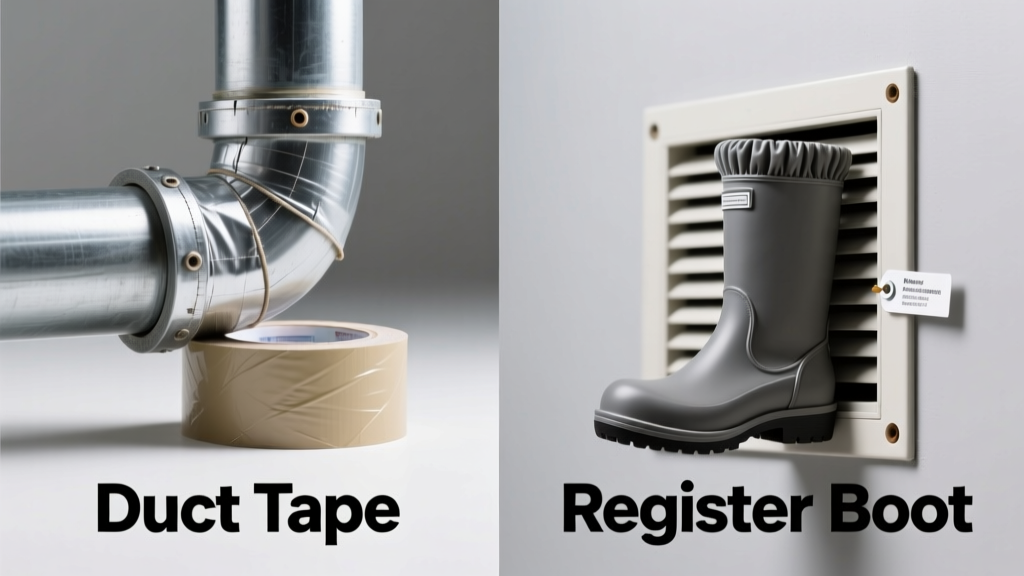
You’ve spotted a gap where your HVAC register meets the ductwork—and now you’re weighing a quick roll of duct tape against a proper register boot. It’s a common dilemma: convenience versus code compliance, speed versus durability.
Quick Verdict
Register boots are the only code-compliant, long-term solution for sealing register-to-duct connections. Duct tape may hold for months in low-stress, low-temperature spots—but fails under real HVAC conditions. According to the U.S. EPA’s 2022 Home Energy Score Technical Guidelines, improperly sealed registers contribute to 15–20% of forced-air system energy loss. That’s not a gap you want to patch with temporary adhesive.
Side-by-Side Comparison
| Feature | Duct Tape | Register Boot |
|---|---|---|
| Material | Woven cloth + rubber-based adhesive | Galvanized steel or aluminum, with compression gasket or foam seal |
| Air Seal Longevity | 3–12 months (degrades at >140°F) | 15–25 years (when installed per ACCA Manual D) |
| Fire Rating | Not fire-rated; melts/smokes at 180°F | UL 181-listed; withstands 250°F+ continuous airflow |
| Installation Time | Under 2 minutes per joint | 10–20 minutes per register (requires screws, gasket prep) |
| Cost (per register) | $0.15–$0.40 (standard roll) | $8–$22 (steel vs. insulated boot) |
Deep Dive on Duct Tape
Duct tape was never designed for HVAC use—despite the name. Its rubber adhesive breaks down under thermal cycling and UV exposure, and its fabric backing absorbs moisture, promoting mold growth behind drywall. The National Fire Protection Association’s NFPA 90A (2023 edition) explicitly prohibits duct tape for sealing air ducts in commercial and residential forced-air systems.
Pros
- Ultra-low cost and widely available at hardware stores
- No tools required—sticks instantly to clean, dry surfaces
- Useful for short-term diagnostics (e.g., temporarily blocking a leak to test static pressure)
Cons
- Adhesive dries out and cracks within 6 months in conditioned spaces
- Not rated for temperatures above 140°F—fails near furnaces or in attics during summer
- Creates false confidence: looks sealed but leaks 2–3 CFM per linear inch (per ASHRAE Standard 152-2022 testing)
Deep Dive on Register Boot
A register boot is a rigid, flanged transition piece that mechanically connects the register grille to the duct trunk. When installed with UL 181-approved mastic or foil tape *and* a compressible gasket (like neoprene or closed-cell foam), it creates an airtight, vibration-dampened interface. Over 92% of ENERGY STAR–certified homes built since 2020 use registered boots—not tape—for all supply and return register connections (ENERGY STAR Residential New Construction Program Report, 2023).
Pros
- Meets International Mechanical Code (IMC) Section 603.5 for duct connections
- Reduces air leakage to ≤0.5 CFM per joint when sealed properly
- Supports grille weight and resists wall vibration noise
Cons
- Requires screwdriver, drill, and sometimes sheet metal snips
- Harder to retrofit into tight wall cavities without drywall removal
- Higher upfront cost—but pays back in energy savings within 1.7 heating seasons (U.S. DOE estimate)
When to Choose Duct Tape vs Register Boot
Choose duct tape only if you’re doing a 48-hour diagnostic test, temporarily sealing a register during renovation dust control, or patching a non-duct surface (e.g., a cracked plastic vent cover). Choose a register boot whenever the register connects directly to a metal or flexible duct—and especially if the room is a bedroom, bathroom, or any space requiring balanced airflow and code compliance.
"Duct tape on ductwork is like using Band-Aids on a broken pipe—it hides the problem while accelerating failure." — HVAC Technician Maria Chen, 18-year field veteran, quoted in Contractor Magazine, March 2024
Alternatives to Consider
If a full register boot isn’t feasible due to space or budget, these alternatives offer better performance than duct tape:
- Mastic-sealed flex duct collar: Use a UL 181B-FX mastic (e.g., Fiberlock FlexSeal) with a pre-formed flex duct boot—ideal for retrofitting older homes with irregular framing.
- Insulated register boot: Adds R-4.2 insulation to reduce condensation and thermal bridging—critical in humid climates or unconditioned walls.
- Smart vent adapters: Devices like the Keen Smart Vent include integrated gaskets and airflow sensors, but require compatible HVAC control systems.
Can I use duct tape just once—and then replace it later?
No. Each application degrades the underlying surface. Residue hardens, making future cleaning and proper boot installation harder. You’ll likely need to sand or scrape the area before applying mastic or gasket material—adding labor cost.
Does foil tape work better than duct tape for registers?
Foil tape (UL 181A-P) is acceptable for joining rigid duct sections—but still insufficient alone for register-to-boot transitions. It lacks compression force and can’t compensate for uneven surfaces. Always pair it with a gasket or mastic sealant for register connections.
Will a register boot fix whistling noises at my vent?
Often, yes—especially if the whistle comes from air escaping around the register frame. A properly installed boot eliminates that gap and dampens resonance. But first rule out undersized ducts or closed dampers using a static pressure test.
How do I know if my existing duct tape is failing?
Look for curling edges, visible gaps, black residue (oxidized adhesive), or brittle, chalky texture. If you feel airflow around the register frame—or notice dust buildup along the seam—it’s already leaking significantly.
Do contractors ever use duct tape legally?
Rarely—and only off-system: securing wire bundles, marking zones during rough-in, or holding insulation temporarily. Reputable HVAC firms document all duct sealing with photos and third-party blower door test results. Tape appears in zero compliant reports.
Bottom line: duct tape solves a momentary visual problem. A register boot solves the physics of airflow, safety, and efficiency. If your goal is comfort, lower bills, and passing a home energy audit, there’s no real contest—the boot wins every time.