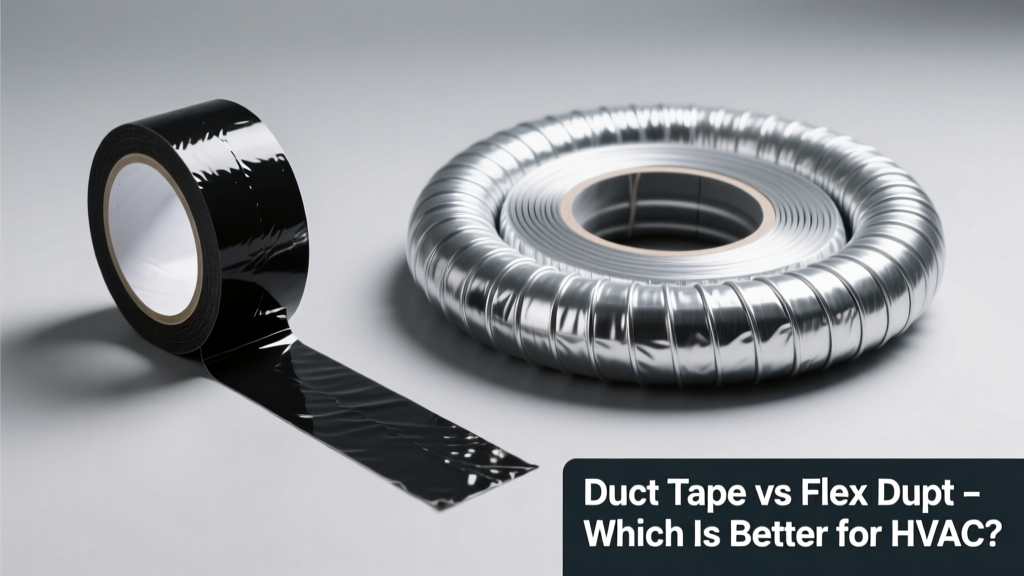
You’ve got a leaky duct joint or a disconnected branch in your attic—and you’re holding duct tape in one hand and a coil of flex duct in the other. It’s a common moment: quick fix versus proper solution. But choosing wrong can cost you energy, air quality, and even violate building codes.
Quick Verdict
Flex duct is the only code-compliant, long-term solution for residential HVAC airflow distribution. Duct tape has no place on ductwork—it degrades under heat, fails within months, and violates the International Mechanical Code (IMC 2021 §603.5). Use duct tape only for temporary non-duct applications like bundling wires or sealing cardboard boxes—not for air handling.
Side-by-Side Comparison
| Feature | Duct Tape | Flex Duct |
|---|---|---|
| Code compliance (IMC 2021) | Not permitted on ducts | Permitted with UL 181B-FX listing |
| Air leakage rate (CFM/100 sq ft @ 1" w.g.) | N/A (not tested; seals fail rapidly) | ≤ 4.0 (UL-certified products) |
| Lifespan in attic conditions (120°F+) | 3–6 months before cracking & peeling | 15–20 years with proper installation |
| Insulation value (R-value) | R-0 | R-4 to R-8 (depending on thickness) |
| Installation labor (per 10 ft run) | 2 minutes (but requires rework) | 15–25 minutes (first-time install) |
Deep Dive on Duct Tape
Duct tape was never designed for ducts. Its rubber-based adhesive breaks down at temperatures above 140°F—common near furnaces and in summer attics. The cloth backing absorbs moisture, stiffens, and delaminates. According to the U.S. Department of Energy’s Energy Saver Guide (2022), improperly sealed ducts waste up to 30% of heating and cooling energy—and duct tape contributes directly to that loss.
Pros
- Extremely low upfront cost ($3–$6 per roll)
- Instant adhesion on clean, dry surfaces
- Useful for non-duct tasks: cable management, emergency pipe wraps, tool handle repair
Cons
- Becomes brittle and sticky residue remains after failure
- No vapor barrier or insulation
- Not listed by UL, ASTM, or any HVAC testing body
Deep Dive on Flex Duct
Flex duct consists of a helical aluminum wire core wrapped in inner air barrier (usually polyester film), insulation (fiberglass batting), and an outer vapor-barrier jacket. When installed correctly—fully extended, no kinks, secured with listed clamps and mastic at connections—it delivers reliable, code-compliant airflow for decades.
Pros
- UL 181B-FX certified for Class 1 air duct use
- Reduces thermal loss (R-4 to R-8 cuts duct surface heat transfer by 50–70%)
- Meets IECC 2021 and IMC requirements for residential duct systems
Cons
- Higher material cost ($12–$22 per 25-ft coil)
- Requires precision: undersized runs cause static pressure drops; over-compression reduces CFM by up to 40% (ASHRAE Handbook, HVAC Applications, 2023)
- Must be supported every 4–5 feet to prevent sagging and pooling condensation
When to Choose Duct Tape vs Flex Duct
Choose flex duct when connecting registers to main trunks, replacing damaged sections, or installing new branch lines—even in tight crawlspaces. Choose duct tape only for non-air-handling tasks: temporarily sealing a torn dryer vent cover, marking conduit paths, or bundling extension cords during renovation. Never use it on supply or return ducts, plenums, or HVAC boots.
"Duct tape on ductwork is like using bubble wrap to seal a basement window—looks plausible, feels secure for a week, then fails catastrophically." — HVAC contractor Maria Chen, founder of AirRight Solutions, interviewed for Contractor Magazine, 2023
Alternatives to Consider
If flex duct isn’t suitable for your layout—or you need rigid performance—consider these code-approved options:
- Rigid metal duct (galvanized steel or aluminum): Best for straight, high-static-pressure trunk lines; R-0 unless insulated externally
- HVAC mastic + fiberglass mesh tape: Ideal for sealing rigid duct joints; lasts longer than tape and passes blower door tests
- Duct board: Insulated fiberglass panels cut and taped for custom plenums; excellent sound attenuation but labor-intensive
Can I use Gorilla Tape instead of duct tape on ducts?
No. Gorilla Tape, like all cloth-backed pressure-sensitive tapes, lacks UL listing for air ducts and fails under sustained HVAC temperature cycles. Its polyurethane adhesive outperforms rubber-based duct tape short-term—but still degrades within 9–12 months in attic environments (per Building Science Corporation Field Report #2022-08).
Is foil tape okay for ductwork?
Only if it’s UL 181A-P or UL 181B-FX listed. Standard HVAC foil tape (e.g., Nashua 324) meets UL 181A-P for rigid duct seams—but not for flex duct connections. For flex-to-rigid transitions, use mastic plus a UL-listed tape as a secondary seal.
How much does improper flex duct installation reduce system efficiency?
ASHRAE estimates that kinked, compressed, or unsupported flex duct can reduce delivered airflow by 25–40%, forcing the blower motor to work harder and increasing runtime by up to 18% annually (ASHRAE Handbook—HVAC Systems and Equipment, 2023, Ch. 19).
What’s the penalty for using duct tape on ducts during inspection?
In most jurisdictions, failed duct inspections require full resealing with mastic or UL-listed tape before final sign-off. Some municipalities (e.g., Austin, TX and Seattle, WA) mandate third-party duct blaster testing—and duct tape guarantees failure. Repairs average $220–$450 in labor alone.
Does flex duct need cleaning?
Yes—if used in return air paths with poor filtration. Fiberglass insulation fibers can shed into airstreams if the inner liner is punctured. The EPA recommends inspecting flex duct interiors every 3–5 years and replacing if fraying or compression damage is visible (EPA Indoor Air Quality Tools for Schools, 2021).
Can I install flex duct myself?
You can—but only if you follow ACCA Manual D for sizing, maintain minimum bend radius (5× duct diameter), and support every 4 ft with straps (not nails). DIY errors cause noise, reduced airflow, and premature failure. For whole-house retrofits, consult an NATE-certified technician.
Bottom line: duct tape solves nothing on ductwork—it just delays the real fix. Flex duct isn’t perfect, but it’s engineered, tested, and required. Invest time in learning proper installation, or hire someone who knows how to do it right. Your comfort, utility bills, and indoor air quality depend on it.