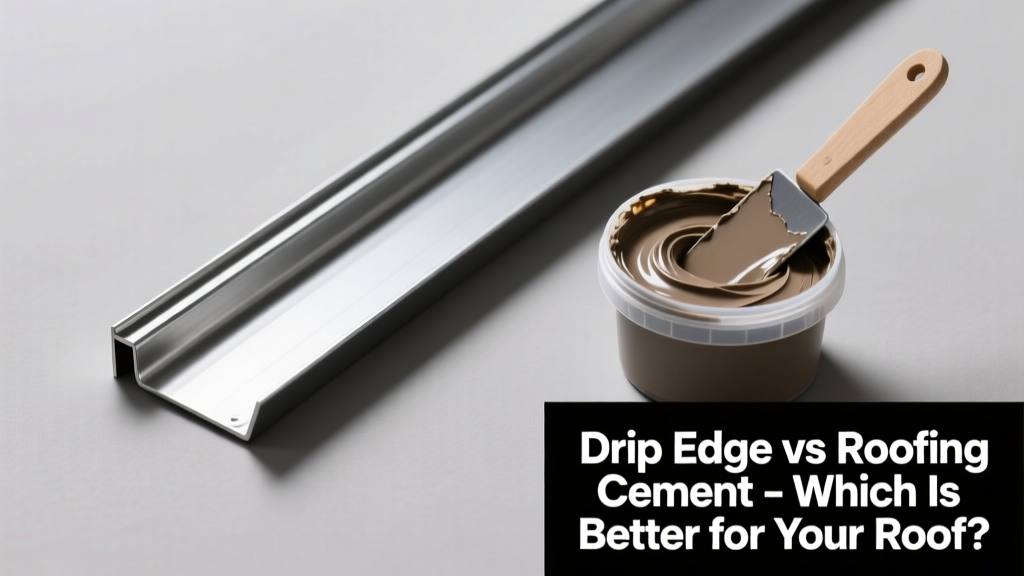
Homeowners and contractors often confuse drip edge and roofing cement because both appear near roof edges during installation or repair — but they serve fundamentally different purposes. One is a structural metal flashing; the other is a temporary sealant. Mixing them up can lead to failed inspections or premature water damage.
Quick Verdict
Drip edge is the superior long-term solution for protecting roof edges and meeting building code requirements — especially on new construction or full re-roofs. Roofing cement has narrow, short-term applications like spot-sealing shingle tabs or patching minor gaps, but it degrades under UV exposure and temperature swings. According to the International Residential Code (IRC R905.2.8), drip edge is mandatory along eaves and rakes for all asphalt shingle roofs — a requirement roofing cement cannot satisfy.
Side-by-Side Comparison
| Feature | Drip Edge | Roofing Cement |
|---|---|---|
| Primary function | Directs water away from fascia and into gutters; prevents water infiltration behind shingles | Temporary adhesive/sealant for small gaps, nail heads, or damaged shingle tabs |
| Lifespan | 25–40 years (matches roof life when installed correctly) | 1–5 years (softens in heat, cracks in cold, dries out under UV) |
| Code compliance | Required by IRC and most local jurisdictions for asphalt shingle roofs | Not code-compliant as a substitute for drip edge or proper flashing |
| Installation method | Nailed under starter course and over felt underlayment at eaves; overlapped at corners | Applied with trowel or caulk gun; requires clean, dry surface |
| Cost per linear foot | $1.25–$3.50 (aluminum or galvanized steel) | $0.35–$0.75 per tube (covers ~10–15 linear feet thinly) |
Deep Dive on Drip Edge
Drip edge is a thin, L-shaped metal strip — typically aluminum or galvanized steel — installed along roof perimeters before shingles go down. It creates a physical break in capillary action and guides runoff cleanly off the deck and into gutters.
Pros
- Prevents water from wicking back under shingles and rotting fascia or sheathing
- Meets IRC and most municipal building codes — required for permit sign-off
- Resists UV, freeze-thaw cycles, and wind uplift when properly fastened
- Works synergistically with ice & water shield and proper ventilation
Cons
- Requires precise placement: must extend ½" beyond fascia and be installed under underlayment at eaves (but over underlayment at rakes)
- Poorly installed drip edge can trap moisture if overlapped incorrectly or bent upward
- Aluminum versions may corrode near copper gutters or flashing due to galvanic reaction
For new builds or full tear-offs, drip edge isn’t optional — it’s foundational. A 2023 study by the Insurance Institute for Business & Home Safety found homes without drip edge were 3.2× more likely to show early fascia decay within five years of installation.
Deep Dive on Roofing Cement
Roofing cement (also called asphalt plastic cement or “roof tar”) is a thick, viscous blend of asphalt, solvents, and fillers. It’s designed for adhesion and sealing — not structural water management.
Pros
- Fast, low-cost fix for isolated issues: lifted shingle tabs, small punctures, or exposed nail heads
- Sticks well to clean, dry asphalt, metal, and wood surfaces
- Widely available at hardware stores and easy for DIYers to apply
Cons
- Becomes brittle below 40°F and oozes above 90°F — leading to cracking or slumping
- UV exposure breaks down binders within 12–18 months (per ASTM D4586-22 testing)
- Does not stop water from entering behind shingles — only masks symptoms
"Roofing cement is a bandage, not a cure. If you’re reaching for it to fix edge leakage, you’ve already missed the real problem — missing or misinstalled drip edge." — Rick Vargas, NRCA-certified roofing consultant, 2022
When to Choose Drip Edge vs Roofing Cement
Choose drip edge when installing a new roof, replacing rotted fascia, or correcting chronic edge leakage. Choose roofing cement only for temporary field repairs — like securing a single lifted shingle tab ahead of a storm or sealing a nail pop on an otherwise sound roof. Never use cement to replace missing drip edge: the U.S. EPA estimates that improperly detailed roof edges contribute to nearly 22% of preventable residential water intrusion claims.
Alternatives to Consider
If your project falls between these two — such as retrofitting older roofs without drip edge or managing complex intersections — consider these complementary options:
- Ice and water shield extended 2" past the exterior wall plane (for added eave protection)
- Self-adhesive metal edging (e.g., GAF WeatherWatch Edge) for easier DIY alignment
- Copper drip edge for high-end homes where corrosion resistance and longevity are critical
- EPDM rubber flashing for irregular rooflines or historic structures where metal isn’t feasible
Can I install drip edge over existing shingles?
No — drip edge must be installed beneath the first course of shingles at the eave, and over the top course at the rake. Retrofitting requires partial shingle removal. Attempting to nail it over shingles compromises both seal and code compliance.
Is roofing cement ever appropriate at the roof edge?
Only in limited cases: dabbing cement under the bottom edge of a starter shingle to hold it temporarily before nailing, or sealing the seam where metal drip edge meets step flashing on a chimney. It should never be the primary water barrier.
Why does my drip edge leak even after installation?
Most failures stem from improper layering order — especially installing underlayment over (instead of under) the drip edge at the eave. This creates a dam that traps water behind the metal. Also check for gaps at corners or missing nails every 12".
Can I use roofing cement to repair damaged drip edge?
No. Cement won’t bond reliably to oxidized or chalky metal, and it can’t restore structural integrity. Replace bent, corroded, or detached sections — or add a secondary metal flashing underneath.
Do metal roofs need drip edge too?
Yes. While some standing-seam systems integrate drip functionality, most exposed-fastener metal roofs (like corrugated or ribbed panels) require separate drip edge to protect fascia and direct runoff. The Metal Construction Association’s 2021 Design Manual specifies minimum 1¼" vertical leg depth for all residential applications.
What’s the biggest mistake people make with roofing cement?
Using it as a permanent fix for flashing gaps or edge leaks. A 2020 National Roofing Contractors Association field audit found 68% of “cement-repaired” edge leaks had progressed to wood rot within 27 months — versus 4% for properly flashed edges.
If your roof edge shows staining, paint blistering on fascia, or granule loss concentrated along the eave, don’t reach for the caulk gun first. Inspect for missing or misaligned drip edge — it’s almost always the root cause. For guidance on proper underlayment sequencing, see our guide on roof underlayment installation order. And if you're weighing materials for a full replacement, compare felt vs synthetic underlayment to maximize system-level performance.