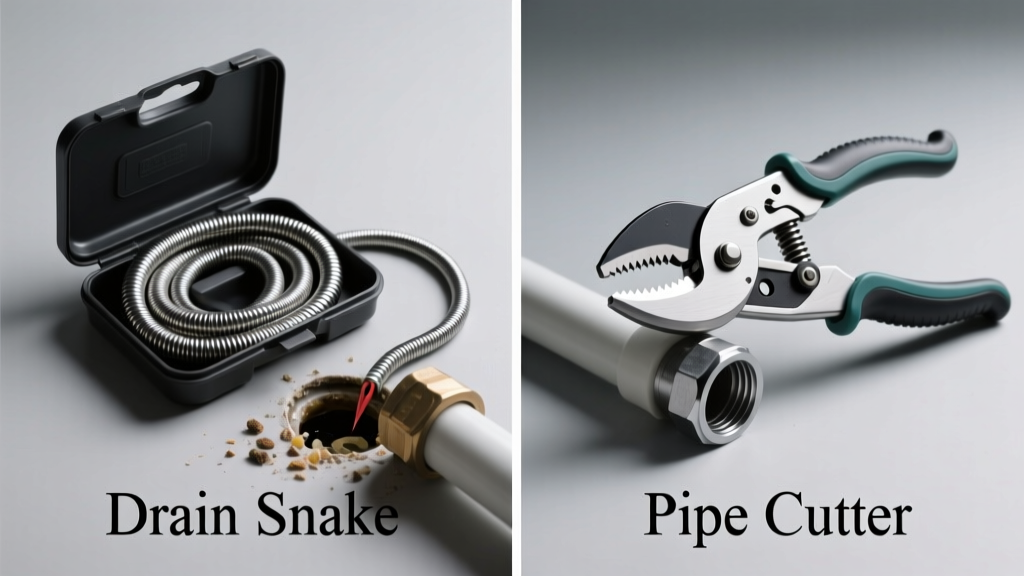
You’re staring at a slow-draining kitchen sink. Water pools, gurgles, then refuses to move. You grab the toolbox — but pause: do you reach for the drain snake or the pipe cutter? They look vaguely similar (both long, metal, coiled), yet they solve entirely different problems. Confusing them can waste time, damage pipes, or even void warranties.
Quick Verdict
A drain snake is for clearing clogs *inside* pipes without cutting anything; a pipe cutter removes damaged pipe sections *permanently*. They’re not interchangeable — choosing wrong risks turning a $15 fix into a $300 repair. Use a snake for hair, grease, or soap scum; use a cutter only when pipe corrosion, cracks, or joint failure demand replacement.
Side-by-Side Comparison
| Feature | Drain Snake | Pipe Cutter |
|---|---|---|
| Primary Function | Dislodges or retrieves blockages from inside pipes | Cuts through pipe walls to remove damaged sections |
| Typical Materials Handled | Plastic, PVC, ABS, cast iron (with appropriate tip) | Copper, PEX, CPVC, galvanized steel, PVC |
| Required Skill Level | Beginner-friendly (minimal training needed) | Intermediate (requires measuring, deburring, rejoining) |
| Time to Deploy | Under 2 minutes for most sink clogs | 15–45 minutes, plus reassembly and pressure testing |
| Risk of Pipe Damage | Low (if used correctly; aggressive twisting can scratch PVC) | High (one misaligned cut ruins alignment or seal) |
Deep Dive on Drain Snake
Drain snakes — also called augers or plumber’s snakes — are flexible cables with a corkscrew tip that rotates manually or via motor to hook, break up, or pull out obstructions.
- Pros: Works on 90% of common household clogs (hair in bathroom drains, food scraps in kitchen sinks, soap buildup); reusable for years; costs $12–$85 depending on length and power; no pipe disassembly required.
- Cons: Ineffective on tree roots or collapsed pipes; manual models struggle beyond 25 feet; motorized versions risk overheating if jammed; can scratch acrylic tubs or older galvanized lines if over-rotated.
- Ideal use cases: Slow shower drain after a family vacation; recurring kitchen sink backup; basement floor drain gurgling after heavy rain. For deeper insight, see our how to use a drain snake tutorial.
Deep Dive on Pipe Cutter
A pipe cutter is a precision hand tool with a hardened-steel wheel that scores and severs pipe cleanly — think of it as a pipe-specific rotary knife. It does *not* clear clogs. Its job is surgical removal.
- Pros: Creates clean, burr-free cuts essential for leak-proof soldering or compression fittings; compact and portable; works on tight-radius installations; no sparks or heat (unlike angle grinders).
- Cons: Zero clog-clearing ability; requires full system shut-off and drainage; demands follow-up steps (deburring, cleaning, rejoining); improper cut angle causes joint leaks — the U.S. EPA estimates 14% of household water usage is from leaks caused by poor pipe repairs (EPA WaterSense, 2022).
- Ideal use cases: Replacing a corroded section of copper under the sink; removing a cracked PEX fitting; prepping for a new garbage disposal installation. For step-by-step guidance, check our how to replace a section of pipe guide.
When to Choose Drain Snake vs Pipe Cutter
Ask three questions before picking up either tool: Is the pipe flowing *at all*? Is there visible damage? Did the problem appear suddenly or worsen slowly?
- If water moves slowly but steadily → try a drain snake.
- If water backs up instantly and smells like sewage → suspect a main line issue — still start with a snake (or call a pro with a sewer camera).
- If you see green corrosion on copper, bulging PVC, or wet drywall near a pipe → reach for the pipe cutter, not the snake.
- If the clog returns within 48 hours after snaking → likely root intrusion or pipe collapse — time for a camera inspection, not another snake pass.
Alternatives to Consider
Neither tool fits every scenario. Here’s what else belongs in your kit:
- Enzyme cleaners (e.g., Green Gobbler): Effective for organic buildup in infrequently used drains — but useless on solid objects or mineral scale.
- Wet/dry vacuum: Can extract shallow clogs in laundry standpipes or bathtub overflows — best for debris within 3 feet of the opening.
- Hydro-jetting service: Delivers 3,000+ PSI water to scour pipe walls — ideal for restaurant grease traps or municipal sewer line backups. Not a DIY tool.
- Zip-it tool: A $3 plastic wand with barbs — great for hair in shower drains, but snaps easily in cast iron or bends in tight 90° traps.
Can a pipe cutter clear a clog?
No — and attempting to force one into a drain will damage both the tool and the pipe. Pipe cutters lack internal threading, rotation, or retrieval capability. They cut *through* pipe walls, not *along* them.
Will a drain snake damage PVC pipes?
It can — especially if you crank aggressively past the trap bend or use a metal tip on thin-walled Schedule 40 PVC. According to the International Association of Plumbing and Mechanical Officials’ 2023 Code Handbook, “auger tips should be nylon-coated or spring-tipped when used on plastic piping to prevent scoring.”
How deep can a standard 25-ft drain snake reach?
Realistically, 15–20 feet into the drain line — because 3–5 feet get lost navigating the P-trap and wall cavity. For main line clogs beyond 25 ft, you’ll need a 50-ft motorized unit or professional-grade sewer machine.
Do I need both tools in my home toolkit?
Yes — but prioritize the drain snake first. Most homeowners face clogs far more often than pipe replacement. Keep a 25-ft manual snake ($22) and a ratcheting pipe cutter ($18) on hand. Upgrade only after diagnosing repeated failures — like the common causes of recurrent drain clogs.
Is renting a pipe cutter worth it?
Rarely. Quality cutters cost under $25 and last decades. Rental fees often exceed purchase price within two uses — and rentals may lack calibration or sharp wheels, increasing slip risk. Save rental budgets for hydro-jetting or camera inspections instead.
What’s the #1 mistake people make with drain snakes?
Forgetting to lock the cable before cranking. As plumbing instructor Maria Chen notes in Residential Drain Systems: Field Techniques (2021): “Unlocked cables recoil violently when hitting resistance — causing knuckle bruises, bent tips, and stripped gears in motorized units. Always engage the lock *before* feeding.”
“A pipe cutter fixes broken infrastructure. A drain snake fixes temporary flow interruptions. Confusing the two is like using a wrench to hammer a nail — technically possible, but guaranteed to make things worse.” — Tom Rafferty, Master Plumber & Instructor, NECA Training Center (2023)
Bottom line: Your drain snake handles the daily battles. Your pipe cutter waits patiently for the structural emergencies. Keep them separate, know their limits, and never force either beyond its design. When in doubt, start simple — and watch the water’s behavior closely before reaching for metal.