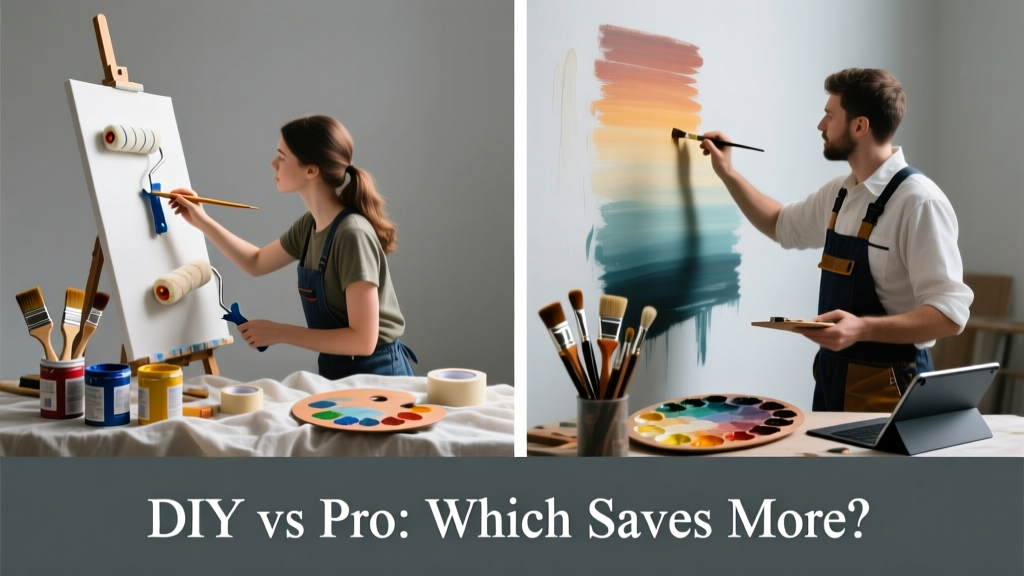
Facing a fresh coat of paint? You’re weighing two clear paths: roll up your sleeves or call a pro. Both promise results—but they demand very different investments of time, money, and nerves.
Quick Verdict
For small, low-risk rooms like a powder bathroom or home office with smooth walls and no major prep, DIY often saves $300–$800 and builds confidence. For whole-house projects, textured ceilings, lead-paint surfaces, or tight deadlines, hiring a licensed painter typically delivers better durability, faster completion, and fewer callbacks—especially when factoring in the true cost of your time and mistakes. According to the U.S. Bureau of Labor Statistics’ 2023 Occupational Outlook Handbook, professional painters earn a median wage of $24.17/hour—but their efficiency and tool access mean most jobs finish in 1/3 the calendar time of a first-time DIYer.
Side-by-Side Comparison
| Feature | DIY Painting | Hiring a Painter |
|---|---|---|
| Average cost (12'×12' room) | $120–$250 (paint, rollers, tape, drop cloths) | $450–$950 (labor + materials, incl. prep & cleanup) |
| Time commitment | 2–5 full days (prep, painting, drying, touch-ups) | 1–2 days on-site (plus 3–7 days scheduling) |
| Surface prep quality | Variable—often skipped or rushed (e.g., 68% of DIYers skip caulk repair per Home Depot’s 2022 Project Confidence Survey) | Standardized—sand, patch, prime, caulk, and clean before first coat |
| Warranty & liability | None—paint warranty only covers product defects | Typical 2–5 year labor warranty; insured against damage |
| Lead-safe compliance (pre-1978 homes) | Requires EPA RRP certification to legally work on surfaces with lead-based paint | Licensed pros must be EPA RRP-certified and follow containment protocols |
Deep Dive on DIY Painting
Going the DIY route gives you full control—and full responsibility. You choose every color, sheen, and brush stroke. But control comes with hidden costs: ladder rentals ($45/day), primer you didn’t know you needed, and that gallon of paint you spilled trying to cut in around crown molding.
Pros of DIY
- Upfront savings: Avoid labor markup (typically 60–75% of total pro quote)
- Flexible timing—you paint when your schedule allows, not theirs
- Satisfaction boost: 72% of homeowners report higher emotional attachment to rooms they painted themselves (National Association of Home Builders, 2023 Remodeling Impact Report)
- No coordination overhead: No background checks, scheduling back-and-forth, or supervising crews
Cons of DIY
- Time sink: A 3-room project often takes 10–16 hours of active work—not counting drying time or rework
- Inconsistent coverage: Especially on porous drywall or dark-to-light transitions without proper primer
- Tool learning curve: Sprayers require practice; cutting in freehand rarely matches pro edge sharpness
- No recourse for flaws: Peeling, lap marks, or uneven sheen stay your problem
Deep Dive on Hiring a Painter
Professionals bring calibrated tools, calibrated eyes, and calibrated expectations. They’ve seen every ceiling crack, popcorn texture, and water stain—and know how to seal, skim, and conceal without overpromising. Their biggest advantage isn’t just speed—it’s predictability.
Pros of Hiring a Painter
- Consistent, camera-ready finish—even on complex surfaces like stucco or brick veneer
- Access to commercial-grade tools: HVLP sprayers, extension pole kits, and moisture meters for drywall readiness
- Insurance-backed protection: Covers accidental drywall punctures, carpet stains, or ladder damage
- Code-compliant prep: Required for rental properties or resale—especially in states like California and New York with strict tenant habitability laws
Cons of Hiring a Painter
- Higher cash outlay: Whole-house interior jobs average $2,800–$6,500 (Angie’s List 2023 Cost Guide)
- Less granular control: You approve colors and sheens, but not every roller pass
- Vetting burden: Requires checking licenses, insurance certificates, and at least three recent job photos—not just online reviews
- Potential scheduling delays: Top-rated local painters often book 4–6 weeks out during spring and fall
When to Choose DIY vs Hiring a Painter
Match the method to your project’s risk profile—not just your budget. A single accent wall in a guest bedroom? DIY is low-stakes and rewarding. A 1950s ranch with cracked plaster, mismatched trim, and a toddler who opens every cabinet? That’s a pro scenario.
- Choose DIY if: You’re repainting one room with flat, untextured walls; have 3+ consecutive weekend days; own basic tools; and are comfortable sanding, caulking, and masking baseboards.
- Choose a pro if: Your home was built before 1978 (lead testing/prep required); walls need skim-coating or texture matching; you’re on a hard deadline (e.g., closing in 10 days); or you value time more than $500–$1,200.
Alternatives to Consider
Hybrid approaches often strike the best balance. Many homeowners hire a pro for prep and ceilings—then DIY the walls using their color-matched paint and leftover primer. Others use vetted contractor matching services to reduce vetting fatigue, or rent a spray rig from a local hardware store after watching our step-by-step sprayer guide. For rental properties, some landlords opt for flat-rate per-unit contracts to lock in pricing across multiple units.
How much does a professional painter really cost per room?
It varies by region and complexity—but expect $350–$650 for a standard 12'×12' bedroom with one door and two windows. Add $120–$200 for popcorn ceiling removal, $80–$150 for replacing rotted baseboard, and $200+ for color-matching historic trim. The National Kitchen & Bath Association notes that 41% of painting quotes jump 22% or more once inspectors flag hidden drywall damage—so always request an itemized scope.
Can I prep myself and hire a painter just for application?
Yes—and many pros welcome it. Just confirm in writing what’s included. Some charge 20–30% less for ‘paint-only’ service, but others won’t accept liability for prep flaws they didn’t perform. Always get a signed addendum specifying surface condition requirements (e.g., ‘all nail holes filled and sanded smooth’).
What’s the biggest DIY painting mistake people make?
“Skipping primer on patched drywall or over new spackle is the #1 cause of visible flashing—where repaired spots look lighter or darker after the topcoat dries.” — Maria Chen, master painter and instructor at the Painting Contractors Association Academy (2022)
Do painters offer eco-friendly or low-VOC options?
Most licensed contractors now stock Benjamin Moore Natura, Sherwin-Williams Harmony, or PPG Ultra Spec zero-VOC lines—and can apply them with low-emission rollers and ventilation plans. Ask for MSDS sheets and verify certifications like Green Seal GS-11. Note: Low-VOC doesn’t mean odorless—plan for 24–48 hours of airing out, even with premium products.
How long should quality interior paint last?
Properly prepped and applied, high-grade interior paint lasts 7–10 years on walls and 5–7 years on trim—assuming normal wear, no humidity spikes, and no direct sun exposure. DIY jobs average 4–6 years before touch-ups are needed, per the Paint Quality Institute’s 2023 Field Performance Review. Fade resistance drops sharply on south-facing walls unless using acrylic-urethane blends.
Is it worth hiring a painter for exterior work?
Almost always yes. Exterior painting involves ladders above 12 feet, pressure washing, wood rot repair, and elastomeric coatings for stucco. The Insurance Institute for Business & Home Safety’s 2023 report found that 63% of DIY exterior paint failures stemmed from inadequate surface cleaning—not poor application technique. Pros carry OSHA-compliant scaffolds and industrial washers; most homeowners rent pressure washers rated under 2,000 PSI—too weak for algae and chalky residue.
There’s no universal right answer—only the right answer for your timeline, skill level, and tolerance for imperfection. If you’re confident with a roller and have time to learn, start small and scale up. If your walls tell a story of decades—or your schedule tells a story of zero margin—investing in expertise pays dividends in peace of mind and longevity. Either way, read labels, test samples in natural light, and never skip the stir stick.