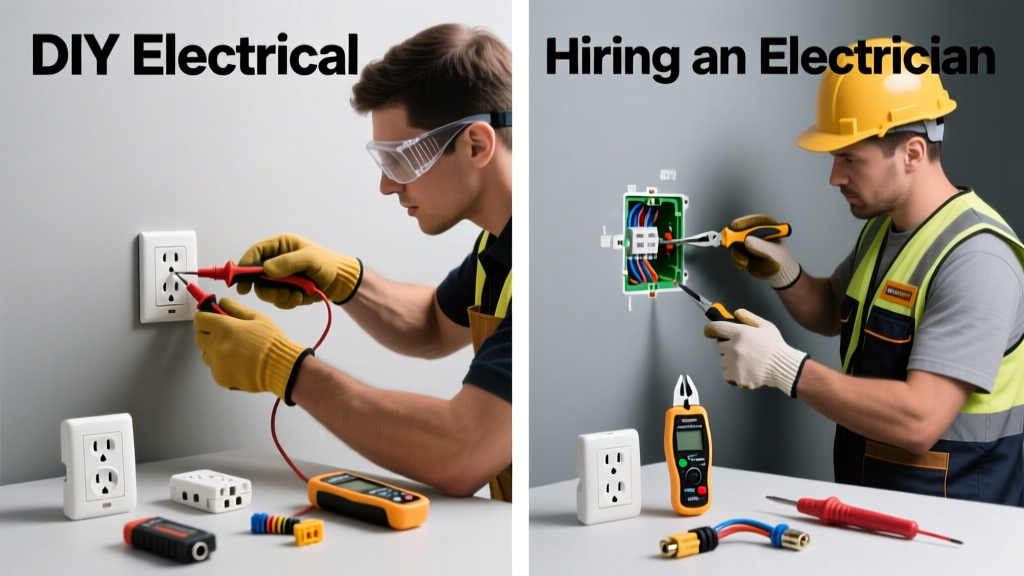
Many homeowners stare at a flickering light switch or a dead outlet and wonder: 'Can I fix this myself?' That simple question opens a high-stakes decision — one that balances savings against safety, time against liability, and confidence against code.
Quick Verdict
Hiring a licensed electrician is safer, code-compliant, and insurable for nearly all non-trivial electrical tasks — including anything involving panels, circuits, or wet locations. DIY is only appropriate for ultra-low-risk replacements (e.g., swapping a like-for-like light fixture or GFCI outlet) — and even then, requires verified knowledge of local codes and proper testing tools. According to the U.S. Consumer Product Safety Commission’s 2022 report, over 40,000 home electrical fires annually are linked to improper repairs or modifications — many tied to unpermitted DIY work.
Side-by-Side Comparison
| Feature | DIY Electrical | Hiring an Electrician |
|---|---|---|
| Typical cost (example: replacing a 20A circuit breaker) | $15–$30 (parts only) | $120–$280 (labor + parts + permit) |
| Time required | 1–3 hours (plus research/testing) | 30–90 minutes on-site (plus scheduling) |
| Permit & inspection required? | Often skipped — but legally required in most jurisdictions for panel work or new circuits | Handled by contractor; documented proof of compliance |
| Liability coverage | None — homeowner assumes full risk | General liability + errors & omissions insurance (standard for licensed pros) |
| Warranty on work | No warranty — voids manufacturer warranties on devices | 1–2 year labor warranty (varies by contractor) |
Deep Dive on DIY Electrical
Pros
- Immediate control — no waiting for scheduling or callbacks
- Zero labor cost if you already own tools and understand fundamentals
- Satisfying sense of accomplishment for small, well-defined tasks
Cons
- No legal protection if wiring causes fire, shock, or property damage
- Most homeowners lack access to a multimeter with CAT III/IV rating — critical for live-panel work
- Insurance companies routinely deny claims tied to unpermitted DIY electrical modifications
DIY works best for like-for-like replacements: swapping a single-pole switch, installing a hardwired smoke detector (if battery backup isn’t required), or mounting a surface-mounted LED fixture where existing junction box and circuit capacity are confirmed. It fails catastrophically when applied to load calculations, AFCI/GFCI coordination, or aluminum-to-copper splicing — all common pitfalls documented in the National Fire Protection Association’s Electrical Safety Foundation International 2023 Incident Report.
Deep Dive on Hiring an Electrician
Pros
- Licensed professionals carry up-to-date knowledge of NEC 2023 updates and local amendments (e.g., California Title 24 or NYC Electrical Code)
- They own calibrated testers, torque screwdrivers, and arc-fault detectors — tools most DIYers don’t realize they need
- Work ties directly to your home’s insurance and resale value: 87% of home inspectors flag unpermitted electrical work as a material defect (InterNACHI 2023 Home Inspection Trends Survey)
Cons
- Higher upfront cost — especially for after-hours or emergency calls
- Scheduling delays: average wait time for non-urgent jobs is 5–12 business days in metro areas
- Variable quality: not all licensed electricians offer the same level of communication or documentation
A licensed electrician isn’t just about wiring — it’s about documentation. They file permits, schedule third-party inspections, and provide stamped diagrams for future renovations. That paper trail matters when selling your home or adding solar later. As master electrician and NEC instructor Carlos Mendez told EC&M Magazine in 2022:
"The difference between a safe DIY fix and a dangerous shortcut is often one missing torque spec or one overlooked grounding conductor — details that take 3,000+ hours of supervised field experience to internalize."
When to Choose DIY vs Hiring an Electrician
Choose DIY only if all of these apply: the task involves no panel access, no new circuits, no rewiring, no load increases, and you’ve verified voltage with a known-good tester — and your jurisdiction doesn’t require a permit for that exact scope. Everything else falls under ‘hire a pro.’ Specifically:
- Do DIY: Replacing a standard wall switch with identical specs; installing a plug-in surge protector; changing a lamp cord
- Hire a pro: Adding an outdoor outlet; upgrading a 100A service to 200A; installing EV charging; troubleshooting tripping breakers; working within 3 feet of a main panel
Alternatives to Consider
Neither extreme fits every situation. Consider these middle-ground options:
- Permit-first hybrid approach: Pull the permit yourself, do prep work (running conduit, rough-in boxes), then hire an electrician for final connections and inspection
- Pre-purchase inspection: For older homes, get a licensed evaluation before committing to any DIY plan — reveals hidden hazards like knob-and-tube or undersized neutrals
- Smart device kits with certified installers: Some brands (e.g., Lutron, Leviton) offer $75–$120 white-glove setup for compatible switches and dimmers
Can I replace my own GFCI outlet?
Yes — if it’s a direct replacement on the same circuit, you verify hot/neutral/ground wires with a multimeter first, and you test the trip/reset function with a GFCI tester afterward. But if the outlet protects downstream devices or feeds a bathroom/kitchen circuit, miswiring can disable protection for multiple locations. Over 22% of GFCI failures in field audits were traced to incorrect line/load terminal connections (NECA Field Audit, 2021).
Does DIY electrical void my home insurance?
Not automatically — but if a claim arises from unpermitted or improperly performed electrical work, insurers routinely investigate and may deny coverage. State Farm’s 2023 Underwriting Bulletin explicitly lists “unlicensed electrical modifications” as a red-flag condition during claim review.
How much does a basic electrical inspection cost?
Most licensed electricians charge $125–$220 for a 1.5-hour visual + thermal scan of panels, outlets, and major circuits. Some offer free walk-throughs if you book repair work — but always ask for written scope and exclusions.
Is there a legal limit to what I can DIY?
Yes — and it varies by state and municipality. In Massachusetts, for example, homeowners may only perform electrical work in owner-occupied 1–2 family dwellings — and must still obtain permits for anything beyond receptacle/switch replacement. In contrast, Idaho allows unrestricted DIY in single-family homes, but still requires inspections for all new circuits. Always check with your local building department before turning a screw.
What tools do I actually need for safe DIY electrical?
At minimum: a CAT III-rated multimeter ($65+), insulated 1,000V screwdrivers, a non-contact voltage tester (plus a contact tester for verification), and a torque screwdriver (many breakers require 50 in-lb ±5). Skip the $12 hardware-store tester — it won’t detect induced voltage or open neutrals. A good starting kit runs $220–$380, not counting time spent learning calibration and interpretation.
Will smart home upgrades require an electrician?
Often yes — especially for neutral-wire-dependent devices (most smart switches/dimmers), multi-location 3-way setups, or whole-home automation hubs. Even ‘no-neutral’ switches frequently demand load compatibility checks that require circuit-level measurement. A 2023 CEDIA survey found 68% of smart home retrofit projects involved at least one licensed electrical visit — usually for neutral verification or dedicated circuit installation.
Electrical work sits at the intersection of physics, law, and personal safety — not convenience. Your choice shouldn’t hinge on YouTube tutorials or tool ownership, but on risk tolerance, local enforcement, and long-term consequences. When in doubt, spend $75 on a 30-minute consult — it’s cheaper than rewiring a burnt-out junction box or defending a denied insurance claim.