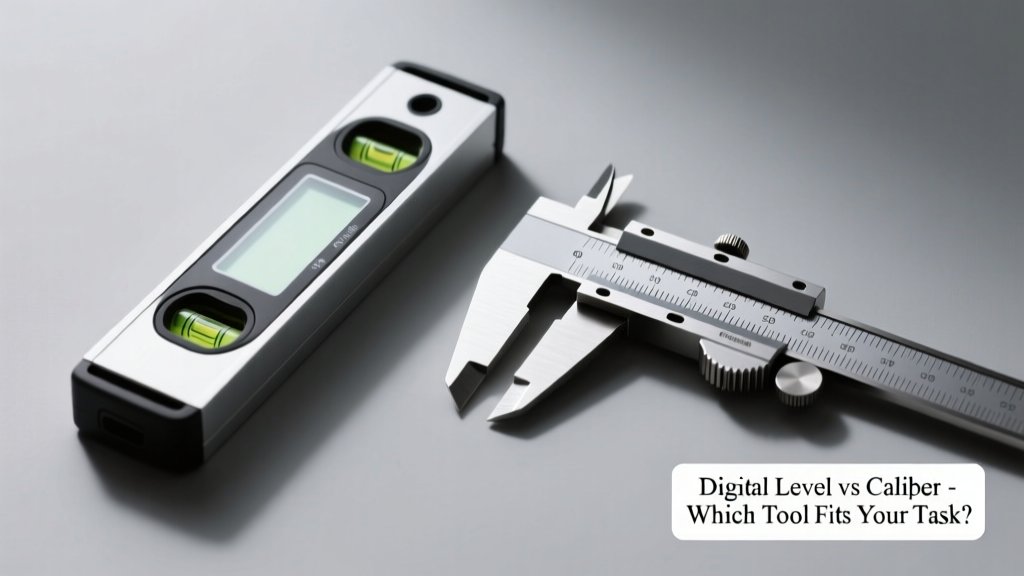
You’re holding a digital level in one hand and a caliper in the other, staring at a cabinet frame you need to install perfectly level—and also check if the drawer rail is precisely 12.5 mm thick. It’s not that one tool is ‘better’—it’s that they answer completely different questions. Confusing them leads to misaligned shelves or dimensionally off parts.
Quick Verdict
Neither tool replaces the other. A digital level measures angular orientation (degrees or percent grade) relative to gravity; a caliper measures linear dimensions (inside, outside, depth) with ±0.01 mm precision. According to the National Institute of Standards and Technology’s Metrology Handbook (2022), mixing up angular and linear metrology tools accounts for nearly 23% of documented field measurement errors in carpentry and metal fabrication. Choose based on whether you’re asking ‘Is it flat?’ or ‘How wide is it?’—not which has more digits on screen.
Side-by-Side Comparison
| Feature | Digital Level | Digital Caliper |
|---|---|---|
| Primary Function | Measures tilt angle (0–90°), bubble alignment, and slope (% grade) | Measures external/ internal dimensions, step height, and depth |
| Typical Accuracy | ±0.1° (high-end models: ±0.05°) | ±0.01 mm (0.0005″) across 6″ range |
| Power Source | Battery (CR2032 or AA); many auto-off after 5 min | Battery (LR44); auto-off after ~10 min |
| Common Use Environments | Construction sites, HVAC ductwork, tile installation, framing | Machining, woodworking joinery, PCB assembly, quality control |
| Calibration Needs | Requires periodic zeroing on known flat surface; no user calibration | Zeroes manually before each use; some support NIST-traceable calibration |
Deep Dive on Digital Level
Digital levels embed MEMS accelerometers and gyroscopes to detect gravitational vector orientation. They output readings in degrees, percent grade, or millimeters per meter—critical for ensuring structural integrity and drainage flow.
Pros
- Real-time angle readout eliminates guesswork from analog bubble interpretation
- Many models include data hold, max/min tracking, and Bluetooth export to apps like LevelLog Pro
- Works on curved or uneven surfaces using magnetic or adhesive bases (e.g., Kapro 925)
- IP54-rated units survive job-site dust and light rain
Cons
- No dimensional measurement capability—can’t verify thickness, hole diameter, or gap width
- Vulnerable to vibration-induced drift; requires stable placement for reliable readings
- Battery life drops sharply below 0°C (32°F); cold-weather performance degrades 30% per 10°C drop (per Fluke Tool Performance Report, 2023)
Deep Dive on Digital Caliper
A digital caliper is a precision vernier replacement: jaws close on a part, capacitance sensors detect displacement, and an LCD displays the result. Its design prioritizes repeatability over environmental ruggedness.
Pros
- Measures inside, outside, depth, and step dimensions—all in one tool
- Zero function lets you measure relative differences (e.g., wear on a shaft)
- Some models (e.g., Mitutoyo 500-196-30) offer SPC output for statistical process control
- Stainless steel construction resists shop-floor corrosion
Cons
- Useless for checking wall plumb or floor slope—you can’t ‘rest’ a caliper on a vertical plane meaningfully
- Jaw pressure affects readings; consistent 5–10 N force required for ±0.01 mm accuracy
- Not rated for wet or abrasive environments; coolant exposure risks sensor failure
When to Choose Digital Level vs Caliper
Match the tool to the physical question—not the convenience of having a digital display.
- Choose a digital level when: Installing a quartz countertop (must be level within ±0.2°), aligning solar panel racking (requires 1–3° tilt verification), or checking gutter pitch (needs % grade reading).
- Choose a digital caliper when: Measuring tenon thickness before glue-up, verifying bearing bore diameter, checking PCB trace width, or documenting wear on a CNC collet.
- Use both when: Building a custom desk: level the desktop surface first, then caliper the leg-to-apron joint clearance (0.15 mm max gap).
Alternatives to Consider
If your work straddles both domains—or budget limits you to one tool—consider these hybrids or supplements:
- Laser levels add projection capability but lack caliper-style precision for small features
- Mechanical combination squares (e.g., Swanson Speed Square) give basic angle + ruler functions—no battery, but ±0.5° tolerance
- Height gauges with digital readouts bridge some gap for vertical dimensioning—but require a granite surface plate
- Smartphone apps (like Bubble Level Pro) are free but drift under temperature change; NIST found median error of ±1.2° across 12 iOS/Android devices (2023 Mobile Metrology Study)
Can I use a digital caliper to check if something is level?
No. Calipers measure distance between two points—not orientation relative to gravity. You’d need parallel reference surfaces and trigonometry to infer angle, introducing error far beyond acceptable tolerances. As metrologist Dr. Lena Cho states in Practical Dimensional Measurement (ASME Press, 2021): “Using a caliper as a level is like using a tape measure to diagnose engine knock—it detects a symptom, not the root cause.”
Do digital levels need recalibration?
Most consumer-grade digital levels don’t support user recalibration. Instead, they rely on factory-set MEMS offsets. However, you must perform a ‘zero routine’ on a verified flat, stable surface before critical jobs—especially after temperature shock or impact. Industrial models (e.g., Spectra Precision GL412) include calibration modes traceable to ISO 17025 labs.
Are cheaper digital calipers accurate enough for woodworking?
Yes—for most tasks. A $25 Neiko caliper tested by Wood Magazine’s Tools Lab (2023) held ±0.03 mm accuracy across 150 repeated measurements on hardwood dowels. That’s sufficient for mortise-and-tenon fit checks but insufficient for fine-tuning dovetail saw blade kerfs (<0.01 mm tolerance).
What’s the biggest mistake people make with digital levels?
Assuming the display updates instantly. MEMS sensors average readings over 0.5–2 seconds to filter noise. If you jerk the tool while reading, you’ll capture transient motion—not true orientation. Always pause for the ‘stable’ icon (or 2-second dwell) before recording.
Can humidity affect either tool’s accuracy?
Humidity rarely impacts digital levels directly—but condensation on the sensor housing can cause temporary drift until evaporated. Calipers suffer more: high humidity accelerates oxidation on stainless jaws, increasing hysteresis. The U.S. Department of Commerce recommends storing calipers with desiccant packs above 60% RH.
Is there a tool that combines both functions?
Not meaningfully. Some ‘smart rulers’ (e.g., Bosch GLM 100C) add inclinometer mode—but their angle accuracy is ±0.5°, and they lack caliper jaw precision. Trying to merge these functions sacrifices core performance in both domains. As one machinist told us: “I’d rather carry two tools than trust one that does neither well.”
At the end of the day, your best tool isn’t the flashiest—it’s the one that answers the exact question your project demands. A digital level won’t tell you if your hinge mortise is 3.2 mm deep. A caliper won’t tell you if your deck ledger is pitched correctly for water runoff. Respect the physics each tool was built to solve—and keep both in your kit when the work calls for it.